
Act on urgent hazards
Do not leave an imminent or uncontrolled hazard on a report for later. Follow stop-work, isolation, emergency and escalation procedures, and apply authorized interim controls while a permanent solution is assessed.
Tell us what's happening and we'll recommend the next practical step.
Workplace Inspection And Compliance Training helps supervisors, managers, health and safety committee members, worker representatives and employees who participate in workplace inspections or corrective-action follow-up address a defined workplace safety need with practical, documented support.
An inspection is more than a checklist. Participants need to prepare, involve workers, observe conditions and work practices, distinguish a finding from its contributing factors, act on urgent hazards, and verify corrective actions for both completion and effectiveness before authorized closure.
Calgary Safety Consultants works with employers across Alberta, British Columbia and Saskatchewan. We confirm the jurisdiction, inspection purpose, workplace scope, participant roles, current forms and any equipment, client or audit requirements before recommending training.
Use the contact form or call 1-888-231-0358 to discuss timing, available records and whether remote, onsite or hybrid support is the right fit.
Serving employers across Calgary, Alberta, British Columbia, Saskatchewan, and Canada.
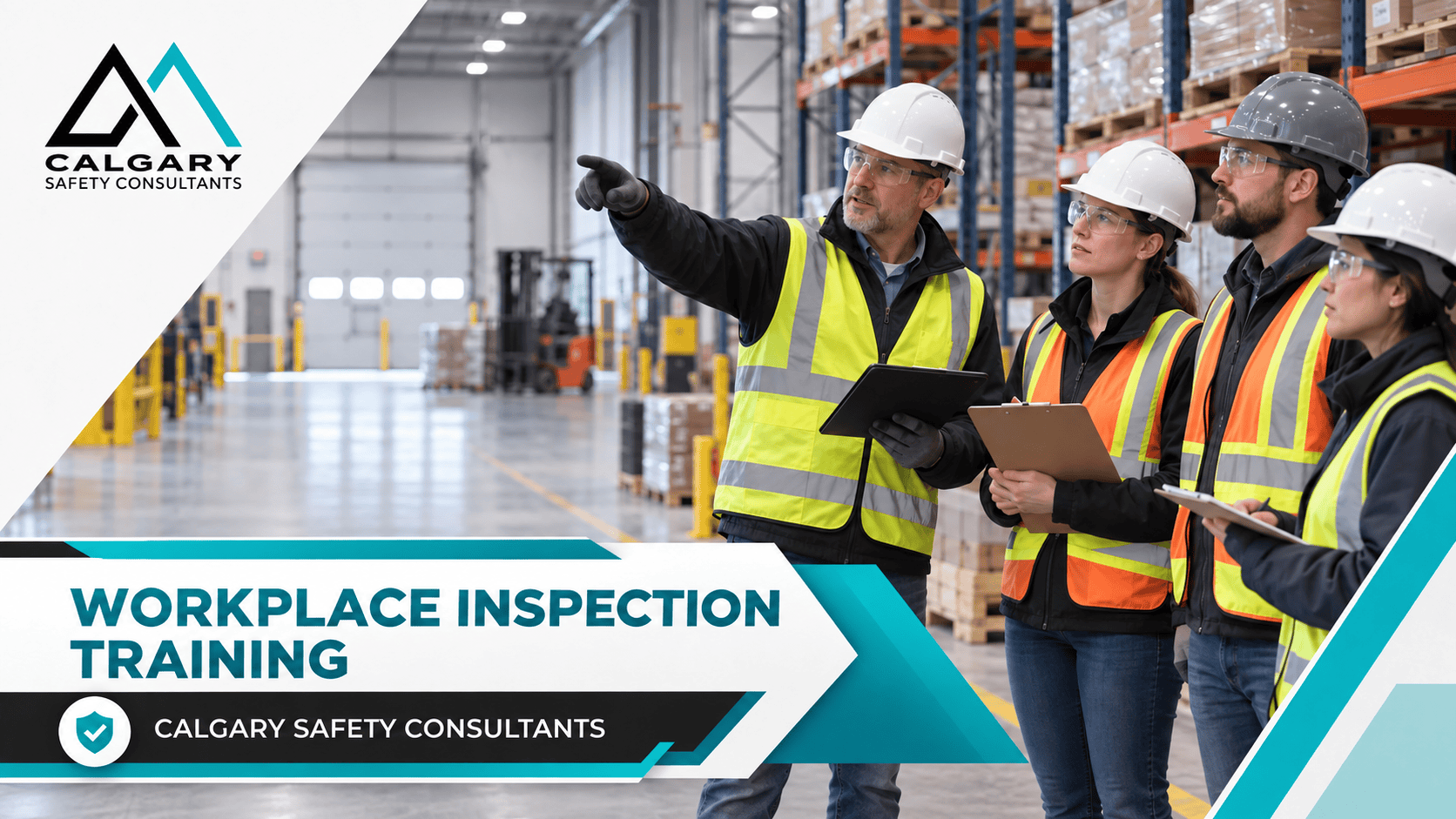
Group training
An inspection is more than a checklist. Participants need to prepare, involve workers, observe conditions and work practices, distinguish a finding from its contributing factors, act on urgent hazards, and verify corrective actions for both completion and effectiveness before authorized closure.
The course connects inspection planning, worker participation, hazard recognition, factual documentation, responsibility, due dates, escalation and effectiveness verification. Examples can be adapted to the agreed workplace while protecting confidential and personal information.
Training can use employer-approved forms and roles after gaps or conflicts are identified. The employer must validate frequencies, legal duties, inspection-team competence and corrective-action authority for each workplace.
Inspections change with the seasons. In winter, they need to catch icy walkways and parking lots, poor lighting, cold work conditions, and temporary heaters that can build up carbon monoxide. Our free Winter Season Work Safety course covers these hazards, and its Student Reference Guide includes a Winter Walkway and Parking Lot Inspection Checklist and a Temporary Heater and Carbon Monoxide Pre-Use Check your team can use on site.
When an inspection finds a hazard, the next step is to assess it and choose the right controls. Hazard Assessment and Control for Canadian Workplaces teaches that process, and our hazard assessment training page explains group options.
Scope and competency limits
An inspection is a sample of conditions at a point in time. It can identify and record hazards, but it does not prove that the whole workplace is safe or legally compliant and cannot replace continuous supervision, worker reporting or required specialist inspections.
Do not leave an imminent or uncontrolled hazard on a report for later. Follow stop-work, isolation, emergency and escalation procedures, and apply authorized interim controls while a permanent solution is assessed.
Equipment, structural, electrical, fire-protection, pressure-system, exposure and other regulated inspections may require a competent or qualified person, engineer, occupational hygienist or authority. General training does not confer those qualifications.
Legal requirements, manufacturer instructions, approved engineering, client rules and audit protocols are different sources. The inspection scope should name which criteria apply and identify unresolved conflicts before relying on a finding.
For independent guidance, see CCOHS: Effective Workplace Inspections. Source verified November 6, 2026.
Why it matters
Useful workplace inspection and compliance training work produces more than a conversation. Depending on the project, expected deliverables can include:
After the initial enquiry, we review the available information, clarify urgency and prepare a scope of work. Once approved, we complete the agreed review or development work, discuss findings and identify the next practical actions. Defined follow-up can be arranged to review a sample of progress or effectiveness evidence; sampling does not verify every area, item, shift or corrective action.
No consulting assignment can guarantee regulatory approval, client acceptance, certification or an incident-free workplace. It can give the employer a clearer basis for decisions and a more organized path to improvement.
A consistent inspection process helps leaders see patterns across shifts and locations. It also gives supervisors a clearer basis for assigning work, escalating overdue items and communicating the reasons for a change.
Training does not make participants enforcement officers or guarantee compliance. It gives them a structured method for observing the workplace, recording useful information and supporting the employer’s corrective-action system.
Workplace examples can be selected to match the participants. An office team may focus on ergonomics, emergency arrangements and public access; a warehouse team may focus on loading, racking, traffic separation and material handling; a shop or field team may need more attention on tools, equipment, energy sources and changing conditions.
Useful learning includes explaining why a finding matters, identifying who has authority to act and selecting evidence that can show whether the risk is controlled. These skills should be checked through scenarios, observed inspection practice, feedback and management review.
Want to see the method before you book? Our free guide on how to conduct a workplace safety inspection walks through planning, the walk-through, writing findings and following up corrective actions, and it comes with a free 20-section inspection checklist. For the follow-up itself, our corrective actions guide shows how to assign, track and verify each fix, with a free corrective action tracker.

 Findings followed through to closureAssign owners, set due dates and verify each fix
 Inspections that look past the checklistObserve the work, talk with workers, record the facts
Course content
The agreed workplace inspection and compliance training scope may include:
We do not replace the employer’s accountability. Management approves priorities, provides access, assigns competent inspection participants and corrective-action owners, and confirms closure authority. Calgary Safety Consultants supplies training, materials and guidance within the defined scope.
Support can be a focused one-time assignment or a defined phase within a broader program-improvement project. The scope, timing, locations, deliverables and follow-up expectations are confirmed before work starts.
Participants practise looking beyond the obvious condition. A useful inspection considers the work being performed, who may be exposed, the adequacy of controls, the quality of supervision and whether earlier findings were actually resolved.
The course also explains how authorized photographs, notes and worker input can support an observation without replacing clear written facts. Personal, medical, security-sensitive and commercially confidential information should be limited to what is necessary and handled through the employer’s approved process. Inspection teams learn to distinguish urgent interim action from longer-term improvement and to avoid vague recommendations such as “be more careful.”
Common questions
Clear answers about participants, learning outcomes, delivery, course length, certificates and group customization.
Workplace Inspection and Compliance Training teaches a method for planning inspections, involving workers, recognizing hazards, documenting facts and following corrective actions through completion and effectiveness checks. It does not authorize participants to perform regulated equipment inspections, engineering reviews or occupational hygiene assessments.
Participants learn preparation, routes and sampling, worker communication, hazard recognition, factual documentation, risk-based prioritization, assignment, due dates, escalation, completion evidence and effectiveness follow-up. Exercises build knowledge, while the employer must verify competence in the actual workplace.
The training is suitable for supervisors, managers, health and safety committee members, worker representatives and employees who participate in workplace inspections or corrective-action follow-up. It can help new inspection participants build a consistent foundation and help experienced teams compare methods, improve documentation and strengthen corrective-action follow-up.
Yes. Group training can use approved company forms and reporting pathways after frequencies, legal duties and conflicts are checked. The employer remains responsible for validating the form, competent participants, site-specific hazards and the process used after training.
Yes. Participants learn that recording a finding is only the beginning. The course addresses interim controls, assignment, due dates, escalation, completion evidence and effectiveness checks so an item is not treated as closed simply because a task was entered into a tracker.
Yes. Live virtual and instructor-led classroom delivery can be arranged for workplace groups. The suitable format depends on the number of participants, desired exercises, locations and level of customization. Delivery details are confirmed in the training proposal.
Course length depends on delivery method, exercises and customization. A focused group session is commonly planned as a short workplace course, while more detailed scenarios or company-specific form review may require additional time. The proposed duration is confirmed before booking.
Certificate arrangements depend on the agreed delivery and completion requirements. A certificate or attendance record documents participation only; the employer must also provide workplace-specific instruction, practical assessment, authorization and supervision appropriate to the assigned inspection duties.
We confirm the audience, number of participants, preferred delivery, workplace hazards, current inspection process and scheduling needs. Calgary Safety Consultants then recommends a suitable format and provides a defined proposal so the employer can review scope, timing and preparation requirements.
Book your training
Build a consistent inspection process for your team. After you enquire, we confirm the participants, delivery method, workplace examples and scheduling needs, then provide a defined training proposal.
Training a team?
Enrol your crew, supervisors or safety committee in any of our online courses. Buy your enrolments online, then complete our Group Training Student Information form so we can set up an individual account for each worker. Each worker completes the training online and receives a certificate of completion. Training 10 or more workers on the same course? A 10% group discount is applied automatically at checkout. For instructor-led training or a custom group arrangement, use the form below to request a group quote.
Free Safety Guides
How to do a pre-use inspection on vehicles and equipment in Canada: legal rules by province, NSC trip inspections, checklists, defects and free downloads.
Learn how to manage corrective actions in 7 steps, with Canadian response deadlines, a priority system and a free corrective action tracker in Excel and PDF.
Learn how to conduct a workplace safety inspection in 8 steps, with Canadian legal requirements, a priority system and a free 20-section inspection checklist.