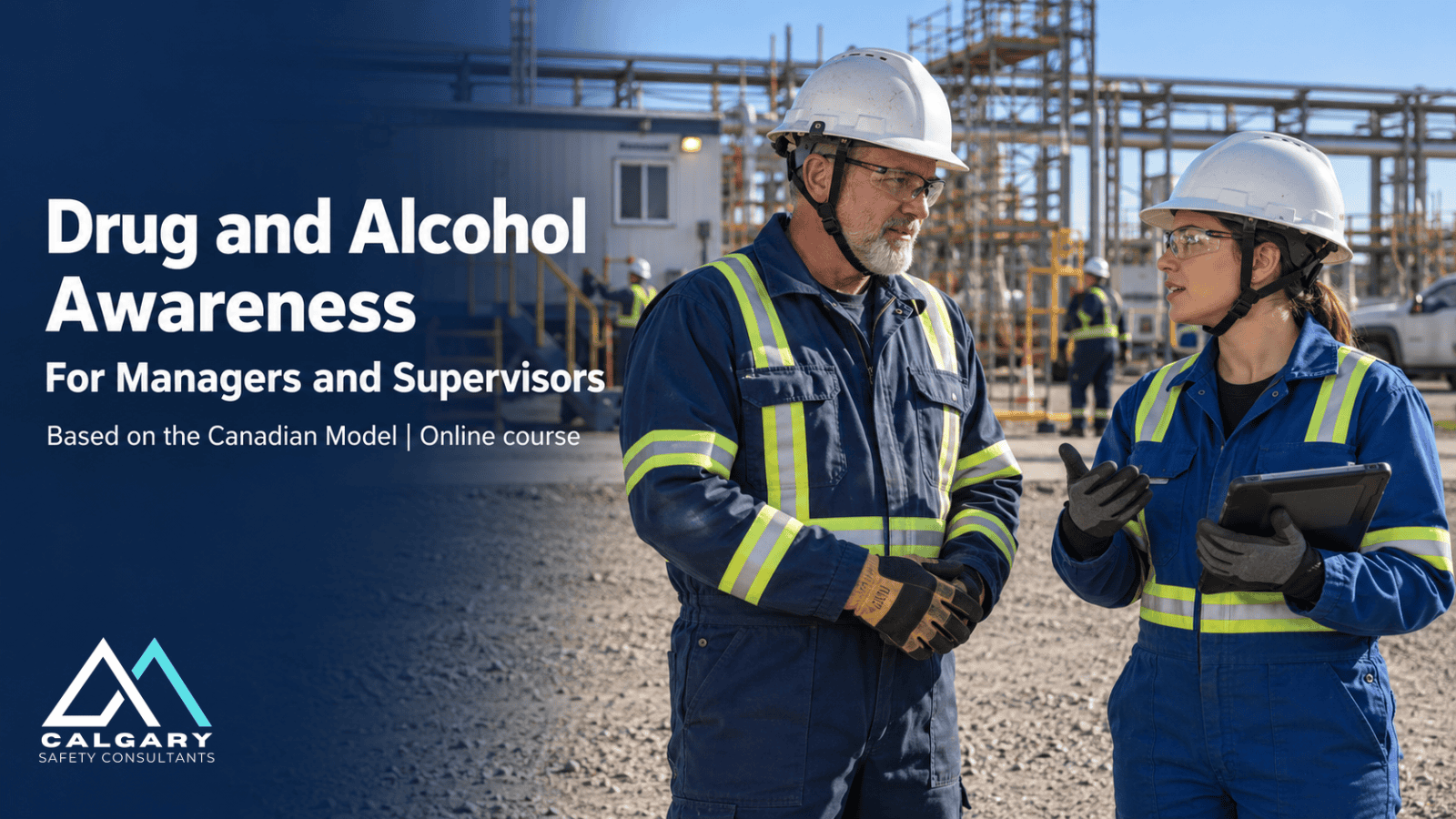
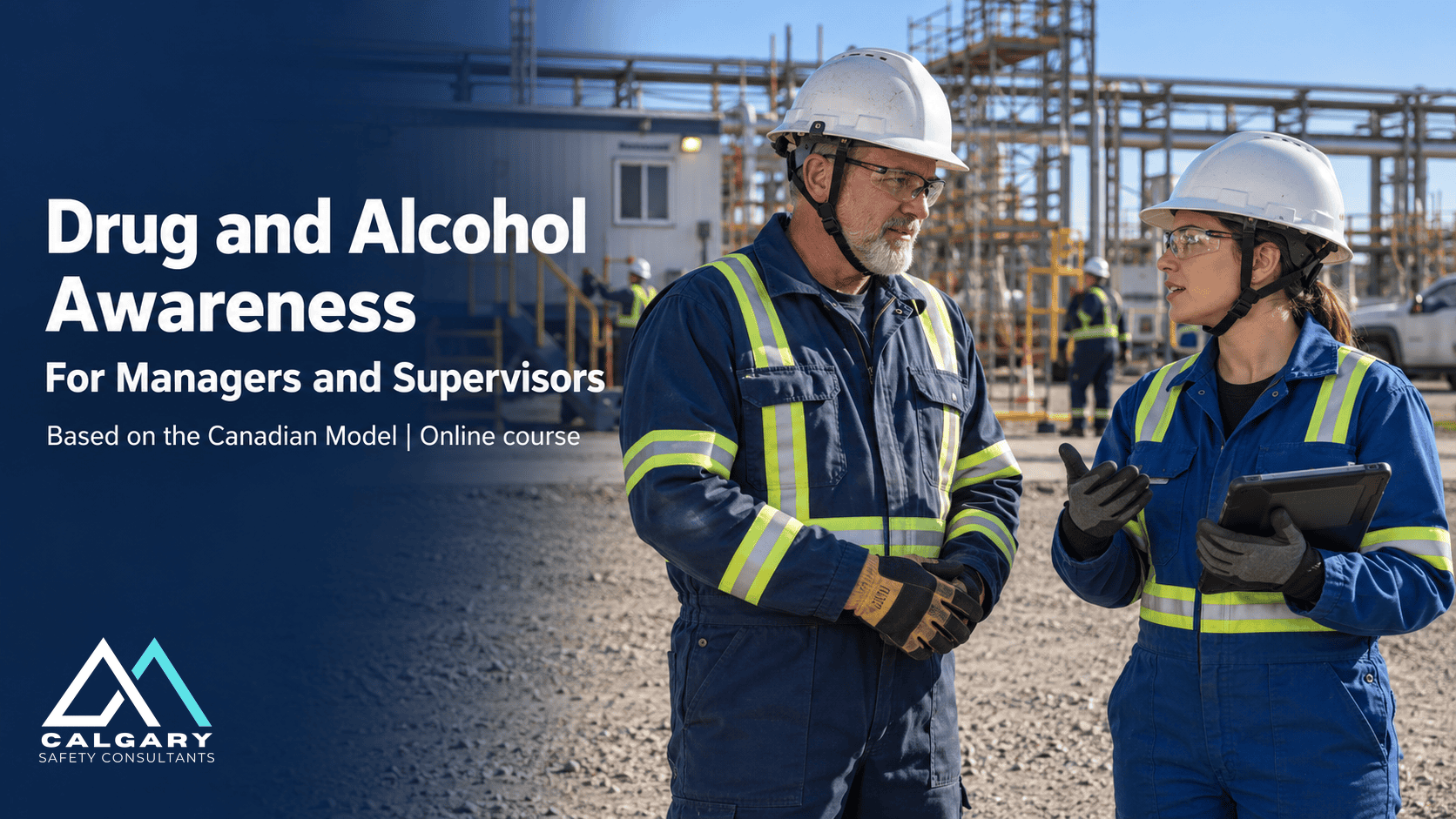
Drug and Alcohol Awareness for Managers and Supervisors (Canadian Model)
Once you have registered and enrolled, scroll to the Course Content section at the end of this page to begin your lessons.
Our online drug and alcohol training for supervisors helps supervisors, forepersons, lead hands, superintendents and managers recognize possible impairment and respond safely and fairly under an alcohol and drug policy based on the Canadian Model. This self-paced, awareness-level course covers the leader’s side of the policy in 12 narrated lessons, from your legal duties and the signs of possible impairment to reasonable grounds and incident testing, privacy and human rights, EAP referral, return to work and leading a fit-for-duty crew.
Training a leadership team? For online group training, buy your enrolments here, then complete our Group Training Student Information form so we can set up each learner’s account. If you need help with your alcohol and drug policy or safety program, see our workplace safety consulting services.
Learn more about how our online safety training works.
When a crew member isn’t fit for duty, the supervisor is usually the first to notice and the one the policy expects to act. A leader who waits for a second sign, asks for a test without giving a reason or lets a worker drive home puts people at risk and weakens the process. Leaders who act on facts protect their crews and the business: fewer incidents and WCB claims, decisions that hold up if challenged, fair treatment that keeps good people, and stronger due diligence, COR and SECOR audits and owner prequalification.
This is awareness-level training for leaders. It isn’t a certification, it doesn’t make anyone competent or qualified, it isn’t legal or medical advice, and it isn’t approved by any regulator. It doesn’t train anyone to collect samples or conduct tests, and completing it doesn’t show that any training requirement has been met.
Calgary Safety Consultants based this course on the Canadian Model for Providing a Safe Workplace, but it isn’t the official Canadian Model and isn’t affiliated with or endorsed by the Construction Owners Association of Alberta (COAA) or Energy Safety Canada. The Canadian Model is a voluntary industry guideline, not law, and your employer’s own alcohol and drug policy is what applies on your site. The course isn’t designed or claimed to meet the U.S. Department of Transportation (U.S. DOT) supervisor training rule, so leaders who supervise U.S. DOT-regulated drivers or workers must check that rule with their employer.
Online Drug and Alcohol Course for Supervisors at a Glance
Price: $34.99 CAD plus GST per learner
Delivery: 100% online and self-paced
Course format: 12 narrated video lessons in five modules, with workplace examples, decision points and a knowledge check after every lesson
Course length (estimated): About 4 hours, including about 3 hours 14 minutes of lesson video plus the knowledge checks and final exam
Assessment: A three-question knowledge check after every lesson (100% to continue) and a 15-question final exam (80% to pass), with unlimited retries
Includes: A downloadable 91-page Student Reference Guide with a card for every teaching slide, lesson summaries, legal reference tables, official sources, worksheets and 13 leader tools
Certificate: Certificate of Completion
Based on: The Canadian Model for Providing a Safe Workplace, Version 6.1, for leaders across Canada
What Does Drug and Alcohol Training for Supervisors Cover?
This drug and alcohol training for supervisors follows the decisions a leader actually makes: who’s fit for today’s work, what to do when someone doesn’t look right, when you have reasonable grounds, what stays private, and how to get a good worker to help and back on the job.
You’ll learn how to:
- Explain why alcohol and drug impairment is a leadership issue, and which positions are safety-sensitive or risk-sensitive.
- Describe your duties under OH&S law, due diligence, the Criminal Code and the Canadian Model.
- Apply the work rule and the medication rule as a leader, and know your key contacts, including the employee assistance program (EAP).
- Recognize possible signs of alcohol, cannabis and other drug use, without labelling or diagnosing anyone.
- Respond to a medication notice, and tell possible impairment apart from medical emergencies.
- Decide when you have reasonable grounds, respond step by step, and record facts, not opinions.
- Apply incident testing after an incident or near miss, and handle results, refusals and tampering correctly.
- Protect privacy, meet the duty to inquire and the duty to accommodate, and apply consequences consistently.
- Hold the hard conversation early, refer workers to help, and support a safe return to work.
- Build a fit-for-duty crew culture, respond to fatigue, stress and mental health concerns, and use coaching and de-escalation in difficult conversations.
- Help run and improve your alcohol and drug program, including for COR, SECOR and owner prequalification reviews.
Each lesson ends with a workplace example from a real Canadian setting, such as a refinery turnaround, a coal mine or a northern camp, so leaders practise the call they’d face on shift.
Drug and Alcohol Rules for Supervisors in Canada and the Canadian Model
The Canadian Model for Providing a Safe Workplace is a best-practice alcohol and drug policy published jointly by COAA and Energy Safety Canada. The current version, 6.1, was issued on May 1, 2023. It applies when your employer adopts it as its own policy or a site owner requires it. Under the Model, leaders must know the work rule, recognize the symptoms of alcohol and drug use, and act on performance deviations and on reported or suspected use. The rule covers leaders too.
The law sits underneath any policy. Across Canada, OH&S law generally makes supervisors responsible for the health and safety of the workers they direct. Several jurisdictions, including British Columbia, Quebec, Newfoundland and Labrador and Nunavut, expressly prohibit working while impaired, and some also say the employer must not allow it. The Criminal Code (section 217.1) puts a legal duty on anyone who directs how another person does work to take reasonable steps to prevent bodily harm. Human rights laws generally treat a substance use disorder as a disability that employers must accommodate to the point of undue hardship, and privacy laws protect test results and health information.
The Student Reference Guide’s legal reference tables cover all 14 Canadian jurisdictions, from impaired-work rules and leader duties to human rights, privacy and Supreme Court of Canada decisions on testing, checked against official sources in October and November 2026. Laws change, so confirm the current official text with your regulator.
Who Should Take This Supervisor Drug and Alcohol Course?
This course is built for leaders who direct safety-sensitive or risk-sensitive work anywhere in Canada under an alcohol and drug policy based on the Canadian Model, and for the people who support them.
It’s suitable for:
- Supervisors, forepersons, general forepersons, lead hands and crew leads
- Superintendents, site, project and operations managers
- Leaders in construction, maintenance and turnarounds, oil and gas, pipelines, energy and utilities, mining, industrial plants and transport
- People in risk-sensitive positions, such as planners, schedulers and on-call engineers who direct work from off site
- HR and safety advisors and coordinators who help leaders apply the policy
- Contractors whose leaders work under owner site-access and alcohol and drug program rules
Employers often assign it to new leaders and as a refresher, alongside their own policy training.
Drug and Alcohol Awareness for Managers: Course Features
Our online course combines drug and alcohol awareness for managers with practical fitness for duty training for supervisors and front-line leaders. It’s realistic, respectful and easy to apply on shift.
Course features include:
- 100% online and self-paced
- 12 narrated video lessons in five modules
- Links between impairment and the 12 CSC Energy Sources, such as Gravity, Motion and Psychosocial
- A three-question knowledge check after each lesson, with feedback after each answer
- A 15-question final exam drawn from all five modules
- A downloadable Student Reference Guide with legal reference tables, worksheets and 13 leader tools
- A Certificate of Completion
The Student Reference Guide includes 13 leader tools:
- Know Your Policy and Contacts: Leader’s Checklist
- Possible Signs of Impairment: Observation Checklist
- Medication Notice: Leader’s Response
- Responding to Suspected Impairment: Step by Step
- Observation and Action Record: What to Write Down
- After an Incident: Testing Decision Checklist
- Privacy and Fair Process Checklist
- The Hard Conversation: Planning Guide
- Return-to-Work Meeting Checklist
- Fit-for-Duty Crew Routines
- Fatigue, Stress and Wellbeing: Leader’s Checklist
- Coaching and De-escalation Guide
- Alcohol and Drug Program Readiness Check
They’re practical aids, not compliance checklists, and they don’t replace your employer’s policy or forms.
Canadian Model Supervisor Training Modules
The course is organized into five modules. Each lesson is one complete narrated video with a knowledge check.
Module One: The Leader’s Role
Module One sets out the leader’s role: why impairment is a leadership issue, your legal and policy duties, and the Canadian Model’s work rule, medication rule and key contacts.
Lessons:
- Lesson One: Alcohol, Drugs and the Leader’s Role
- Lesson Two: The Canadian Model From the Leader’s Side
Module Two: Recognizing Possible Impairment
Module Two is about recognizing possible impairment, from alcohol and cannabis to other drugs and medications, and telling it apart from fatigue, illness and medical emergencies.
Lessons:
- Lesson Three: Alcohol and Cannabis: Effects and Signs at Work
- Lesson Four: Other Drugs, Medications and Other Causes of Impairment
Module Three: Responding and Testing
Module Three covers responding and testing: acting on reasonable grounds step by step and on the record, then incident testing, the testing process, results, refusals and tampering.
Lessons:
- Lesson Five: Reasonable Grounds: From Observation to Action
- Lesson Six: Incident Testing, the Testing Process and Results
Module Four: Fairness, Help and Return to Work
Module Four is about fairness, help and return to work: privacy, human rights, the duty to inquire and consistent consequences, then the hard conversation, EAP referral and a safe return.
Lessons:
- Lesson Seven: Privacy, Human Rights and Fair Process for Leaders
- Lesson Eight: Conversations, EAP Referral and Return to Work
Module Five: Leading a Fit-for-Duty Workplace
Module Five moves from responding to leading every day: crew culture, fatigue, stress and mental health, communication and coaching, and your part in managing the alcohol and drug program.
Lessons:
- Lesson Nine: Building a Fit-for-Duty Crew Culture
- Lesson Ten: Fatigue, Stress and Mental Health: Fitness for Duty Beyond Substances
- Lesson Eleven: Communication and Coaching for Leaders
- Lesson Twelve: Managing the Alcohol and Drug Program
If your program needs work before an audit, our COR consulting and safety program support can help you close the gaps.
Complete Your Online Supervisor Drug and Alcohol Course
Enrol on this page, then work through the lessons in order. After each video, complete the lesson’s three-question knowledge check. You need all three answers correct (100%) to move on, with feedback after each answer and unlimited retries.
After Lesson 12, complete the 15-question final exam, drawn from all five modules. You need 12 correct answers (80%) to pass, and you can retake it as often as you need. Once you’ve completed all 12 lessons, their knowledge checks and the final exam, you can download your Certificate of Completion.
The certificate shows that you completed awareness-level online training for leaders, based on the Canadian Model. It isn’t a certification, and it doesn’t show that you’ve met any employer’s, owner’s or regulator’s training requirement.
Frequently Asked Questions About Drug and Alcohol Training for Supervisors
What is the Canadian Model, and what does it expect of supervisors?
The Canadian Model for Providing a Safe Workplace is a best-practice alcohol and drug policy from the Construction Owners Association of Alberta (COAA) and Energy Safety Canada, and the current version, 6.1, was issued on May 1, 2023. It’s a voluntary guideline, not a law, and it applies when your employer adopts it or a site owner requires it. It expects supervisors to recognize the symptoms of alcohol and drug use and act on performance changes and suspected use.
Is this official Canadian Model training?
No. Calgary Safety Consultants based this course on the Canadian Model and explains it in our own words, but it isn’t affiliated with or endorsed by COAA or Energy Safety Canada. Your employer’s own policy is what applies on your site.
Does this course meet my supervisor training requirement?
Check with your employer or the site owner first, because they decide what supervisor training their policy requires. The Canadian Model refers to minimum criteria from the U.S. Department of Transportation (U.S. DOT) for supervisor training, and this course isn’t designed or claimed to meet those criteria or the U.S. DOT supervisor training rule (49 CFR 382.603). If you supervise U.S. DOT-regulated drivers or workers, check that rule with your employer.
Is this drug and alcohol training for supervisors also reasonable grounds training?
Yes. Lesson 5 covers reasonable grounds, sometimes called reasonable suspicion or reasonable cause: what counts, your duty to request a test, the steps from concern to collection, and what to write down. Lesson 6 covers incident testing. The course doesn’t train anyone to collect samples or conduct tests.
How long does the online course take?
We estimate about 4 hours: about 3 hours 14 minutes of lesson video, plus the knowledge checks and final exam. You can stop and return at any time.
Do I receive a certificate?
Yes. You receive a Certificate of Completion after you complete all 12 lessons, their knowledge checks and the 15-question final exam (12 of 15 correct, 80%, with unlimited retakes). It records completion of awareness-level online training and isn’t approved by any regulator.
Can employers purchase training for several leaders?
Yes. Employers can buy online training for two or more learners on this page. After placing your order, complete our Group Training Student Information form with your order number and each learner’s details so we can set up their accounts.
Additional Drug and Alcohol Resources for Supervisors
These official sources sit behind the course. Use them alongside your employer’s alcohol and drug policy.
Canadian Model for Providing a Safe Workplace
Issued by: Energy Safety Canada
The current Canadian Model, with implementation guides for employers, supervisors and workers and tools to evaluate a program.
Canadian Model for Providing a Safe Workplace
Criminal Code, section 217.1
Issued by: Government of Canada (Justice Laws website)
The legal duty on anyone who directs work to take reasonable steps to prevent bodily harm.
Criminal Code, section 217.1
Impairment in the workplace
Issued by: Government of Alberta
Guidance on impairment from substances, medications, fatigue and other causes, and what employers and workers must do.
Impairment in the workplace
Impaired at Work: A guide to accommodating substance dependence
Issued by: Canadian Human Rights Commission (archived)
The duty to inquire, accommodating substance dependence and return-to-work agreements.
Impaired at Work: A guide to accommodating substance dependence
9-8-8 Suicide Crisis Helpline
Issued by: 9-8-8: Suicide Crisis Helpline
Call or text 9-8-8 for crisis support, 24 hours a day. In an emergency, call 911.
9-8-8 Suicide Crisis Helpline
Workplace Safety Consulting Services
Issued by: Calgary Safety Consultants
Our support for safety programs, policies, audits and COR and SECOR readiness across Western Canada.
Workplace Safety Consulting Services
Related courses: OH&S Online Leadership Training, Incident Reporting and Investigation Training, Understanding Canadian OH&S Legislation and Hazard Assessment and Control for Canadian Workplaces.