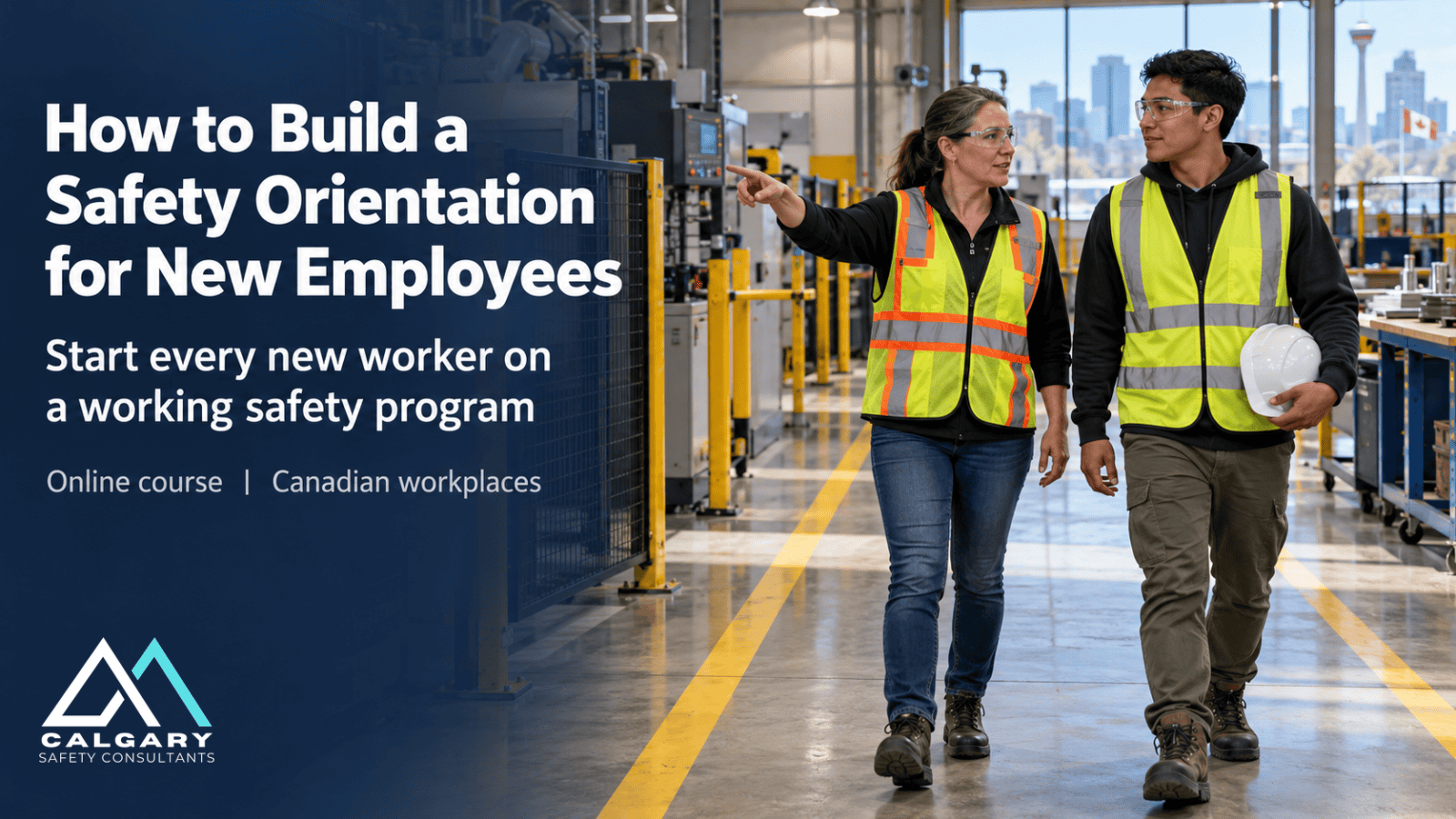
How to Build a Safety Orientation for New Employees
This course is free. Sign in or create your free account, select Enroll, then scroll to the Course Content section at the end of this page to begin your lessons.
Table of Contents
Our free online safety orientation training shows owners, managers and supervisors across Canada how to build a new employee safety orientation that actually protects people. It’s short and practical: four narrated lessons, about 40 minutes of video, built on one main rule. A safety orientation only works when it’s built on a functional health and safety program or manual.
Enrolment is for one person at a time: each learner creates their own free account and enrols on this page. If you know an owner or supervisor who’s about to hire, please share this page with them. If your health and safety program or manual needs work before you build your orientation, see our workplace safety consulting services.
Learn more about how our online safety training works.
A Free Course We’re Glad to Share
New workers are hurt far more often than experienced ones. Research from the Institute for Work & Health found that workers in their first month on a job have about three times the risk of a lost-time injury compared with workers who’ve been there more than a year. A good orientation is the first and best chance to change that.
The trouble is that many orientations are built backwards. A company tells new workers to follow procedures that don’t exist, report to a system nobody uses, or gather at a muster point nobody has picked. This course fixes that by starting where every good orientation starts: a health and safety program that’s written, current, in use and known.
This is awareness-level training. It isn’t a certification or legal advice, it doesn’t guarantee compliance, and it doesn’t replace your jurisdiction’s OHS legislation or your own health and safety program.
Safety Orientation Training Course at a Glance
Price: Free
Delivery: 100% online and self-paced
Course format: 4 narrated video lessons in two modules, with written lesson notes
Video time: about 40 minutes in total, each lesson about 9 to 11 minutes
Knowledge checks: three questions after each lesson (100% to continue, unlimited retries)
Final quiz: five questions, 80% to pass
Course guide: a downloadable Student Reference Guide with a jurisdiction reference table and five fill-in orientation tools
Certificate: Certificate of Completion
Coverage: Canada-wide, with British Columbia, Alberta, Saskatchewan, Manitoba, Ontario and federal rules named
What Does This Safety Orientation Training Cover?
This safety orientation training follows the job of building an orientation from start to finish: check your program, work out what the law expects, build the package, then deliver it, record it and keep it current.
You’ll learn how to:
- Explain what a safety orientation is and who counts as a new worker, including part-time, temporary, seasonal and returning workers.
- Explain the employer’s duty to provide a safe workplace, and why missing program pieces are an omission, possibly non-compliance, and a cause of a weak orientation.
- Describe what a good health and safety program or manual includes, and check whether yours is ready: written, current, in use and known.
- Describe what Canadian OHS laws generally expect a new worker orientation to cover, and find the rules that apply to you.
- Build a core topic list of twelve topics and link each one to its source in your program.
- Separate company, site and job orientation so each part stays specific.
- Plan who delivers the orientation, when and how long, and build a short checklist from free regulator samples.
- Prepare practical materials and teach with tell, show, do and check.
- Deliver the orientation well, confirm understanding with open questions and demonstrations, and keep proper records.
- Know when to re-orient, and keep your orientation current as your program and workplace change.
Every lesson includes written notes, workplace examples, decision points and a knowledge check, so learners practise making sound decisions rather than memorizing rules.
New Worker Orientation Requirements in Canada
Canada has 14 health and safety jurisdictions: the federal government, 10 provinces and 3 territories. Each has its own law, but they share the same basic expectations. Employers must inform workers about the hazards they’ll face, instruct and train them to work safely, and supervise them while they work. Many also spell out that employers must make sure workers know their rights and duties.
Some jurisdictions go further. In British Columbia, sections 3.22 to 3.25 of the OHS Regulation set out workplace-specific orientation and training for young and new workers, with listed topics and records. Manitoba’s Workplace Safety and Health Regulation, section 2.2.1, has a similar list, and Saskatchewan’s OHS Regulations, 2020, section 3-8, require training when a worker starts or moves to work with different hazards. Ontario requires basic OHS awareness training under O. Reg. 297/13, and federally regulated employers follow the Canada Labour Code.
The Student Reference Guide includes a jurisdiction reference table for these rules, checked against official sources in October 2026. Laws change, so always confirm the current official text with your regulator.
Who Should Take This Safety Orientation Course?
This course is built for anyone who has to get new people started safely, in any industry and any region of Canada.
It’s suitable for:
- Owners and managers of small and medium-sized businesses
- Supervisors and crew leads who orient new workers on site
- Safety coordinators and health and safety committee members
- HR and office staff who handle new hires and their paperwork
- Employers preparing for a COR or SECOR audit who want their orientation records in order
- Anyone who has been handed the job of building or fixing a new worker orientation
Each person enrols individually with their own free account. Managers often share the course link with the supervisors who deliver orientations.
Safety Orientation Training Course Features
Our online safety orientation training is designed to be practical, realistic and easy to apply in your own workplace.
Course features include:
- 100% online, self-paced and free
- 4 narrated video lessons, each about 9 to 11 minutes long
- Written lesson notes with learning objectives, workplace examples and decision points
- Real Canadian scenarios across many industries and regions
- A three-question knowledge check after each lesson, with feedback after each answer
- A five-question final quiz
- A downloadable Student Reference Guide with lesson summaries, reflection questions, a jurisdiction reference table and five orientation tools
- A Certificate of Completion
The five orientation tools are a Program Readiness Check, a Core Orientation Topic List, a New Worker Orientation Checklist, an Orientation Record and Follow-up, and a Re-orientation and Review form. The Word-friendly checkboxes are clickable, and the PDF prints cleanly.
Safety Orientation Training Course Modules
The course is organized into two modules. Each lesson is one complete narrated video with written notes and a knowledge check.
Module One: Foundations of a Safety Orientation
Module One lays the foundation: what a safety orientation is and who needs one, the employer’s duty to provide a safe workplace, why an orientation only works when it’s built on a functional health and safety program, what a good program includes, what Canadian OHS laws generally expect, and how to build a core topic list linked to your program.
Lessons:
- Lesson One: Start With a Working Health and Safety Program
- Lesson Two: What the Law Expects and What to Include
Module Two: Building and Delivering Your Orientation
Module Two turns that foundation into a working orientation: planning who delivers it, when and how, building the checklist and practical materials, delivering it with tell, show, do and check, confirming understanding, keeping proper records, and keeping the orientation current as your program and workplace change.
Lessons:
- Lesson Three: Build Your Orientation Package
- Lesson Four: Deliver, Record and Keep It Current
Complete Your Safety Orientation Training
Create your free account, enrol on this page, then work through the lessons in order at your own pace. After each video, complete the lesson’s three-question knowledge check. You need all three answers correct (100%) to move on, and you can retry as many times as you need, with feedback after each answer to help you learn.
After Lesson 4, complete the five-question final quiz, which draws on both modules. You need four correct answers (80%) to pass, and you can retake it as many times as you need. Once you’ve completed all four lessons, their knowledge checks and the final quiz, you can download your Certificate of Completion.
The certificate shows that you completed awareness-level online training in building a safety orientation. It isn’t a professional designation, and it doesn’t confirm that any workplace’s orientation or health and safety program meets the law.
Frequently Asked Questions About Safety Orientation Training
Is the course really free?
Yes. There’s no charge for the course, the Student Reference Guide or the certificate. Create your free account, enrol on this page and start whenever you like.
Is this safety orientation training for workers or for employers?
It’s for the people who build and deliver orientations: owners, managers, supervisors, safety coordinators and committee members. If you’re a new worker looking for your own safety basics, our free New Worker Safety Essentials course is the better fit.
Why do I need a health and safety program before I build an orientation?
Because your orientation teaches your program. Every topic, from hazards and procedures to emergencies and reporting, comes from it. If the program isn’t written, current, in use and known, the orientation has nothing real to teach. Lesson 1 includes a readiness check, and the Student Reference Guide has a Program Readiness Check you can fill in.
Does the course cover the law in my province or territory?
It teaches the expectations all 14 Canadian jurisdictions share, and names the specific orientation rules in British Columbia, Manitoba, Saskatchewan and Ontario, Alberta’s general duties and program requirement, and the Canada Labour Code for federally regulated employers. Every other jurisdiction is pointed to its regulator. Always confirm the current rules with your regulator.
How long does the course take?
Most learners finish in about 50 minutes. The four lesson videos run about 40 minutes in total, and the knowledge checks and final quiz add time depending on your pace. You can stop and return at any time.
Will this course give me a ready-made orientation?
It gives you the method and the tools: a core topic list, a starting checklist, a record and follow-up form, and a review form. You fill them in from your own health and safety program, because a generic orientation isn’t specific enough to your workplace and your hazards.
Is there a final quiz?
Yes. After Lesson 4 there’s a five-question final quiz. You need four of five correct (80%) to pass, and you can retake it as many times as you need.
Do I receive a certificate?
Yes. You receive a Certificate of Completion after you complete all four lessons, their knowledge checks and the final quiz. It records completion of awareness-level online training. It isn’t a professional designation, and it isn’t approved by any regulator.
Can an employer enrol a group of workers?
No. Enrolment for this course is for one person at a time. Each person creates their own free account and enrols individually, and we don’t set up group or bulk enrolments for this course. Employers are welcome to share the course link with their supervisors.
Additional Safety Orientation Resources
The resources below are the official sources used in the course. Use them to check the rules where you work and to find free sample checklists, and use our services when your program needs more than training.
Young and new worker orientation checklist
Issued by: WorkSafeBC
A free checklist for orienting young and new workers in British Columbia. A good starting point anywhere, as long as you customize it to your workplace.
Young and new worker orientation checklist
Health and safety orientation and training guide
Issued by: WorkSafe Saskatchewan
A guide for employers on orientation and training, with a sample checklist.
Health and safety orientation and training guide
New Worker Orientation and Training Guide
Issued by: SAFE Work Manitoba
A step-by-step guide for employers on orienting and training new workers.
New Worker Orientation and Training Guide
Health and safety program
Issued by: Government of Alberta
What a health and safety program includes and when Alberta employers need one.
Health and safety program
Canada Labour Code, section 125
Issued by: Government of Canada
The specific duties of federally regulated employers, including information, instruction, training and supervision.
Canada Labour Code, section 125
Workplace Safety Consulting Services
Issued by: Calgary Safety Consultants
Our consulting support for health and safety programs and manuals, hazard assessments, orientations and COR and SECOR readiness across Western Canada.
Workplace Safety Consulting Services
Related courses: New Worker Safety Essentials (free), Winter Season Work Safety (free), Hazard Assessment and Control for Canadian Workplaces and Working Alone and Lone Worker Safety for Canadian Workplaces.
Your orientation is only as strong as the program behind it. Learn more about our hazard assessment and control training and our workplace inspection and compliance training.