On this page
- What a Health and Safety Representative Is
- When a Representative Is Required Instead of a Committee
- Who Chooses the Representative
- What a Health and Safety Representative Does
- Training Requirements by Jurisdiction
- Paid Time and What the Employer Must Provide
- Responding to the Representative's Recommendations
- Inspections, Investigations and Work Refusals
- Records to Keep
- Making the Role Effective
- How the Representative Shows Up in a COR or SECOR Audit
- A Practical Workplace Example
- Common Representative Mistakes to Avoid
- What an Auditor Expects to See
- The Bottom Line
- Download the Checklist and Quick Guide
- Frequently Asked Questions
- Related Guides and Articles
- How Calgary Safety Consultants Can Help
- Sources
What a Health and Safety Representative Is
A health and safety representative is a worker who speaks for their co-workers on health and safety in a workplace that's too small for a joint health and safety committee. In effect, a one-person committee. They take in worker concerns, help find hazards, take part in inspections and investigations, and make recommendations to the employer.
The role exists because the people doing the work usually see problems first. A representative gives them a named person to go to, someone who knows the rules and can raise issues without fear of reprisal. For the employer, a good health and safety representative is an early warning system that costs very little.
The role goes by different names across Canada. British Columbia, Newfoundland and Labrador and Yukon talk about a worker health and safety representative, and Manitoba about a worker safety and health representative. Saskatchewan, Prince Edward Island and the Northwest Territories and Nunavut use occupational health and safety representative. Alberta, Ontario, Nova Scotia, New Brunswick and federally regulated workplaces use health and safety representative, and Quebec has its own system, explained below.
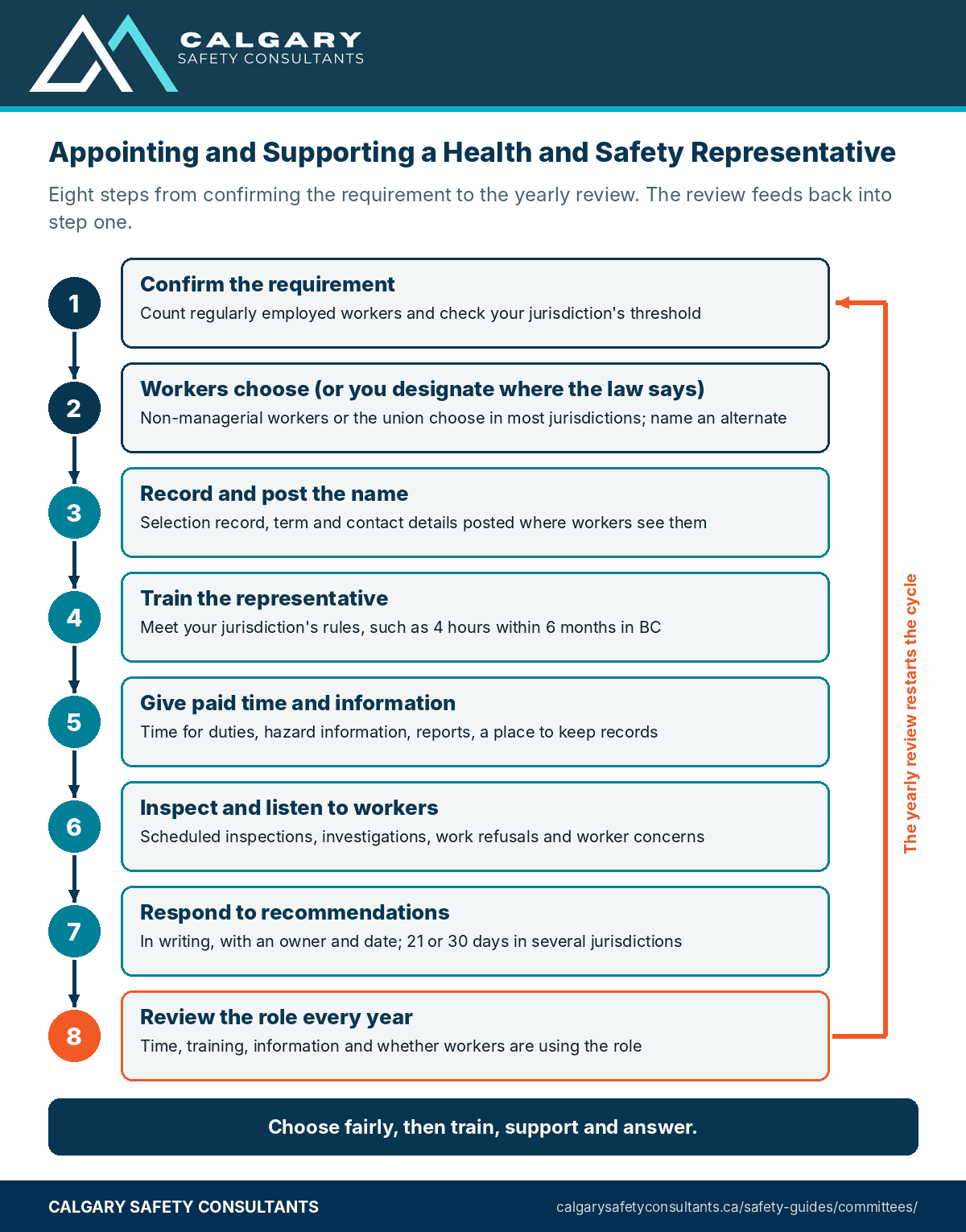
If you're still working out whether you need a committee or a representative, our article on when a health and safety committee or representative is legally required is a good starting point. The steps in this guide are summed up in the diagram.
When a Representative Is Required Instead of a Committee
In most of Canada, the line between a committee and a representative is 20 workers. At 20 or more, you generally need a joint committee. Below that, you need a health and safety representative once you reach a lower threshold, usually five or six workers. British Columbia starts at 10 and Saskatchewan only requires one at prescribed high-hazard workplaces. Newfoundland and Labrador, the Northwest Territories and Nunavut and federal workplaces have no lower threshold. The tables set out the rules by jurisdiction, with section references.
Who needs a representative, and who chooses them
| Jurisdiction | Local name and when required | How the representative is chosen |
|---|---|---|
| Alberta | Health and safety representative; 5 to 19 regularly employed workers, or a work site a Director designates (OHS Act s. 14(1)). The employer may set up a committee instead (s. 14(6)) | The employer designates a worker who isn't associated with management, after consulting any union (s. 14(1)) |
| British Columbia | Worker health and safety representative; more than 9 but fewer than 20 workers regularly employed, or by WorkSafeBC order (WCA s. 45(1)) | Selected from workers who don't exercise managerial functions, under union procedures or by secret ballot (ss. 45(2), 34) |
| Saskatchewan | Occupational health and safety representative; 5 to 9 workers at workplaces prescribed as highly hazardous in Table 7 (OHS Regulations s. 4-8) | The employer must have one in place (s. 4-8(2)); the ministry says co-workers appoint the representative, or the union under its bylaws |
| Manitoba | Worker safety and health representative; 5 to 19 regularly employed workers (Act s. 41) | Elected by the workers they represent, or appointed under the union's constitution |
| Ontario | Health and safety representative; more than 5 regularly employed workers where no committee is required (OHSA s. 8(1)) | Selected by workers who don't exercise managerial functions, or by the union (s. 8(5)) |
| Quebec | Représentant en santé et en sécurité (health and safety representative) alongside the committee in establishments with 20 or more workers (Act s. 87); an agent de liaison (liaison officer) at 19 or fewer | Designated in the same way as the workers' committee representatives (s. 89) |
| Federal | Health and safety representative; fewer than 20 employees, or where no work place committee is required (CLC s. 136(1)) | Selected by employees who don't exercise managerial functions, by majority vote if there's no union (SOR/2015-164 s. 11), or by the union (CLC s. 136(2)); two-year term (Regulations s. 12) |
| Nova Scotia | Health and safety representative; 5 or more employees where no committee is required (OHS Act s. 33(1)) | Employees select from employees not connected with management (s. 33(1)) |
| New Brunswick | Health and safety representative; 5 to 19 employees, where the safety policy provides for one or WorkSafeNB requires it (OHS Act s. 17(1), (2)); project sites with more than 5 but fewer than 30 employees must have one (s. 17.1) | Employees elect the representative (s. 17(3)); on project sites, the contractor and employees designate jointly (s. 17.1(3)) |
| Prince Edward Island | Occupational health and safety representative; 5 or more workers where no committee is required (OHS Act s. 26(1)) | Workers select from workers who don't perform managerial functions (s. 26(1)) |
| Newfoundland and Labrador | Worker health and safety representative; fewer than 20 workers (OHS Act s. 41(1)); under 6 workers, the employer may use a workplace designate if a representative is impracticable (s. 42.1) | Elected by workers or appointed under the union's constitution (s. 42); not connected with management (s. 41(1)) |
| Northwest Territories and Nunavut | Occupational health and safety representative; fewer than 20 workers and no committee (OHS Regulations s. 39) | The employer designates at least one worker (s. 39) |
| Yukon | Worker health and safety representative; 5 to 19 regularly employed workers (Yukon WSCB) | Chosen by workers; no managerial role in the workplace |
Training, paid time and the employer's response
| Jurisdiction | Training | Paid time | Employer response to recommendations |
|---|---|---|---|
| Alberta | Employer ensures the representative is trained (OHS Code s. 201) | Duties done during normal working hours (Act s. 14(5)); time away and pay (Code s. 199.3) | No fixed number of days in the Act |
| British Columbia | At least 4 hours within 6 months (OHS Regulation s. 3.27(3)), plus 8 hours of educational leave a year (WCA s. 41) | Time off for duties, paid as time worked (s. 40) | Written, within 21 days of a request (s. 39) |
| Saskatchewan | Training on the role (Regulations s. 4-9(1)); up to 5 working days of leave a year (s. 4-9(3)) | No loss of pay for duties and meetings (s. 4-11) | Written, after written notice of an unsafe condition (s. 3-17(2)) |
| Manitoba | Competent training (Act s. 41(8)); yearly leave of two shifts or 16 hours, whichever is greater (s. 44) | Training leave without loss of pay (s. 44) | The 30-day rule (s. 41.1) is described for committees; check the Act for your case |
| Ontario | Not required by the Act | Regular or premium pay for inspections and duties (s. 8(15)) | Written, within 21 days (s. 8(12)) |
| Quebec | Representative (20 or more): CNESST training attestation, mandatory since January 1, 2024. Agent de liaison (19 or fewer): CNESST attestation required | Deemed at work while exercising functions (Act s. 96) | Recommendations go to the committee, or to the workers and employer (s. 90(4)) |
| Federal | Prescribed training (CLC s. 125(1)(z.01)), with content set by SOR/2015-164 s. 14 | Time for duties, plus preparation and travel as authorized by the policy committee chairs or the employer, at regular or premium rate (s. 136(8), (9)) | Written, within 30 days (s. 125(1)(z.10)) |
| Nova Scotia | Additional training as prescribed (s. 13(2)(c)) | Reasonable time off, paid as work time (s. 33(5)) | Written, within 21 days of a request (s. 34(1)) |
| New Brunswick | Project site representatives must have attended a prescribed educational program (s. 17.1(2)) | Not set out in s. 17 | No fixed period; if the employer and representative disagree, the representative calls an officer (s. 18(3)) |
| Prince Edward Island | Time off to take prescribed training (s. 26(4)) | Deemed work time with usual pay and benefits (s. 26(5)) | Written, within 30 days of a request (s. 27(1)) |
| Newfoundland and Labrador | Employer provides and pays for training that meets the Commission's requirements (s. 41(2), (3)) | Training paid as regular work (s. 41(5)) | Written, within 30 days (s. 5(f.1)) |
| Northwest Territories and Nunavut | Training on duties and functions (Regulations s. 51(2)) | Duties during normal hours without loss of pay or benefits (s. 47) | Written reply as soon as reasonably possible (s. 52) |
| Yukon | Orientation within 30 days; competency training within 6 months, at the employer's cost | Orientation, training and representative work are paid work time | No fixed period stated by the regulator |
Thresholds, exceptions, project and multi-employer rules vary, and regulators can order a representative or committee where the law wouldn't otherwise require one. Check the current law for your jurisdiction; our OHS legislation guide links them all.
The official sources behind the tables:
- Ontario. The province's guide for committees and representatives sets out the representative's powers and notes that farming operations with more than five regularly employed workers also need one. The guide to the OHSA confirms the 21-day written response.
- British Columbia. The Workers Compensation Act gives the representative a committee's duties, to the extent practicable, and applies the committee rules on response, time off, educational leave and employer assistance (s. 45(3), (4)). The OHS Regulation sets the 4-hour training rule.
- Alberta. The OHS Act sets the threshold and duties, and OHS Code Part 13 covers posting names, special meetings of representatives, time away and pay, and training. Alberta's committee and representative information sheet explains both.
- Saskatchewan. The ministry's page on OHS representatives explains the role in plain language, and the OHS Regulations, 2020 set out training, leave, meetings and access to records.
- Manitoba. SAFE Work Manitoba explains representatives on its page about creating a committee, and the province's committee FAQ covers training leave for committee members and representatives.
- Quebec. The CNESST sets out the prevention and participation mechanisms by establishment size, and the Act respecting occupational health and safety lists the representative's functions in s. 90.
- Federal. See Canada Labour Code section 136, the committee and representative regulations and the employer duties in section 125.
- Atlantic Canada. See the OHS Acts of Nova Scotia, New Brunswick, Prince Edward Island and Newfoundland and Labrador. Nova Scotia and Prince Edward Island let the Director order a representative even where fewer than five people work.
- The North. The WSCC's joint committee code of practice quotes the Northwest Territories and Nunavut representative rules, and Yukon's WSCB covers representatives on its committees page.
Who Chooses the Representative
This is where many small employers go wrong. In most jurisdictions, the workers choose the health and safety representative, not management. Ontario, British Columbia, Manitoba, Nova Scotia, New Brunswick, Prince Edward Island, Newfoundland and Labrador, Yukon and the federal Code all put the choice in the hands of workers, or their union where there is one.
Alberta and the Northwest Territories and Nunavut are different. There, the employer designates the representative, and in Alberta it must consult any union first and choose a worker who isn't associated with management. Saskatchewan's regulations make the employer responsible for having a representative in place, while the ministry says co-workers appoint the person. Even where the law lets you designate, asking workers to put a name forward makes the role far more credible.
Most jurisdictions rule out supervisors and managers. The representative has to be someone who doesn't exercise managerial functions, because the whole point is an independent worker voice. A lead hand who directs work is usually a poor fit, however experienced.
A simple, fair process works well in a small workplace:
- Explain the role. Tell workers what the representative does, how much time it takes, and that it's paid.
- Ask for volunteers or nominations. Give people a few days to think about it.
- Let workers decide. Use a show of hands if everyone's comfortable, or a secret ballot if not. British Columbia's Act names a secret ballot where there's no union process.
- Record and post the result. Write down who was chosen, the date and how, then post the name and how to reach them.
- Name an alternate. A second person who can step in during holidays or shift changes keeps the role covered. British Columbia's Act lets the representative designate an alternate for inspections and investigations (s. 46).
Set a term so the role doesn't quietly lapse. Federally, the term is two years and a vacancy must be filled within 30 days. Elsewhere, a two-year term written into your health and safety program is a sensible default.
What a Health and Safety Representative Does
The duties look much the same across Canada, because in most jurisdictions the representative does what a committee would do, scaled to one person. Quebec's Act and the federal Code spell the list out in detail, and the federal Code lists 13 separate duties. In practice, a health and safety representative's work falls into six areas.
- Receiving worker concerns. Workers bring concerns to the representative, who raises them with the employer and follows up. Federally, the representative must consider and quickly resolve complaints.
- Inspecting the workplace. Ontario representatives inspect the whole workplace at least once a month, or, where that isn't practical, all of it at least once a year and part of it every month on an agreed schedule. Federal representatives inspect all or part of the workplace each month so every part is covered at least once a year. In the Northwest Territories and Nunavut, inspections happen at least every three months, with a written report to the employer.
- Taking part in investigations. Representatives take part in investigations of serious incidents in most jurisdictions, including Saskatchewan, Nova Scotia, Yukon and federally.
- Helping identify hazards. Alberta's Act includes participating in the employer's hazard assessment, and Nova Scotia's includes co-operative identification of hazards.
- Making recommendations. The representative recommends improvements to the employer, which in several provinces triggers a written response.
- Being part of work refusals. In Ontario, the representative must be present for the employer's investigation of a work refusal. Quebec's representative can intervene when a worker exercises the right of refusal, and under Alberta's OHS Act the employer must inform the representative of a refusal report as soon as possible (s. 17(5)).
Be clear about what the role is not. The representative isn't responsible for safety; the employer and supervisors are, and the representative doesn't enforce rules or discipline anyone. Federally, the Code says a representative isn't personally liable for things done in good faith. Making this clear at the start helps the person say yes to the role.
Training Requirements by Jurisdiction
Training is where the rules differ most. Some jurisdictions set hours and deadlines, others say the employer must make sure the representative is trained, and Ontario's Act doesn't require specific training for representatives at all.
- British Columbia. At least 4 hours of instruction and training as soon as practicable, and no more than 6 months after becoming a representative. It must cover the role's duties and functions, investigations, inspections and refusal of unsafe work. The representative is also entitled to 8 hours of educational leave each year.
- Alberta. The employer must make sure the representative is trained under OHS Code s. 201. Alberta's guidance says it can be delivered in-house or by an outside provider, and should cover the role, the obligations of work site parties and workers' rights.
- Saskatchewan. Representatives must receive training on their duties, delivered by WorkSafe Saskatchewan or an approved instructor, and can take up to five working days of training leave a year.
- Manitoba. Representatives must receive competent training, and the employer must allow yearly training leave of two shifts or 16 hours, whichever is greater.
- Yukon. An orientation within 30 days of being chosen and competency training within 6 months, at the employer's cost, plus investigation training within 6 months for at least one worker representative.
- Federal. Prescribed training that the employer develops after consulting the representative, covering the Code, the means to carry out the role, and consensus building. The program must be reviewed at least every three years.
- Newfoundland and Labrador. The employer provides and pays for training that meets the Commission's requirements, and the representative must take part.
- Quebec. Since January 1, 2024, representatives must obtain a CNESST training attestation, and liaison officers in smaller establishments need their own attestation.
Even where the law is silent, as in Ontario, train your representative anyway. Someone who doesn't know what an inspection should cover or how a refusal works can't do the job. SAFE Work Manitoba's training program standard for committees and representatives is a useful benchmark: it covers inspections, investigations, serious incident reporting and work refusals, and says learners should refresh their training every three years.
Our joint health and safety committee and representative training covers roles, inspections, hazard assessment and follow-up on corrective actions, online, virtually or in a classroom.
Paid Time and What the Employer Must Provide
A representative who has to do the job on breaks or after hours won't last long, and in most of Canada the law doesn't allow it. Representative work is treated as work time. Ontario pays representatives at their regular or premium rate for inspections and other duties. Federally, the representative is paid for time spent on duties, and for preparation and travel the employer or policy committee chairs authorize, even outside regular hours.
Employers must also:
- Share information. Ontario employers must give the representative information on hazards from materials, processes and equipment, copies of inspector orders and reports, and notice of critical injuries and lost-time injuries. Federally, the representative can request information needed to identify hazards and has full access to government and employer reports, but not to medical records without consent.
- Provide resources. British Columbia applies its committee rule on equipment, premises and clerical help to representatives.
- Meet regularly. Saskatchewan and the Northwest Territories and Nunavut require the employer to meet with the representative regularly, and the representative can call a special meeting for urgent concerns. Alberta's Code also provides for special meetings of representatives (s. 199.2).
- Consult and co-operate. British Columbia, Manitoba and the federal Code require employers to consult and co-operate with the representative, and federally that includes planning changes that may affect health and safety.
- Protect the representative. Reprisal for raising concerns or carrying out the role is prohibited. British Columbia's Act and Quebec's Act both say so directly.
U.S. OSHA's recommended practices on worker participation sum it up well: give workers the time and resources to take part, and authorize enough of both to make participation possible.
Responding to the Representative's Recommendations
Recommendations are the representative's main tool, and how the employer handles them decides whether the role means anything. Several jurisdictions set a written deadline:
- 21 days. Ontario, Nova Scotia and British Columbia (in Nova Scotia and British Columbia, when the recommendation includes a request for a response).
- 30 days. Federal, Newfoundland and Labrador, and Prince Edward Island (from the request).
- Written response, no fixed days. Saskatchewan, after written notice of an unsafe condition, and the Northwest Territories and Nunavut.
A good response either accepts the recommendation with a date and an owner, or explains why the employer won't act and what it will do instead. Nova Scotia and Prince Edward Island also require the employer to explain any delay and say when a full answer will follow. In New Brunswick, if the employer and representative can't agree, the representative must call an officer.
Even where there's no legal clock, answer every written recommendation in writing within 21 to 30 days. Log each one, and use our corrective actions guide to follow the fixes through. Our guide to writing JHSC minutes and recommendations has more on wording a recommendation so it can be answered with a clear yes, no or date.
Inspections, Investigations and Work Refusals
Inspections are the representative's most visible work. Plan them with the representative, not around them. Agree a schedule, give them the employer's inspection checklist, and walk the site together at least some of the time so you see the same things. British Columbia's regulation says workplace inspections must include the representative's participation where feasible. Our guide on how to conduct a workplace safety inspection explains how to make each walk-around count.
After a serious incident, call the representative early. Ontario representatives can inspect the scene of a critical injury or fatality and report their findings. The Northwest Territories and Nunavut OHS Regulations have the representative and employer investigate serious accidents together. Our incident investigation guide covers the full process.
Work refusals are where the representative matters most. In Ontario, the representative must be there when the employer investigates a refusal, and the inspector must consult them if the refusal goes further. In British Columbia, an unresolved refusal is investigated with a worker member of the committee, a union-selected worker or another worker the refusing worker selects. Our guide on how to handle a work refusal walks through the steps.

Records to Keep
Without committee minutes, a representative's work is easy to lose track of. Keep a short, simple record set:
- Selection record. Who was chosen, how, the date, the term and the alternate.
- Posting. The representative's name and contact details posted where workers can see them. Alberta, Nova Scotia, Prince Edward Island, New Brunswick, Yukon, the Northwest Territories and Nunavut and the federal Code require it, and federally the posting includes the work phone number and work location.
- Training records. Course names, dates, hours and certificates.
- Inspection reports. Signed by the representative, with findings and follow-up.
- Concerns and recommendations log. Date received, issue, what was recommended, the employer's response and date, and when it was closed.
- Meeting notes. Saskatchewan requires written records of meetings with the representative, readily available to workers and officers. Elsewhere, a few lines after each meeting is enough.
Keep these records with your health and safety program for at least three years. Our free HSR Appointment and Support Checklist, below, includes a selection record and a recommendations log you can fill in.
Making the Role Effective
A few habits make the role work.
- Introduce the representative. Tell every worker who the representative is and how to reach them, at orientation and again after any change.
- Book regular time together. A 30-minute check-in each month between the owner or manager and the representative keeps issues moving. Use the same short agenda each time: open concerns, recent inspections, incidents, upcoming changes.
- Close the loop. When a concern is fixed, say so, and give the credit to the worker who raised it.
- Use the hierarchy of controls. Help the representative push past "be careful" to real fixes. Our hierarchy of controls guide explains how.
- Review the role yearly. Ask whether the representative has the time, training and information they need, and whether workers are using them.
The UK Health and Safety Executive puts it plainly on its page on health and safety representatives: worker involvement and consultation have proved key to improving health and safety at work. An HSE research report notes that workplaces with safety representatives and committees have significantly better accident records than those without any consultation arrangement.
ISO 45001, the international standard for occupational health and safety management systems, treats worker consultation and participation as a core requirement. A representative who's trained, heard and answered is one of the clearest ways a small employer can show it.
If your workplace grows past 20 workers, you'll usually need a committee instead. Our guides on how to set up a JHSC and how to run a JHSC meeting cover that next step, and your representative is often the natural first worker member.
How the Representative Shows Up in a COR or SECOR Audit
For small employers, the representative is part of the audit. Energy Safety Canada's SECOR Element J is built around the health and safety representative, with seven questions: a representative designated as the law requires, written duties, proof of training, proof of participation in activities such as inspections and investigations, a system for handling worker concerns, proof concerns are resolved in a timely way, and contact information available to employees.
For larger employers, Energy Safety Canada's 2023 COR audit protocol covers the committee and representative in Element J. In Ontario, IHSA's COR 2020 audit tool includes participation and consultation with the health and safety representative or committee among its management review inputs.
Our guides on preparing for a SECOR evaluation and preparing for a COR audit explain the wider process.
Workplace example
A Practical Workplace Example
Situation: Consider a small millwork shop in British Columbia that grew from eight to 14 workers in a year. When a worker asked who the safety representative was, the owner named the shop foreman. The foreman had never been trained, did no inspections and assigned the work, so workers kept their concerns to themselves, including a dust collector that kept clogging.
Action: The owner checked the Workers Compensation Act and learned that a workplace with more than nine workers needs a worker health and safety representative, chosen by the workers and not by management. At a crew meeting, a secret ballot chose a cabinetmaker with ten years on the floor, with an apprentice as alternate. The representative took a 4-hour course within two months. The owner booked a paid monthly inspection and a 30-minute check-in, and posted the representative's name by the time clock.
Result: The first inspection turned up the dust collector, two missing blade guards and a blocked exit. The representative made a written recommendation on the dust collector, and the owner answered in writing within two weeks with a repair date. Within six months, workers were bringing concerns forward regularly, and the owner had a binder of inspection reports, training records and responses ready for his first small-employer COR audit.
Common Health and Safety Representative Mistakes to Avoid
- Management picking the representative. In most jurisdictions the workers choose. Appointing your favourite worker, or a supervisor, undermines the role and can breach the law.
- Naming a supervisor or lead hand. In most jurisdictions the representative must be someone who doesn't exercise managerial functions, and even where the law doesn't say so, a supervisor undermines the role.
- Skipping training. British Columbia, Alberta, Saskatchewan, Manitoba, Yukon, Newfoundland and Labrador, the Northwest Territories and Nunavut and the federal Code all require it.
- Expecting the work on unpaid time. Representative work is work time. Book it and pay for it.
- Ignoring recommendations. Missing a 21-day or 30-day written response is a compliance gap, and it tells workers not to bother.
- Not posting the name. Workers can't use a representative they don't know about.
- Letting the role lapse. When the representative leaves, choose a new one quickly. Federally, it's 30 days.
- Forgetting to check the headcount. A growing business can cross a threshold without noticing. Check numbers every quarter.
Audit perspective
What an Auditor Expects to See
An auditor looking at the health and safety representative wants to see that the role exists as the law requires and actually does something. That usually means a record of how the representative was chosen, written duties, training records that meet your jurisdiction's rules, inspection reports and investigation records the representative took part in, a log of worker concerns with dates received and dates addressed, written responses to recommendations, and the representative's name and contact details posted.
Interviews complete the picture. Workers should be able to name their representative and say how they'd raise a concern. The representative should be able to describe a recent inspection, a concern they raised and what happened to it. A name on a poster with nothing behind it is where audit marks are lost.
Calgary Safety Consultants helps employers set up representatives, train them and prepare for COR and SECOR audits; we don't issue certificates. CORs and SECORs are issued through the applicable certifying partner.
The Bottom Line
If your workplace is too small for a committee, it almost certainly needs a health and safety representative. Check your threshold, let the workers choose where the law says so, train the person, give them paid time and the information they need, and answer their recommendations in writing on time. Keep simple records of all of it.
Start this week. Count your regularly employed workers, check the table for your jurisdiction, and if you need a representative and don't have one, call a crew meeting and get the selection under way.
Download the HSR Appointment and Support Checklist and Duties Quick Guide
Two free downloads go with this guide. Both are fillable PDFs with clickable checkboxes, so you can complete them on screen or print them.
- HSR Appointment and Support Checklist (PDF). A six-page fillable checklist and record set for employers that follows the eight steps in this guide. It includes a headcount and jurisdiction check, a one-page quick reference for every province, territory and federal workplace, a selection record and posting checklist, a training record, a paid time and support checklist with a meeting log, an inspection schedule, a concerns and recommendations log with response dates, and a yearly review with common mistakes, what an auditor looks for and sign-off.
- HSR Duties Quick Guide (PDF). A six-page guide for the representative: what the role is and isn't, what to expect from the employer, duties area by area with self-checks, 13 inspection prompts with OK and action boxes, a recommendation form with a worked example, your part in a work refusal, jurisdiction notes, and an activity log.
Click either button to download the file. Adapt both to your workplace and the law where you work.

About the author
John Duplessis, B.Sc., CRSP
John Duplessis is a Canadian Registered Safety Professional with more than 30 years of occupational health and safety experience in oil and gas, construction, green energy, midstream operations and industrial project work. He is an external auditor with Energy Safety Canada.