
On this page
- What JHSC Minutes and Recommendations Are and Why They Matter
- JHSC Minutes and Recommendation Rules by Jurisdiction
- Who Writes, Approves, Posts and Keeps the Minutes
- What JHSC Minutes Should Record
- How to Write Clear JHSC Minutes
- Posting, Distributing, Filing and Keeping Minutes
- How to Write a JHSC Recommendation That Gets Acted On
- The Employer's Response: What It Must Say and When
- Escalation: When Recommendations Are Ignored
- Tracking Recommendations to Closure
- How Minutes and Recommendations Show Up in a COR Audit
- A Practical Workplace Example
- Common Minutes and Recommendation Mistakes
- What an Auditor Expects to See
- The Bottom Line
- Download the Minutes and Recommendation Templates
- Frequently Asked Questions
- Related Guides and Articles
- How Calgary Safety Consultants Can Help
- Sources
What JHSC Minutes and Recommendations Are and Why They Matter
A joint health and safety committee, or JHSC, does most of its work through two documents. The minutes are the official record of each meeting: who was there, what concerns came up, what the committee decided and who agreed to act. A recommendation is the committee's formal, written advice to the employer about how to fix a hazard or improve the health and safety program.
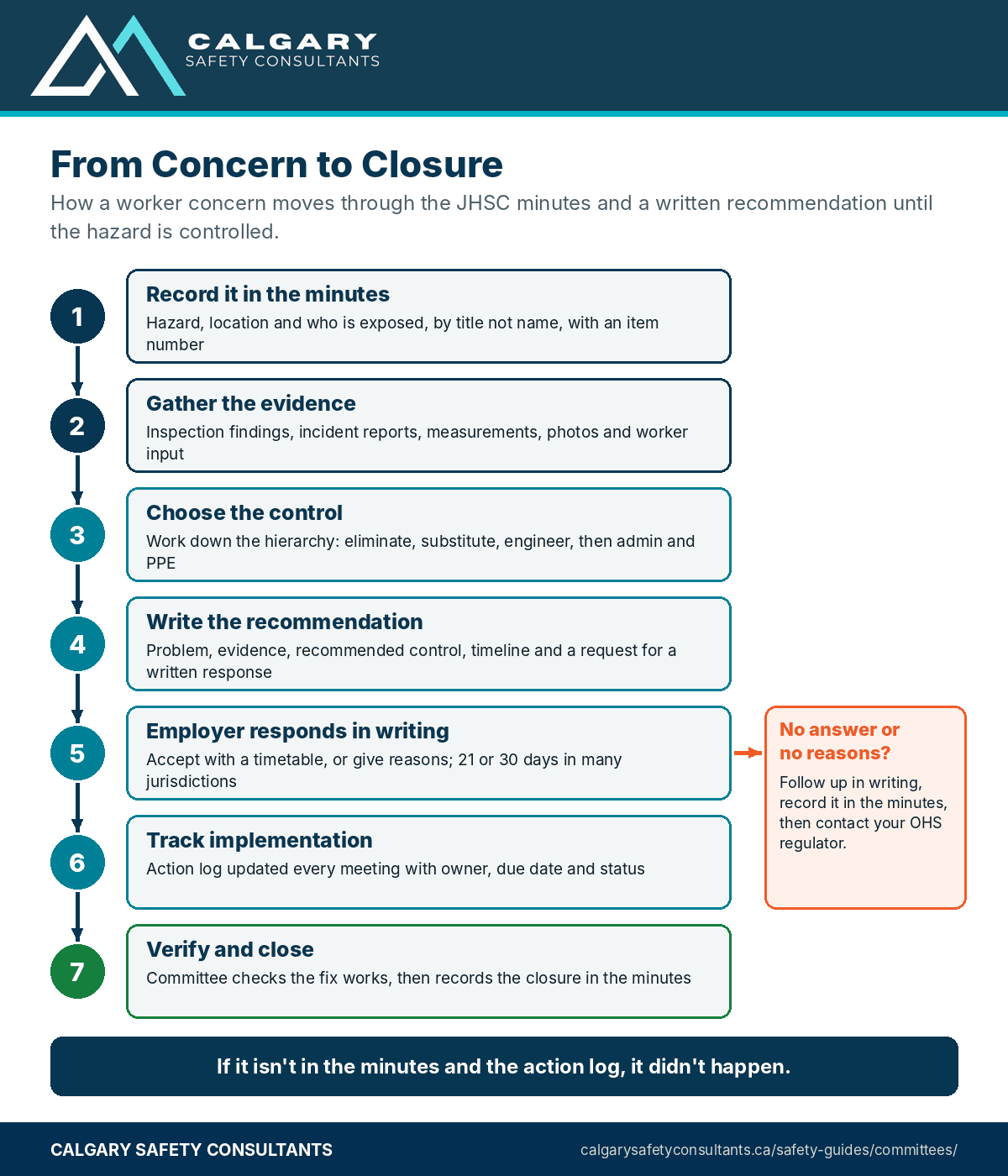
The two work together. A worker concern is raised at a meeting and recorded in the JHSC minutes. If it can't be fixed on the spot, the committee turns it into a written recommendation. The employer's answer, the work that follows and the final check that the fix worked all go back into the minutes. Read in order, a year of minutes should tell the story of every hazard the committee dealt with.
That record matters for three reasons. It's how workers see that raising a concern leads somewhere. It's what an OHS officer or auditor will ask for first. And in most jurisdictions, a written recommendation starts a legal clock on the employer's answer, so a recommendation that was only said out loud may never get one.
Comcare, the Australian federal regulator, sums up good practice in its guide for effective health and safety committees: minutes should be clear and concise, identify the issues raised and who is responsible for follow-up, and make sure problems are resolved by a specified date.
This guide builds on our guides to running a JHSC meeting and setting up a JHSC. If you're not sure your workplace needs a committee at all, see our article on when a health and safety committee is legally required.
JHSC Minutes and Recommendation Rules by Jurisdiction
Every province, territory and the federal jurisdiction has its own rules on JHSC minutes and on how the employer answers recommendations. Some require minutes on a regulator's form, some require them to be filed or posted, and retention ranges from two years to five or more. The table summarizes the rules with section references.
| Jurisdiction | Minutes: who keeps them, posting and filing | How long to keep them | Employer response to recommendations |
|---|---|---|---|
| Alberta | The committee's terms of reference must say how records are kept (OHS Code s. 197) | Special meeting minutes 2 years (Code Part 13); set the rest in your terms of reference | No fixed period; the employer must ensure concerns raised by the committee are resolved in a timely manner (Act s. 3(1)(f)); set a response time in your terms of reference |
| British Columbia | Committee prepares a report of each meeting and gives it to the employer (WCA s. 43(1)); employer posts the 3 most recent (s. 44) | Employer keeps 2 years (s. 43(2)(b)) | Written, within 21 days of a written recommendation with a request for a response; accept or give reasons (s. 39(1), (2)) |
| Saskatchewan | Ministry format, kept on file by the committee, posted until all concerns are resolved; employer keeps a copy for inspection (Regulations s. 4-5) | No period set; keep at least until concerns are resolved | On written notice of an unsafe condition: immediate protection, correction as soon as possible, and a written report of actions or reasons (s. 3-17(2)); written reasons if a committee concern isn't resolved, with referral to an officer (Saskatchewan Employment Act s. 3-29) |
| Manitoba | Recorded for each meeting, signed by both co-chairs and posted on the safety and health bulletin board (WSH Regulation ss. 3.7, 3.11) | 10 years (SAFE Work Manitoba) | Written, within 30 days, including interim controls and reasons for disagreeing (Act s. 41.1(2), (3)) |
| Ontario | Recorded for each meeting and available to an inspector (OHSA s. 9(22)) | No period in s. 9; keep them for your records retention period | Written, within 21 days; a timetable if accepted, reasons if not (s. 9(20), (21)) |
| Quebec | Approved at the next meeting; employer keeps them (r. 8.3 s. 29); annual activity report to the CNESST (Act s. 78(8)) | At least 5 years, unless the committee's own rules say otherwise (r. 8.3 ss. 17, 29) | Written reply explaining points of disagreement, for matters under s. 78(1) to (4) (Act s. 79) |
| Federal | Approved by both chairpersons, copied to the employer and members, available to employees for one month (SOR/2015-164 s. 8); annual report by March 1 (s. 9) | 2 years (s. 8(5)) | Written, within 30 days, saying what action will be taken and when (CLC s. 125(1)(z.10)) |
| Nova Scotia | Form approved by the Director, copy to an officer on request (s. 31(g)); latest minutes posted (s. 37(b)) | No period set in the Act | Written, within 21 days of a request; accept, give reasons or explain the delay (s. 34(1)) |
| New Brunswick | Form approved by the Commission (s. 14(8)); latest minutes posted (s. 14(9)) | Signed copy kept 3 years, available to the Commission on request (s. 14(10)) | No fixed period; if the committee can't agree, it must call an officer (s. 14(13)) |
| Prince Edward Island | Form approved by the Director, copy to an officer on request (s. 25(7)(g)); latest minutes posted (s. 27(7)(b)) | No period set in the Act | Written, within 30 days of a request; accept, give reasons or explain the delay (s. 27(1), (2)) |
| Newfoundland and Labrador | Commission's form; one copy on file, one filed with the Commission, one posted (OHS Regulations s. 25(2)) | No period set in s. 25 | Written, within 30 days, accepted or rejected with a reason, then updates until done (Act s. 5(f.1), (f.2)) |
| Northwest Territories and Nunavut | Recorded, kept on file and posted; copy to the Chief Safety Officer if required (Regulations s. 43) | Employer keeps at least 2 years (WSCC code of practice) | Written, as soon as reasonably possible (s. 52); the code suggests 21 calendar days |
| Yukon | Committee maintains records of its duties (WSCB guidance) | Not stated by the regulator | No fixed period stated by the regulator |
Project sites, small workplaces and representatives can have different rules, and laws change. Confirm the current requirements for your jurisdiction; our OHS legislation guide links every province and territory.
The official sources behind the table, with details worth knowing:
- Ontario. The province's guide for committees and representatives says minutes should give a full description of the issues raised, any recommendations and the employer's response, and should identify members by title, not by name. It also recommends that the co-chairs sign them and post them in the workplace or in an accessible electronic format.
- British Columbia. The Workers Compensation Act calls the minutes a report. The employer must give copies to the union on request and keep them readily accessible to members, workers and officers.
- Alberta. The OHS Act makes recommendations a committee duty, and OHS Code Part 13 covers terms of reference and special meetings. Check the Code text for your committee's records rules.
- Saskatchewan. The OHS Regulations, 2020 require minutes in the ministry's format and posting until every concern in them is resolved.
- Manitoba. SAFE Work Manitoba's page on creating a committee says minutes must note hazards discussed, with recommendations and timelines. The province's committee FAQ explains the 30-day response.
- Quebec. The regulation on participation mechanisms sets the minutes rules where the committee has no agreement of its own, and the Act respecting occupational health and safety sets the written reply and the annual activity report.
- Federal. The Canada Labour Code requires work place committees to keep accurate records and minutes, the committee regulations set approval, distribution and the annual report, and section 125 sets the 30-day response.
- Atlantic Canada. See the OHS Acts of Nova Scotia, New Brunswick, Prince Edward Island and Newfoundland and Labrador, and Newfoundland and Labrador's OHS Regulations, 2012, the only Atlantic rule that sends every set of minutes to the Workplace Health, Safety and Compensation Commission (WorkplaceNL).
- The North. The WSCC's joint committee code of practice for the Northwest Territories and Nunavut says meeting reports should be brief and factual and show the action required, who is responsible and target dates. Yukon's committee guidance lists record keeping and recommendations among committee duties.
Who Writes, Approves, Posts and Keeps the Minutes
The law usually says what has to happen to the minutes, not who holds the pen. Settle the details in your terms of reference so nobody has to guess.
- The recorder. Pick one person to take notes at every meeting. It can be a committee member or an administrative support person, but not whoever is chairing. Rotating the job is fine if each recorder uses the same template.
- The co-chairs. Both co-chairs should review and approve the draft before it's posted. Manitoba requires both signatures and the federal regulations require approval by both chairpersons; elsewhere it's still the best way to show the record is joint.
- The employer. In many jurisdictions, the employer is the one who must post the minutes and keep copies for the retention period, even though the committee writes them. Name a person, often the safety coordinator or office manager, who files every approved set.
- The committee. Members approve the previous minutes at the start of each meeting, as Quebec requires, and correct anything that's wrong before it becomes the permanent record.
Aim to have draft JHSC minutes to the co-chairs within two or three working days, approved within a week and posted as soon as they're approved. Minutes posted a month late lose most of their value to workers.
What JHSC Minutes Should Record
Whatever template you use, good JHSC minutes cover the same core content. Use the same headings every time so readers can find things quickly.
- Meeting details. Committee name, workplace, date, start and end time, location or video link, and whether it was a regular or special meeting.
- Attendance and quorum. Members present and absent, shown as worker or employer members, guests, and a clear statement that quorum was or wasn't met under your law or terms of reference.
- Approval of the last minutes. Any corrections, and that they were approved.
- Open action items. Each item's number, status and any new due date, with the reason it changed.
- Employer responses. Responses received to earlier recommendations and whether the committee accepts them.
- Inspection and incident reviews. The main findings from inspections, incidents and investigations, and what the committee decided about each.
- New concerns. Each concern, with the hazard, location and who is exposed.
- Decisions and actions. For each item, what was decided, who will act and by when.
- Recommendations sent. The number and subject of each formal recommendation going to the employer.
- Next meeting and sign-off. The date of the next meeting and both co-chairs' approval.
Give every item a unique number, such as 2026-10-03, that it keeps until it's closed. Numbers make it easy to follow an item across months of minutes and to match it to your action log and to any recommendation letter.
How to Write Clear JHSC Minutes
JHSC minutes are a record of decisions, not a transcript. Readers, including workers on the floor and an inspector two years from now, should understand each item without having been in the room.
- Write facts, not opinions. "Guard missing on the bandsaw in Shop 2, found on the October 6 inspection" beats "the shop guarding is bad again."
- Be specific about place and exposure. Name the area, equipment or task and who is exposed, such as "night shift forklift operators at doors 3 and 4."
- Record decisions as actions. Each decision gets an owner by title, a due date and a status. "Maintenance lead to install guard by October 20" can be checked; "maintenance to look at it" can't.
- Summarize discussion briefly. One or two sentences on the key points is enough. Where members disagree, record each position fairly and without names.
- Use titles, not names, for people raising concerns. Ontario's guide recommends identifying members by title. Never record a worker's medical details, injury specifics that could identify someone, or anything said about a person's performance.
- Use plain language. Spell out short forms the first time and avoid jargon, because the minutes are posted for everyone.
- Read back actions at the end. The recorder reads each action, owner and date aloud before people leave, so the minutes match what was agreed.
A simple test: if a new worker read the posted JHSC minutes, would they know what the committee found, what it decided and when things will be fixed? If not, rewrite before posting. Our joint health and safety committee and representative training covers minutes, action items and recommendations with practice examples.
Posting, Distributing, Filing and Keeping Minutes
Approved JHSC minutes need to reach three audiences: committee members, the employer and the workers the committee represents. Where your law has specific rules, follow them exactly.
- Posting. Many jurisdictions require posting. Nova Scotia, New Brunswick and Prince Edward Island require the latest minutes to be posted, British Columbia the three most recent meeting reports, and Saskatchewan requires each set to stay posted until every concern in it is resolved. Saskatchewan's page on OHC meeting minutes links the ministry's fillable template.
- Distribution. Send approved minutes to every member and the employer. Federally, the employer member chairperson sends copies to the employer and each member, and the employer makes the minutes available to employees for one month.
- Filing with the regulator. In Newfoundland and Labrador, a copy of every set of minutes is filed with the Workplace Health, Safety and Compensation Commission. Federal work place committees send an annual report of their activities to the Head of Compliance and Enforcement by March 1, and Quebec committees send an annual activity report to the CNESST. Elsewhere, minutes usually go to an officer only on request.
- Retention. Keep minutes at least as long as your law requires: two years federally, in British Columbia and in the Northwest Territories and Nunavut, three years in New Brunswick and five years in Quebec (the default rule). Many employers keep them longer, because they're due diligence evidence and auditors look back over the full audit period.
Electronic posting on an intranet or a shared screen in the lunchroom can work, as Ontario's guide notes, but only if every worker can actually get to it. Crews in the field, shift workers and people without a company login still need a paper copy or a reliable link.
How to Write a JHSC Recommendation That Gets Acted On
A JHSC recommendation is the committee's formal tool for getting a decision from the employer. Many concerns never need one, because the manager at the table can fix them on the spot. A formal written recommendation is for anything that needs a decision above the committee, costs money, involves a policy, or hasn't been fixed after being raised informally.
Strong JHSC recommendations follow the same four-part structure.
- The problem. State the hazard, where it is, who is exposed and what could happen. One or two sentences.
- The evidence. Show why the committee is concerned: inspection findings, incident or near miss reports, measurements, photos, worker concerns, and the law or standard that applies. Dates and numbers make a recommendation hard to dismiss.
- The recommended control. Say exactly what the committee recommends. Work down the hierarchy of controls: can the hazard be eliminated, substituted or engineered out before relying on procedures, training and PPE? NIOSH's hierarchy of controls explains why elimination, substitution and engineering controls are more effective, since they don't depend as much on what workers do every day. If a permanent fix will take time, also recommend interim controls.
- The timeline. Propose a reasonable completion date, and a shorter one for interim controls. End by asking for a written response, which in British Columbia, Nova Scotia and Prince Edward Island is what starts the employer's clock.
Here's the difference in practice. Weak: "The committee recommends the company look at the noise in the grinding room." Strong: "Noise readings on September 18 showed levels above the exposure limit at both grinding stations, and three workers reported ringing ears. The committee recommends enclosing the two grinders with acoustic panels by January 31, requiring hearing protection in the room immediately, and including the room in the hearing conservation program. Please respond in writing."
Number each recommendation, date it, have both co-chairs sign it, and send it to the person who can actually say yes. Keep it to one hazard per recommendation, so a yes on one item isn't held up by a no on another.

The Employer's Response: What It Must Say and When
Once a written recommendation reaches the employer, the law in most jurisdictions requires a written answer. The deadlines and required content differ.
- 21 days. British Columbia, Ontario and Nova Scotia. In British Columbia and Nova Scotia, the clock runs from a written recommendation that includes a request for a response. In those two provinces, if an answer isn't possible in time, the employer must explain the delay in writing and say when the response is coming.
- 30 days. Manitoba, Prince Edward Island, Newfoundland and Labrador and federally regulated workplaces. Prince Edward Island counts from the committee's request and allows the same written explanation for a delay.
- As soon as reasonably possible. The Northwest Territories and Nunavut, where the WSCC code of practice suggests 21 calendar days.
- Other approaches. Saskatchewan requires a written report of actions or reasons after written notice of an unsafe condition, Quebec requires a written reply explaining disagreement on certain matters, and Alberta, New Brunswick and Yukon set no fixed period, so the terms of reference should.
The content matters as much as the timing. Ontario requires a timetable for accepted recommendations and written reasons for any that aren't accepted. The federal Code requires the employer to say what, if any, action will be taken and when. Manitoba requires any interim controls and the reasons for disagreeing, and Newfoundland and Labrador requires periodic written updates until an accepted recommendation is fully in place.
Employers don't have to accept every recommendation. They can choose a different control that deals with the hazard just as well. Where the law requires a response, what they can't do is ignore the recommendation or reject it without reasons. A good response names the recommendation number, accepts, accepts in part or declines each part, gives reasons and a timetable, and names who is responsible.
Escalation: When Recommendations Are Ignored
Most JHSC recommendations get answered. When one doesn't, or the answer doesn't deal with the hazard, escalate in steps and record each one in the JHSC minutes.
- Check the clock and follow up in writing. Confirm the recommendation was received and when the response is due. A short reminder from both co-chairs to the decision maker solves most delays.
- Meet with the decision maker. Ask the co-chairs to meet the manager with authority to approve the fix. Bring the evidence and listen to the employer's concerns about cost or practicality; an alternative control may work.
- Raise it through the organization. If there's still no answer, take it to senior management with a copy of the recommendation, the dates and the minutes that show the follow-up.
- Contact the regulator. When the legal deadline passes without a response, or a serious hazard isn't controlled, the law gives committees a route to the regulator.
The regulator route differs by jurisdiction:
- British Columbia. A co-chair may report a rejected recommendation to WorkSafeBC, which may investigate and try to resolve it, or report an unreasonable delay, in which case WorkSafeBC may order a response deadline.
- Nova Scotia and Prince Edward Island. The committee must report an unreasonable delay to an officer.
- Manitoba. Any party can contact Workplace Safety and Health to have an unresolved response referred to a safety and health officer.
- Saskatchewan. If the employer doesn't resolve a committee concern, it must give written reasons, and the employer, the committee or any member can refer the matter to an occupational health officer.
- New Brunswick and Quebec. A committee that can't agree must call an officer in New Brunswick, and in Quebec either side can submit a continuing disagreement to the CNESST.
- Northwest Territories and Nunavut. The WSCC code tells co-chairs they may report to the WSCC when the committee can't reach consensus or the employer doesn't accept its recommendations, and any member can ask a WSCC Safety Officer for help.
Where your law doesn't set out a route, the committee or any worker can still contact the OHS regulator about a hazard that isn't being controlled. Escalating isn't a failure of the committee. It's the system working as designed. Keep the tone factual and keep every step in writing. If a hazard puts a worker in immediate danger, don't wait for a recommendation cycle: stop the work and use the work refusal process. Our guide on how to handle a work refusal covers that process in detail.
Tracking Recommendations to Closure
A recommendation isn't finished when the employer says yes. It's finished when the control is in place and the committee has checked that it works. A simple action log, reviewed near the top of every meeting, keeps that from slipping.
- Log every item. Record the item number, the source, the hazard, the recommended control, the date sent, the response due date, the response received, the owner, the target date and the status.
- Use clear status words. Open, sent to employer, accepted, in progress, overdue, verified and closed. Avoid "ongoing," which hides items that have stalled.
- Verify before you close. Someone from the committee, ideally a worker member, checks the fix in the field, often during the next inspection, and the minutes record who checked and when.
- Report the numbers. Show open, overdue and closed items at each meeting, and how long the employer takes to respond compared with the legal limit.
U.S. OSHA's guidance on program evaluation and improvement points to the same measures: timely completion of corrective actions and tracking progress in controlling identified hazards. Our guide on managing corrective actions covers verification and effectiveness checks, and our guide on workplace safety inspections shows how to feed findings into the log.
Once a year, look at the log as a whole. In British Columbia, employers must evaluate the joint committee annually, and WorkSafeBC's JHSC evaluation tool is a useful template anywhere. Be honest: in a study that developed a tool to assess committee functioning and effectiveness, committee members lowered their self-assessment scores after their meetings, and the tool helped them discuss and agree on where they stood.
How Minutes and Recommendations Show Up in a COR Audit
JHSC minutes are some of the first records a COR auditor asks for. Energy Safety Canada's 2023 COR audit protocol has a full element, Element J, on the joint health and safety committee and representative, covering how the committee is designed, implemented and involved in the program. Minutes, recommendations and responses are the main evidence for the implementation and involvement questions.
In Ontario, IHSA's COR 2020 audit tool doesn't have a separate committee element, but its management review requires the results of participation and consultation with the committee, which auditors usually confirm through minutes and recommendations.
Minutes also support other elements: inspection findings reviewed by the committee, incident investigations it took part in, and corrective actions followed to closure. Our guide on how to prepare for a COR audit explains the wider audit.
Workplace example
A Practical Workplace Example
Situation: Consider a food processing plant in Nova Scotia with about 85 workers on two shifts. Its committee met every month, but the minutes were a page of loose notes with lines like "sanitation chemicals discussed" and "forklift issue raised again." Nobody could say which items were open. Workers had raised slippery floors near the wash line at four meetings, but no recommendation had ever gone to the employer in writing, so no response was ever due.
Action: The co-chairs switched to a standard template with numbered items, owners and due dates, and approved and posted the minutes within a week of each meeting. They wrote a formal recommendation on the wash line floors: two slips and one fall in three months, a recommendation for a drainage fix and anti-slip flooring with interim mats and footwear, a proposed date, and a written request for a response. They logged it and checked the date at each meeting.
Result: The plant manager answered in writing within Nova Scotia's 21 days, accepted the interim controls right away and approved the flooring for the next planned shutdown, with a date. The committee checked the work after the shutdown and recorded the closure. Within six months, the open action list was down from an unknown number to nine numbered items, and workers began bringing concerns to members because they could see results in the posted minutes.
Common JHSC Minutes and Recommendation Mistakes to Avoid
- Minutes as a transcript. Pages of who said what bury the decisions. Record outcomes, owners and dates.
- Actions with no owner or date. "To be looked into" can't be tracked or closed.
- Recommendations that stay verbal. If it isn't in writing, the employer's legal response clock never starts.
- Several hazards in one recommendation. One item held up can stall them all. Keep one hazard per recommendation.
- Jumping straight to training and PPE. Show the committee considered higher-level controls first.
- Names and personal details in posted minutes. Use titles and keep medical and personal information out.
- Closing items without checking. "Done" from the owner isn't the same as a verified fix.
- Minutes that are posted late, or not at all. Workers stop raising concerns when they can't see what happened to the last ones.
Audit perspective
What an Auditor Expects to See
An auditor or OHS officer will usually ask for a full set of JHSC minutes for the audit or inspection period and check them against the law and your terms of reference. They look for meetings held at the required frequency, quorum recorded, concerns and inspection findings discussed, actions with owners and dates, and items followed from one set of minutes to the next until they close.
They'll also pick a few written recommendations and trace them: when each was sent, whether the employer answered within the legal limit, what the answer said, and whether the work was done. Minutes posted where workers can see them, and members who can describe a recent recommendation and its outcome, round out the evidence. Gaps in the minutes, items open for months with no explanation and recommendations with no response are where marks are lost.
Calgary Safety Consultants helps employers set up committees, train members and prepare for COR and SECOR audits; we don't issue certificates. CORs and SECORs are issued through the applicable certifying partner.
The Bottom Line
Good JHSC minutes are short, factual and consistent: who attended, whether there was quorum, what was raised, what was decided, and who is doing what by when, with every item numbered until it's closed. Good JHSC recommendations go in writing and set out the problem, the evidence, a control chosen with the hierarchy of controls in mind, and a timeline, with a request for a written response.
Know your jurisdiction's rules on posting, filing, retention and response deadlines, track every recommendation to a verified fix, and escalate calmly and in writing when the answer doesn't come. Start with your next meeting: number the items, use a standard template and send your first formal recommendation in writing.
Download the JHSC Minutes and Recommendation Templates
Two free, fillable PDF downloads go with this guide. Both have clickable checkboxes and fill-in fields, and both are complete resources, so you can use every page or just the parts you need.
- JHSC Meeting Minutes Template (PDF, 7 pages). A how-to-use page with definitions and a worked example, then fillable pages for meeting details, attendance and quorum, open actions, employer responses, inspection and incident reviews, new concerns and decisions, and recommendations sent. It includes a full action item log, a before-posting checklist, a posting, distribution, filing and retention record, co-chair sign-off, and a jurisdiction table of minutes rules.
- JHSC Recommendation Letter Template and Quick Guide (PDF, 7 pages). A fillable written recommendation form covering the problem, evidence, recommended controls by the hierarchy of controls, interim controls, timeline and request for a written response, followed by an employer response section, a committee follow-up and escalation record, a jurisdiction table of response deadlines and escalation routes, a worked example, and a one-page quick guide with a quality checklist, common mistakes and a hierarchy of controls reference to writing recommendations that get acted on.
Click either button to download the file. Adapt both to your committee, your terms of reference and the law where you work.

About the author
John Duplessis, B.Sc., CRSP
John Duplessis is a Canadian Registered Safety Professional with more than 30 years of occupational health and safety experience in oil and gas, construction, green energy, midstream operations and industrial project work. He is an external auditor with Energy Safety Canada.