On this page
- What a Site-Specific Safety Plan Is
- Does the Law Require a Site-Specific Safety Plan?
- Who Prepares the Plan and When You Need One
- What Goes Into a Good Site-Specific Safety Plan
- How to Build the Plan Quickly but Properly
- How to Review a Subcontractor's Site-Specific Safety Plan
- Keep the Plan Alive During the Project
- Close Out the Plan at the End of the Project
- How a Site-Specific Safety Plan Supports COR and Owner Reviews
- A Practical Workplace Example
- Common Site-Specific Safety Plan Mistakes to Avoid
- What an Auditor Expects to See
- The Bottom Line
- Download the Template and Checklist
- Frequently Asked Questions
- Related Guides and Articles
- How Calgary Safety Consultants Can Help
- Sources
What a Site-Specific Safety Plan Is
A site-specific safety plan is the bridge between your company safety program and the work happening on a particular site. Your safety manual says how you manage health and safety in general. The site-specific safety plan says how you'll do it here, on this project, with these hazards, these people and these other employers working beside you.
The idea isn't unique to Canada. In the UK, the principal contractor on a construction project must prepare a written construction phase plan before construction begins and keep it under review. WorkSafe New Zealand's advice on working together when contracting recommends that the lead contractor prepare a contract-specific safety plan. Canadian owners ask for the same thing, usually called an SSSP.
It helps to see where the plan sits alongside the documents you already have.
| Document | What it covers | Who uses it |
|---|---|---|
| Company safety manual | Your whole health and safety program: policy, responsibilities, hazard assessment process, safe work practices and procedures, training, inspections, incidents and records. It applies everywhere you work. | Everyone in the company, on every job |
| Site-specific safety plan | How that program is applied on one project or work site: site details, roles and contacts, site hazards and controls, permits, coordination with other employers, orientation and the site emergency plan. | Everyone working on that site, including other employers |
| Field-level hazard assessment | The hazards of today's task in today's conditions, completed by the crew before work starts and whenever conditions change. | The crew doing the task |
The three work together. The manual sets the rules, the site-specific safety plan applies them to the site, and the field-level hazard assessment applies them to the task in front of the crew. If you're still building the company program itself, start with our guide on how to build a health and safety system.
Why does a plan for one site matter so much? Construction and other project work bring together changing hazards, short timelines and several employers. In the United States, construction accounted for 1,034 of the 5,070 fatal work injuries recorded in 2024, about one in five. A good plan won't remove that risk on its own, but it makes sure the hazards and the people controlling them are identified before the first worker arrives.
Does the Law Require a Site-Specific Safety Plan?
Here's the precise answer. Most Canadian health and safety laws don't use the phrase "site-specific safety plan" as a named requirement. They do require the pieces a good plan pulls together: a party to coordinate a multi-employer site, a system to ensure compliance, shared hazard information, notices to the regulator, written emergency procedures and, for certain work, written plans such as fall protection plans. Saskatchewan and Quebec come closest to requiring a site plan by law.
| Jurisdiction | Coordinating role | Related written or notice requirements | Where to look |
|---|---|---|---|
| Alberta | Prime contractor on construction and oil and gas work sites, and sites a Director designates, with two or more employers | Prime contractor designated in writing, with a system or process to ensure compliance; employer emergency response plan | OHS Act, s. 10; OHS Code, ss. 115 to 117 |
| British Columbia | Prime contractor on multiple-employer workplaces (the owner if none is named in writing) | Notice of project to WorkSafeBC at least 24 hours before prescribed construction work; qualified coordinator, posted site drawing and construction safety procedures where required; written fall protection plan where a fall of 7.5 m or more may occur without permanent guardrails | Workers Compensation Act, s. 24; OHS Regulation, ss. 11.3, 20.2 and 20.3 |
| Saskatchewan | Prime contractor on construction (excluding residential construction under four units), forestry and oil and gas sites with 10 or more workers under two or more employers | Written plan explaining how the requirements will be met, given to all employers and self-employed persons before work starts | The Saskatchewan Employment Act, Part III, and regulations |
| Manitoba | Prime contractor on construction project sites with more than one employer or self-employed person | Prime contractor coordinates the employers' safety and health programs; contractors tell the prime contractor about every employer they bring on site | Workplace Safety and Health Act, ss. 7, 7.1 and 7.4(8) |
| Ontario | Constructor on construction projects | Notice of project before work starts on prescribed projects, such as those over $50,000; written emergency procedures posted at the project | OHS Act, s. 23; O. Reg. 213/91, ss. 6 and 17 |
| Quebec | Principal contractor (maître d'oeuvre) on construction sites | Notice of site opening 10 days before work; site prevention program when 10 or more construction workers will be on site at the same time; site committee at 20; full-time coordinator at 100 workers or over $12 million | Act respecting occupational health and safety, ss. 197, 198, 204 and 215; Safety Code for the construction industry, s. 2.4.1 |
| Nova Scotia | Constructor on projects | Every reasonable precaution for people at or near the project | OHS Act, s. 15 |
| New Brunswick | Contractor and contracting employer | Every reasonable precaution at the project site; ensure directed employers comply | OHS Act, ss. 10 and 10.1 |
| Prince Edward Island | Constructor | Coordinate the activities of employers and share safety information among them | OHS Act, s. 13 |
| Newfoundland and Labrador | Principal contractor for a project | Ensure everyone working on the project complies, where reasonably practicable | OHS Act, s. 10 |
| Northwest Territories and Nunavut | Principal contractor, or the owner, coordinates employers at the same establishment | Coordination of employers' activities | Safety Act, s. 4(2) |
| Yukon | Check the current Act and regulations | Confirm the coordination duties for multiple-employer sites | Workers' Safety and Compensation Act (in force July 1, 2022) |
| Federally regulated | Employer duties toward every person granted access to the work place | Hazard prevention program; emergency procedures prepared after consultation, with employee training | Canada Labour Code, s. 125(1); COHSR Parts XVII and XIX |
This table summarizes the related requirements, not every rule that could apply to your project. Thresholds and triggers change, so check the current legislation for your jurisdiction. Our OHS legislation guide links them all.
A closer look at the main requirements shows why an SSSP is the practical way to meet them.
- Alberta. Under the OHS Act, every construction and oil and gas work site with two or more employers needs a prime contractor, designated in writing by the person in control of the site. If no one is designated, the person in control is the prime contractor. Alberta's prime contractor guidance says the prime contractor must have a system or process to ensure compliance and cooperation on site. The site plan is that system written down.
- British Columbia. The Workers Compensation Act requires the prime contractor to coordinate health and safety and keep a compliance system. The construction part of the OHS Regulation requires a notice of project at least 24 hours before prescribed work, such as projects over $100,000. Where more than five workers are on site and overlapping work creates hazards, the owner or prime contractor must appoint a qualified coordinator and keep a posted site drawing, showing layout, first aid, emergency transportation and the marshalling station, and construction safety procedures on site.
- Saskatchewan. Where a prime contractor is required, it must prepare a written plan that explains how the requirements will be met and deliver a copy to all employers and self-employed persons before any work starts. The prime contractor must also post its contact information and coordinate activities that affect health and safety.
- Manitoba. Under the Workplace Safety and Health Act, the prime contractor on a construction project must coordinate, organize and oversee the work and coordinate the safety and health programs of the employers on site.
- Ontario. The constructor must make sure every employer and worker on the project complies, as Ontario's guide to the OHS Act explains. Constructors must file a notice of project before construction begins on prescribed projects, such as those over $50,000, and keep a signed copy at the project. Under section 17 of the Construction Projects regulation, the constructor must also establish written emergency procedures, review them with the joint committee or representative, if any, and post them.
- Quebec. Under the Act respecting occupational health and safety, the principal contractor is the owner or other person responsible for carrying out all the work on a construction site. The CNESST's page on shared prevention responsibilities explains that it must send a notice of site opening 10 days before work begins and apply a prevention program when at least 10 construction workers will be on site at once. Employers must commit in writing to follow that program.
- Atlantic Canada. Nova Scotia's OHS Act requires constructors to take every reasonable precaution to protect people at or near a project. New Brunswick's OHS Act places duties on the contractor at a project site and on contracting employers that direct other employers. Prince Edward Island's OHS Act requires constructors to coordinate employers' activities and share safety information, and Newfoundland and Labrador's OHS Act requires the principal contractor to ensure compliance by everyone working on its project, where reasonably practicable.
- The North. In the Northwest Territories and Nunavut, the principal contractor or owner must coordinate the employers sharing an establishment, as the WSCC's code of practice on OHS programs sets out. Yukon's Workers' Safety and Compensation Act came into force on July 1, 2022, replacing the former Occupational Health and Safety Act, so confirm the current coordination duties there.
- Federally regulated work. Under the Canada Labour Code, employers must make sure people granted access to the work place don't endanger employees and are told about known hazards. The hazard prevention program in Part XIX of the federal regulations requires hazard identification and assessment, preventive measures and employee training, which a site plan helps organize for a particular site.
Beyond the law, the most common reason a company writes a site-specific safety plan is that the owner asked for one. Many owners and prime contractors require an SSSP in the contract, in the bid package or as part of prequalification, and they'll want to review it before you mobilize.
Who Prepares the Plan and When You Need One
On a multi-employer site, the overall site-specific safety plan belongs to the party coordinating the site: the prime contractor, constructor or principal contractor, or the owner if no one else holds that role. It sets the site rules, the emergency plan and the coordination process that every employer follows. If you're that party, the plan is yours even when most of the work is subcontracted.
Subcontractors and other employers usually prepare their own, smaller plans for their scope of work. A subcontractor's plan doesn't repeat the site plan. It shows how the subcontractor's crew will work safely inside it. A good subcontractor plan covers:
- Scope and crew. What the subcontractor will do, when, and how many workers, with the name and phone number of its on-site supervisor.
- Task hazards and controls. The hazards of its own work, with the job hazard analyses, safe work procedures and specific plans, such as a fall protection or lift plan, that apply.
- Training and equipment. The tickets and certifications its workers hold for the tasks, and the inspection records for the equipment it brings to site.
- How it fits the site plan. A commitment to the site rules, orientation, permits, emergency plan and incident reporting, and how it will take part in coordination meetings.
- Its own subcontractors. Anyone it brings to site, so the prime contractor knows every employer present.
Our guide on how to manage contractor safety explains how the prime contractor collects, reviews and monitors these plans, and the review section later in this guide gives you a quick way to check one.
When do you need one? A practical rule is that you need a site-specific safety plan whenever:
- The owner, prime contractor or contract asks for one
- Two or more employers will work on the same site at the same time
- The work triggers a notice of project or a coordinating role under the law
- The site has hazards your normal procedures don't cover, such as an operating plant, live utilities, public traffic or a remote location
- The work includes high-risk activities, such as excavation, cranes and hoisting, confined space entry, work at heights or hot work
Timing matters as much as content. Many owners ask for an outline of your plan in the bid, the full plan within a set number of days of contract award and an accepted plan before you mobilize. Build owner review time into your schedule. A plan sent the night before mobilization usually comes back with comments, and crews end up waiting at the gate while it's fixed.
Scale the plan to the risk, not to a page count. The table shows how the same idea fits jobs of different sizes.
| Type of job | Typical example | What the plan usually looks like |
|---|---|---|
| Short, low-risk job with one employer | A two-day equipment install in a client's warehouse | A field-level hazard assessment plus a one- or two-page site sheet: contacts, site rules, muster point, nearest hospital and any client permits |
| Small project or a subcontractor's scope | A three-week mechanical retrofit, or a subcontractor's scope on a larger site | A short plan of five to 15 pages that references the company manual, covers the scope's hazards and controls, and shows how the crew fits into the prime contractor's site plan |
| Multi-employer project | A commercial building, pipeline spread or solar farm with several trades | A full plan with every section in this guide, a site drawing, attached job hazard analyses and specific plans, a coordination schedule and a tested emergency plan |
| Work inside an operating facility | A turnaround at a plant, or renovation in an occupied hospital or school | A full plan built around the owner's permit system, isolation and lockout rules, occupant protection and the facility's own emergency response |
When in doubt, ask one question: if something went wrong on this site tomorrow, would the people there know who's in charge, what the main hazards are and exactly what to do? If the answer depends on someone's memory rather than something written down and shared, you need a plan.
What Goes Into a Good Site-Specific Safety Plan
A good site-specific safety plan answers one question for anyone who picks it up: how do we keep people safe on this site? The 11 sections below cover the same ground as our free template. Not every project needs every section in depth, but each one should be considered and either completed or marked not applicable with a reason. "Not applicable because no excavation is planned" tells a reviewer you thought about it. A blank section tells them you didn't.
As you read, keep one test in mind. Every section should contain details that would be wrong on any other site: names, locations, distances, equipment and dates. If a paragraph would fit any project you've ever done, it belongs in your safety manual, and the plan can simply reference it.
1. Project and Site Information
Start with the basics, because everything else in the plan depends on them. Record the project name and number, the owner, the prime contractor or constructor, the site address, the scope of work, the start and finish dates and the expected peak number of workers. For rural and remote sites, add the legal land description or GPS coordinates and written driving directions from the nearest highway, because a street address may not exist or may send an ambulance to the wrong place.
Describe the site as it is now and as it will change. Is it a bare lot, an occupied building, an operating plant or a road right-of-way? What's beside it: a school, a busy sidewalk, a rail line, a watercourse, another contractor's site? Which phases will the project go through, such as site preparation, foundations, structure, enclosure, mechanical and electrical, and commissioning?
Add a site map or drawing. It doesn't need to be an engineered drawing; a marked-up aerial photo or site plan works well. It should show:
- Site entrances and the ambulance meeting point
- Access routes for vehicles and pedestrians, and where they're separated
- Laydown, parking and site office or trailer locations
- First aid, eyewash stations, fire extinguishers and washrooms
- Known hazards, such as overhead power lines, excavations, crane swing areas and fuel storage
- The muster point, with a backup if the main one could be blocked
Finally, note any notice of project, permits or approvals that have been filed, such as a building permit, road-use permit or ground disturbance approval, and where the copies are posted on site. Update the map as the site changes. The map from week one rarely matches week eight.
2. Roles, Responsibilities and Contacts
Name the people, not just the positions. A plan that says "the supervisor" without a name doesn't help anyone at 6 a.m. when something goes wrong. For each key role, spell out what that person is responsible for on this site and how to reach them, using phone numbers that actually work on site. On remote sites with poor cell coverage, list the radio channel or satellite phone as well.
| Role | Responsibilities on this site | Example entry |
|---|---|---|
| Owner's representative | Site access, the owner's permit system, hazard information about the site and acceptance of the plan | Name, title, mobile number |
| Prime contractor or constructor | Overall coordination, site rules, orientation, the emergency plan and the plan itself | Company, project manager, mobile number |
| Site superintendent | Day-to-day control of the site, scheduling overlapping work, stopping unsafe work, plan revisions | Name, mobile number, backup name and number |
| Health and safety lead | Inspections, orientation, records, incident reporting and supporting supervisors | Name, mobile number, hours on site |
| Each employer's supervisor | Their crew's hazard assessments, training, equipment and compliance with the site plan | Company, supervisor name, mobile number |
| First aiders | First aid response and records, by shift | Names, level of first aid certificate, shift |
Be clear about three things in particular. First, who has the authority to stop work, which should include every worker for imminent danger, and who decides when work can restart. Second, who backs up the superintendent and the safety lead when they're off site, on days off or on another shift. Third, who signs off on permits and plan revisions.
Include the outside contacts people need in a hurry: emergency services and how to describe the site location to them, the nearest hospital, the local OHS regulator's incident reporting line, utility emergency numbers, the owner's emergency contact and your company's after-hours contact. Post the contact list at the site entrance, in the site office and in each crew's truck or lunchroom, and update it whenever a name changes.
3. Legal and Owner Requirements
List the legislation that applies to the site: the provincial, territorial or federal OHS act and regulations, and any specific rules that apply to the work, such as the construction, excavation, fall protection or confined space parts of the regulations. You don't need to quote the law. A short list with section references shows that someone checked, and it tells supervisors where to look.
Then list the notices and permits required for the project and who's responsible for each, such as a notice of project, a ground disturbance or excavation permit, utility locates, a road or sidewalk occupancy permit, or a crane permit from the municipality.
Owner and client requirements often go further than the law. Capture them in the plan so supervisors don't have to dig through the contract:
- The owner's orientation and any site-specific training
- The owner's permit system, such as safe work, hot work and isolation permits
- Minimum PPE, which may be stricter than your own standard
- Incident and near-miss reporting timelines, often within a few hours
- Rules on drugs and alcohol, smoking, cell phones, vehicles and photography
- Required meetings, inspections and reports to the owner
Where the owner's rules and your procedures differ, say which applies. Usually the stricter rule wins, but write it down so no one has to guess. Also ask the owner for the hazard information it already holds about the site, such as hazardous materials surveys, drawings of buried services, previous incident history and the hazards of the owner's own operations. In Ontario, for example, owners must give the constructor a list of designated substances present at the project before a binding contract is signed.
4. Site Hazard Assessment and Controls
This is the heart of the plan, and it's the section reviewers read most closely. Work through two kinds of hazards. The first is the hazards of the site itself, which exist whatever the work is: overhead power lines, buried utilities, traffic and public exposure, adjacent operations, ground conditions, existing hazardous materials, weather, wildlife and the distance from emergency help. The second is the hazards of the work, task by task and phase by phase: excavation, lifting, work at heights, hot work, energized equipment, mobile equipment, silica and other dusts, noise and manual handling.
For each hazard, record where and when it applies, the controls and the person responsible for putting them in place. Choose controls using the hierarchy of controls, starting with elimination and engineering before relying on procedures and PPE. Getting the utility to de-energize a power line beats a spotter, and a spotter beats a sign. A short table keeps this readable. Here's what a few rows might look like for a small commercial build:
| Hazard | Where and when | Controls | Responsible |
|---|---|---|---|
| Overhead power line along the north property line | Crane lifts and material deliveries, all phases | Utility contacted about de-energizing or covering the line; limits of approach marked with goalposts and flagging; spotter for all equipment working near the line; lift plans show the line | Superintendent; crane contractor's lift supervisor |
| Excavation over 1.5 m for the foundation | Weeks 2 to 5 | Utility locates before digging; trench boxes or sloping as specified; ladder access within the distance the regulations require; spoil piles set back from the edge; daily inspection by a competent person | Excavation subcontractor's supervisor |
| Public pedestrians on the east sidewalk | All phases, especially deliveries | Hoarding and covered walkway; traffic control person during deliveries; deliveries scheduled outside school drop-off and pick-up times | Superintendent |
| Work at heights on the roof and steel | Weeks 6 to 14 | Guardrails installed as soon as the deck is placed; written fall protection plan for steel erection; rescue plan and equipment on site | Steel subcontractor's supervisor; superintendent |
Notice what makes these rows useful. Each one names a real location, a time in the schedule, specific controls and a person. "Falls: use fall protection" tells a reviewer nothing; "work at heights on the roof and steel, weeks 6 to 14, guardrails as soon as the deck is placed" tells them you've planned it.
You don't need to rewrite every task analysis in the plan. Reference the job hazard analyses and safe work procedures that apply, and attach the ones written for this site. Rate the risk if your program uses a risk matrix, so the highest risks get the most attention in planning, supervision and inspections.
Then explain how daily field-level hazard assessments will catch the changes a plan written in advance can't predict: a new crew beside yours, overnight rain softening the ground, a delivery arriving early. The plan sets the controls for the hazards you can foresee; the field-level assessment handles today's conditions. When a field-level assessment keeps flagging the same new hazard, that's a sign the plan needs a revision.
5. High-Risk Work and Permits
List the high-risk activities on the project and the permit, written plan or procedure each one needs before it starts. Common examples include:
- Hot work. Welding, cutting and grinding near combustibles, especially in occupied or operating facilities, usually under a hot work permit with a fire watch.
- Confined space entry. Tanks, vaults, manholes and pits, with a hazard assessment, entry permit, atmospheric testing, an attendant and a rescue plan.
- Excavation and ground disturbance. Utility locates, a ground disturbance or excavation permit where required, and protective systems for trenches.
- Lockout and isolation. Work on machinery, piping or electrical systems, often under the owner's isolation procedure when working inside a facility.
- Critical lifts. Lifts near capacity, over occupied areas, with two cranes or near power lines, each with a written lift plan.
- Work at heights. Roofs, steel, scaffolds and elevated work platforms, with a fall protection plan and rescue arrangements.
- Work near overhead lines or energized equipment. Limits of approach, utility involvement and qualified workers.
For each activity, the plan should say who issues and signs the permit, who's competent to do the work, what equipment and testing are needed, and how the permit is closed out. If the owner runs the permit system, describe how your crews will get permits and who holds them on your side.
Some of these plans are legal requirements. In British Columbia, the fall protection rules require a written fall protection plan where workers could fall 7.5 m or more without permanent guardrails, available before the work starts. Other jurisdictions set their own triggers, so check the rules where you're working. Attach the specific plans to the site plan, or say where they're kept, so a supervisor can find the lift plan or the confined space rescue plan in a minute.
6. Subcontractor and Multi-Employer Coordination
Explain how the employers on site will work together, because the hazards on a multi-employer site often come from one crew's work affecting another's. A painter below a steel crew, an excavator beside a pedestrian route and a welder near another trade's solvents are coordination problems, not task problems.
Start with a list of every subcontractor, its scope, its supervisor and its dates on site. Then describe:
- How you'll check them before they start. Review their plans, hazard assessments, training records and equipment inspections, and confirm they've completed the site orientation.
- How overlapping work will be scheduled. Who reviews the three-week look-ahead for conflicts, and how work in the same area or above another crew is separated or sequenced.
- How information will be shared. Weekly coordination meetings with each supervisor, daily start-up meetings, and how one employer tells the others about a new hazard.
- How you'll monitor them. Joint inspections, how findings are passed to the subcontractor and closed, and what happens when a subcontractor doesn't comply.
U.S. OSHA's guidance on communication and coordination recommends sharing hazard information before work starts and whenever conditions change, scheduling work to minimize impacts on other crews and harmonizing safety policies so every worker gets consistent protection. Safe Work Australia's guidance on coordinating with other duty holders adds a useful test: agree who manages each risk, and make sure the controls each party puts in place work together.
That last point catches a common gap. Each employer may control its own hazards well, but no one has agreed who maintains the shared guardrail, who controls the shared access road or whose first aider responds for the whole site. Write those shared responsibilities into the plan by name.
7. Orientation, Training and PPE
Describe the site orientation every worker and visitor receives before they start. A good site orientation is short, specific and done on the site, not just in a classroom. It usually covers:
- The site map, entrances, traffic routes and restricted areas
- The main site hazards and the controls in place
- Site rules, permits and the minimum PPE
- The emergency plan: alarm signal, muster point, first aid and who to call
- How to report hazards, incidents and near misses, and the right to refuse unsafe work
- Who their supervisor is and how they'll get daily hazard information
Record attendance with a signature and date, and keep the records on site so you can show who was oriented and when. Repeat or update the orientation when the site changes significantly, such as a new phase or a new muster point.
List the training and certifications required for the site and for specific tasks, such as fall protection, confined space entry, first aid, ground disturbance, WHMIS, rigging and equipment operation, and say how they'll be verified before work starts. Checking tickets at orientation is easier than finding out after an incident that an operator wasn't qualified. Pay extra attention to new and young workers, who are more likely to be hurt in their first months on a job.
Set out the site's minimum PPE, such as hard hats, safety footwear, high-visibility clothing and eye protection, the task-specific PPE, such as respirators, hearing protection and fall arrest equipment, and who supplies, inspects and replaces it. Visitors need a short orientation, the right PPE and an escort where the hazards call for one.
8. Site Emergency Response Plan
The emergency plan is where generic plans most often fail. A company emergency plan can tell workers to stop work, raise the alarm and go to the muster point. Only a site plan can tell them where the muster point is, which entrance the ambulance will use, who meets it at the gate and how long it will take to reach a hospital.
| Emergency detail | What to write in the plan |
|---|---|
| Location for emergency services | Civic address or GPS coordinates, the entrance to use, the ambulance meeting point and who meets the ambulance |
| Nearest hospital | Name, address, driving route and drive time, checked by actually driving it; the nearest emergency department may differ from the nearest hospital |
| Alarm and communication | The alarm signal, how it's raised, who calls 911 and how the call is confirmed |
| Muster point | Main and backup locations, who takes the head count and how visitors and subcontractors are accounted for |
| First aid | First aiders by shift, kit and eyewash locations, the first aid room if required and how injured workers are transported |
| Fire | Extinguisher locations, fire watch for hot work and how the fire department reaches the site |
| Specific rescues | Rescue plans for falls into a harness, confined spaces, trench collapses and other site hazards, with equipment and trained rescuers named |
| Other site emergencies | Spills, gas releases, utility strikes, severe weather, wildfire smoke and wildlife, as they apply |
Alberta's emergency response planning tool kit explains the OHS Code's rules: employers must establish an emergency response plan for emergencies that may require rescue or evacuation, involve affected workers and keep it current. The plan must cover potential emergencies, procedures, equipment, training, alarms, first aid, and rescue and evacuation, with designated rescue and evacuation workers.
In British Columbia, the general conditions require a risk assessment wherever a need to rescue or evacuate workers may arise, with written procedures where the assessment shows that need. Federally regulated employers must prepare emergency procedures after consultation and train employees in them.
Plan specific rescues for specific hazards. A worker suspended in a fall arrest harness, a worker overcome in a confined space and a trench wall collapse each need a rescue plan, the right equipment and trained people on site before the work starts. Calling 911 isn't a rescue plan when help is 40 minutes away, and even in a city, firefighters may not arrive in time to rescue someone suspended in a harness.
On multi-employer sites, agree on one emergency plan for the whole site, owned by the prime contractor, with every employer's supervisor knowing their part. Two crews running to two different muster points with two different head counts is a recipe for someone being missed. Our emergency management guides cover emergency planning in more depth.
9. Communication, Inspections and Incidents
Describe how safety information will move around the site, both down to workers and back up from them:
- Daily start-up meetings or toolbox talks led by each crew's supervisor, covering the day's tasks, hazards and any changes
- Weekly coordination meetings with each employer's supervisor, covering the look-ahead schedule, overlapping work, permits, inspection findings and incidents
- Posted information at the site entrance or office, such as the site map, contact list, emergency plan, notice of project and any required postings
- A clear way for workers to raise concerns, including the health and safety committee or representative where one is required, and feedback when a concern is dealt with
Set an inspection schedule that matches the risk. Describe who inspects, how often, what checklist they use and how findings are tracked to completion. Many sites combine a daily walk by the superintendent, weekly documented inspections, pre-use equipment checks by operators and specific inspections, such as scaffolds and excavations, at the frequency the law or manufacturer requires. Our guides on workplace safety inspections and corrective actions explain how to make both count.
Spell out incident reporting on site: what must be reported, to whom and how quickly, who notifies the regulator and the owner, and who preserves the scene. On a multi-employer site, decide in advance who leads the investigation when more than one employer is involved and how findings will be shared. Near misses deserve the same attention, because they show you where the plan isn't working before someone is hurt. Our guide on how to investigate a workplace incident covers the investigation itself.
10. Environmental Protection, Public Safety and Site Security
Many owners expect the site plan to cover environmental protection alongside health and safety. Include spill prevention and response, with spill kit locations and who to notify, fuel storage and refuelling rules, waste handling, dust and noise control, erosion and sediment control, and any restrictions near watercourses, wetlands or other sensitive areas. Note any permits or conditions from the owner or local authorities.
Protect the public, because many sites sit beside sidewalks, roads, homes, schools or occupied parts of a building. Describe the fencing and hoarding, signage, traffic control and flaggers, overhead protection near sidewalks, and how deliveries and crane lifts will be managed so loads never pass over the public. In occupied buildings, describe how you'll separate work areas from occupants and keep their exits clear.
Describe site security: who can enter, how workers and visitors sign in and out, how the site is secured at the end of the day, and how open excavations, equipment, keys, fuel and hazardous materials are protected after hours. A child who wanders onto an unfenced site at night is a public safety failure, not a security footnote.
11. Document Control and Review Triggers
A site-specific safety plan is a controlled document. Give it a revision number and date, an approval signature from the person responsible for the site, and a distribution list showing who has a copy. Say where the current copy is kept, both on paper in the site office and electronically, and make sure old versions are removed or clearly marked as superseded.
Then list the review triggers, the events that mean the plan must be checked and updated:
- A change in scope, design or schedule
- A new subcontractor, crew or shift
- A new phase of work, such as moving from excavation to structure
- New equipment, materials or methods
- A significant incident or near miss
- Repeated inspection findings or field-level hazard assessment findings
- A regulatory order or owner direction
- A change in site conditions, such as the season, access or neighbouring work
Keep a short revision log at the front of the plan showing what changed, when and who approved it, and record how the change was communicated to the crews affected. A plan without review triggers is out of date by the second week, and a plan with a revision log is one of the easiest ways to show an owner or auditor that it's actually in use.
How to Build the Plan Quickly but Properly
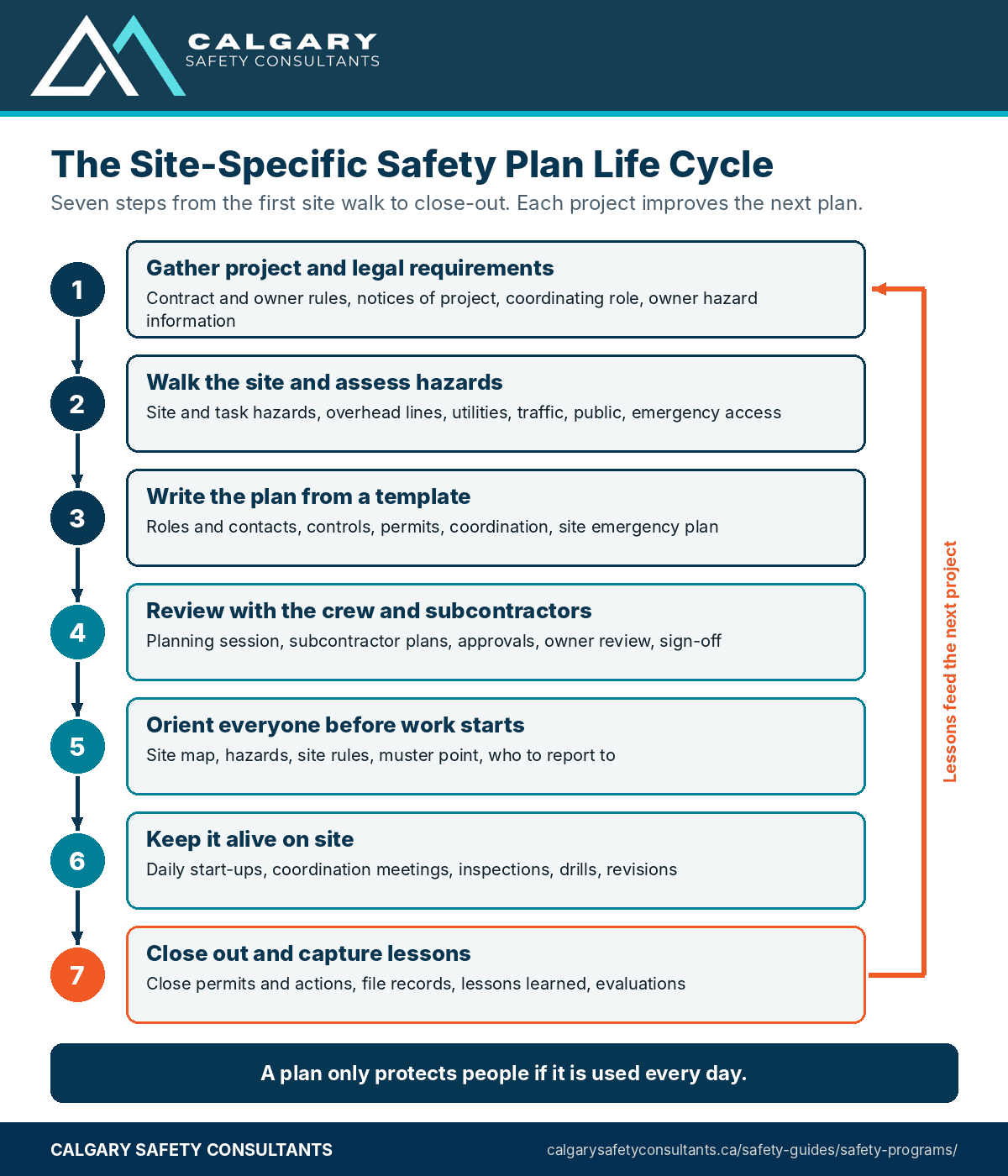
Most site-specific safety plans are written under time pressure, often between contract award and mobilization. You can work quickly and still produce a plan that means something if you work in this order. On a typical small to mid-size project, these steps fit into one to two weeks.
- Start from a template. A good template keeps you from missing sections and lets you spend your time on the site-specific content. Our free template, below, follows the sections in this guide. Copy in what's common to all your projects, then replace every generic statement with the details of this site.
- Collect the project documents. Gather the contract safety requirements, owner site rules, drawings, schedule, subcontractor list and any hazard information the owner provides, such as hazardous materials surveys, utility locates and existing hazard assessments. Note the owner's deadline for the plan and how long its review usually takes.
- Walk the site. Nothing replaces seeing it. Take the site map and a camera. Look for overhead lines, access and egress, ground conditions, drainage, neighbouring operations, public exposure and where the muster point and emergency access should be. Check cell coverage. Drive the route to the nearest emergency department and time it.
- Involve the crew and subcontractors. The foreman and the workers who'll do the job often know the hazards better than the estimator. Hold a short planning session with your supervisors and each subcontractor's lead, walk through the schedule phase by phase, and work through the hazard assessment together. It also builds buy-in, because people follow plans they helped write.
- Write it for the field. Use plain language, short sections, tables and the site map. Put the emergency plan and contact list at the front or on a tab. If a supervisor can't find the emergency plan in under a minute, it's too long or badly organized.
- Attach what's specific, reference what's general. Attach site-specific job hazard analyses, fall protection and lift plans, the site drawing and the emergency plan. Reference company procedures by name rather than copying them in.
- Review and sign it. Have the superintendent and project manager review the plan against the checklist, send it to the owner if required and respond to comments quickly. Get each subcontractor's supervisor to acknowledge it before their crew starts.
- Launch it on site. Run the first orientation from the plan, post the site map, contact list and emergency plan, and hold the first coordination meeting before or on the first day of work.
Our checklist, below, is a quick way to review a plan before work starts, whether it's your own or one a subcontractor has submitted. Once you've built a few plans this way, keep your best one as a model. The next plan will take half the time.
How to Review a Subcontractor's Site-Specific Safety Plan
If you're the prime contractor, you'll receive plans as well as write them. A quick, consistent review protects your site and shows the due diligence the law and owners expect. You don't need to rewrite a subcontractor's plan. You need to know whether it shows that the subcontractor understands this site and its own hazards, and whether it fits your site plan.
Look for these signs of a plan that's ready:
- It names this project, this site and the subcontractor's supervisor, with a working phone number
- Its hazards match the scope of work, with specific controls and attached job hazard analyses or procedures
- It includes the specific plans its work needs, such as a fall protection, lift or confined space rescue plan
- It commits to your site orientation, rules, permits, emergency plan and incident reporting
- Training and equipment records match the tasks and are current
- It lists any sub-subcontractors the subcontractor will bring to site
Watch for the red flags: another project's name left in the document, a hazard list that doesn't match the work, an emergency section that doesn't mention your muster point, or no supervisor named at all. Send the plan back with specific comments, agree on fixes before mobilization and keep a record of your review and the accepted version. Our guides on managing contractor safety and contractor prequalification cover the steps before and after this review.
Keep the Plan Alive During the Project
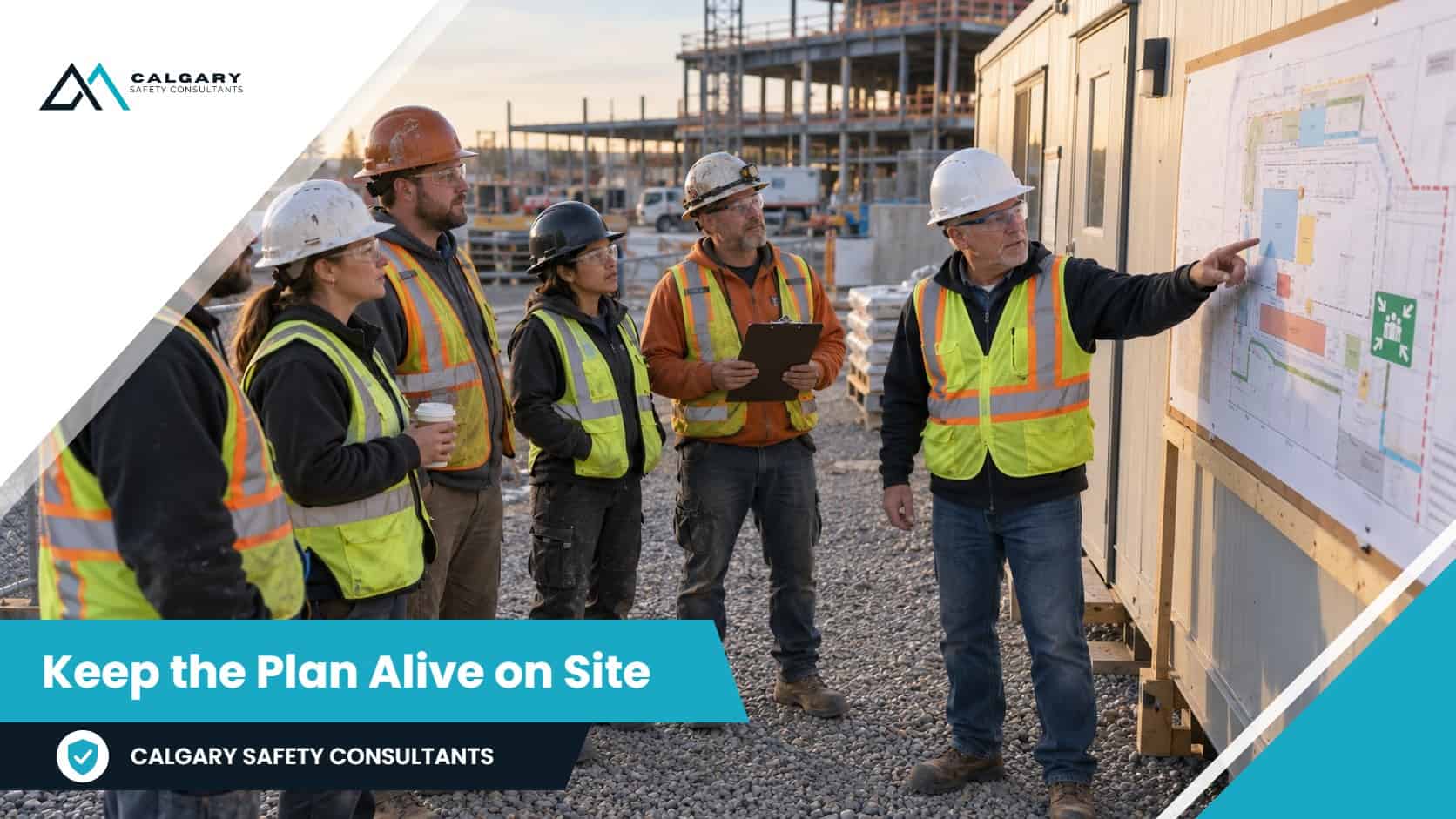
The biggest weakness of most site-specific safety plans is that they're written for the owner, filed in the site trailer and never opened again. The plan only protects people if it's used every day.
- Use it in orientation. Walk every new worker through the site map, the hazards, the site rules and the emergency plan, and show them where the plan is kept.
- Bring it to meetings. Use the plan as the agenda for coordination meetings: what's changing this week, which crews will overlap, which permits are coming up and whether the emergency plan still fits.
- Check it during inspections. Compare what's happening on site with what the plan says. If they don't match, either the work needs to change or the plan does.
- Update it when things change. Revise the plan at each review trigger, record the change and brief the people affected. A new phase of work, such as moving from excavation to structure, often needs a new section.
- Test the emergency plan. Run a drill early in the project and after major changes, and check that the muster point, alarm and rescue equipment still work for the current site layout. Time how long the head count takes.
- Ask the crews. Spot-check a few workers each week: where's the muster point, who's your first aider, what's the biggest hazard on your task today? Their answers tell you whether the plan has reached the people it's meant to protect.
There are some reliable signs that a plan has stopped working: the revision log hasn't changed in a month while the site has, the posted site map shows a laydown area that's now a building, new workers start before they're oriented, or field-level hazard assessments keep listing hazards the plan doesn't mention. Any one of these is a prompt to review the plan with your supervisors this week, not at the end of the project.
Close Out the Plan at the End of the Project
Close-out is the step most often skipped, and it's where the next project's plan gets better. As the project winds down, update the plan for the final phase, which often brings its own hazards: demobilizing equipment, removing scaffolds and guardrails, commissioning and energizing systems, working around the owner's operating systems and handing over areas to occupants while work continues nearby. Crews thin out and attention drifts in the final weeks, so this phase deserves the same planning as the first.
- Confirm all permits are closed and all corrective actions are complete
- Remove temporary hazards, such as open excavations, fuel storage and temporary electrical, or hand them over formally to the owner
- Collect and file the plan, revisions, orientation records, inspections, meeting minutes, incident reports and training records together
- Hold a short lessons-learned review with supervisors and subcontractors: what worked, what didn't and what should change in the template
- Evaluate subcontractor safety performance for future work
- Keep the records for the period your legislation, owner contract and certification program require
The lessons-learned review only takes an hour, but it's worth more than any other part of close-out. Ask three questions: what hazards did we miss in the original plan, what slowed us down, and what would we do differently next time? Then update your template and your estimating checklist so the next plan starts from a better place.
Those records are your evidence of due diligence, and the first thing an auditor or owner will ask to see.
How a Site-Specific Safety Plan Supports COR and Owner Reviews
A site-specific safety plan isn't a separate COR element, but it's strong evidence that your program works in the field. Energy Safety Canada's 2023 COR audit protocol has elements on hazard assessment, emergency response and other affected parties. The last asks about site-specific orientations for other employers and visitors, how hazards are communicated to them and how other employers are selected, monitored and evaluated. A well-used site plan touches all three.
In Ontario, IHSA's COR 2020 audit tool has an element on procurement and contractor management that covers leading coordination on multi-employer sites.
During an audit, site plans give auditors a sample of real field records to test against your written program. If your manual says every site gets a site-specific orientation and emergency plan, the auditor will ask to see them for a few sites and will check that workers on those sites can describe them. Plans that are consistent from site to site, with records that match, make that part of the audit straightforward.
Owners review site plans too, often as part of prequalification or before mobilization. They're looking for evidence that the plan was written for their site, that the emergency plan works there and that the contractor will coordinate its subcontractors. A contractor that sends a strong plan quickly stands out, and that reputation carries into the next bid. If you're working toward certification, our guides on how to prepare for a COR audit and how to prepare for a SECOR evaluation explain the wider process.
Workplace example
A Practical Workplace Example
Situation: Consider a mid-size general contractor in British Columbia that won a contract to build a two-storey commercial building on a busy corner lot. The owner's contract required a site-specific safety plan within 10 days of award. In the past, the contractor had sent owners a copy of its company manual with a new cover page. On its last project, an ambulance had gone to the wrong entrance and lost minutes finding an injured worker.
Action: The superintendent started from a template and walked the lot with the foreman and the excavation and steel subcontractors' leads. They marked overhead power lines, sidewalk exposure, laydown and a muster point, and drove the hospital route. They filed the notice of project, built the hazard assessment together, attached the fall protection plan for the steel erection and set up a weekly coordination meeting. The site drawing, posted at the entrance, showed first aid, the muster point and the ambulance meeting point.
Result: The owner accepted the plan on first review. Over the five-month project, the plan was revised four times as phases changed, and two near misses involving overhead work were caught and resolved at coordination meetings. The contractor now uses the same process, and the lessons from this project, on every new job.
Common Site-Specific Safety Plan Mistakes to Avoid
- Renaming the company manual. A plan that would fit any site doesn't help on this one. Owners and auditors spot it immediately.
- A generic emergency plan. No muster point, no hospital route and "call 911" as the rescue plan for work at heights or in confined spaces.
- Writing it without visiting the site. The hazards that hurt people are often the ones you only see in person.
- Leaving out subcontractors. The plan has to cover every employer on site, and their supervisors need to know it.
- No names. Roles without names and phone numbers mean no one is clearly responsible.
- Writing it once and filing it. Sites change every week. A plan with no revisions after month one probably isn't being used.
- Too long to use. A 200-page plan no one can navigate is as unhelpful as no plan at all.
- Missing the shared responsibilities. Each employer controls its own hazards, but no one owns the shared guardrail, access road or first aid response.
- Leaving out the public. Sidewalks, neighbours and building occupants need protection that's planned, not improvised on delivery day.
- Not checking tickets and equipment before work starts. Finding out after an incident that an operator wasn't qualified is too late.
- Sending the plan the night before mobilization. Owners need time to review it, and crews end up waiting at the gate while it's fixed.
- Skipping close-out. Without a lessons-learned review, the same gaps show up on the next project.
Audit perspective
What an Auditor Expects to See
An auditor or owner reviewing a site-specific safety plan wants to see a plan that clearly belongs to the site, and evidence that it was used. That means site hazard assessments with controls, a site emergency plan with real details, orientation records that match the people on site, coordination meeting minutes, inspection records, revision history and subcontractor acknowledgements.
Interviews tell the rest of the story. Workers on site should be able to point to the muster point, say who to report to and describe the main hazards of their work. Supervisors should know what triggers a plan review and when the last one happened. Gaps between the plan and those answers are where audit marks and owner confidence are lost.
Calgary Safety Consultants helps employers build site plans and safety programs and prepare for COR and SECOR audits; we don't issue certificates. CORs and SECORs are issued through the applicable certifying partner.
The Bottom Line
A site-specific safety plan turns your safety program into a plan for one site: who's in charge, what the hazards are, how they're controlled, how employers coordinate and what happens in an emergency. The law in most of Canada doesn't use the name, but it does require the pieces, and owners often require the plan itself.
Start from a template, walk the site, involve the people who'll do the work, keep the plan current while the project runs and close it out properly. Done that way, the plan protects your crew and gives owners and auditors the evidence they want to see.
Download the Site-Specific Safety Plan Template and Checklist
Two free downloads go with this guide.
- Site-Specific Safety Plan Template (PDF). A fillable template with clickable checkboxes that follows the sections in this guide, from project and site information to the site emergency plan, review triggers and close-out.
- Site-Specific Safety Plan Checklist (PDF). A short fillable checklist for reviewing a plan, your own or a subcontractor's, before work starts and at each review point.
Click either button to download the file. Adapt both to your own projects, sites and contracts.

About the author
John Duplessis, B.Sc., CRSP
John Duplessis is a Canadian Registered Safety Professional with more than 30 years of occupational health and safety experience in oil and gas, construction, green energy, midstream operations and industrial project work. He is an external auditor with Energy Safety Canada.