Find clear answers to common questions about our safety consulting, training, COR support, and OH&S program development services.
What workplace safety training do employees need?
The workplace safety training employees need depends on their job duties, the hazards they may be exposed to, the province they work in, and the company’s internal safety requirements. Common training may include WHMIS, workplace violence and harassment prevention, incident reporting, hazard assessment, emergency response, PPE, supervisor responsibilities, TDG, and task-specific training for higher-risk work.
The goal is to make sure workers understand the hazards of their work, know how to follow safe work procedures, and can meet the training expectations required by the employer’s safety program and applicable occupational health and safety legislation.
Do you offer online safety training?
Yes. We provide online safety training options that allow workers to complete training from their own location and at a time that works with operational needs. Online training can be useful for employers with multiple workers, changing schedules, remote worksites, or employees located in different cities or provinces.
Online training also helps employers maintain consistent course content, simplify access, and keep training records organized.
Can training be delivered virtually or in person?
Yes. Workplace safety training can be delivered online, virtually, or in person depending on the topic, workforce size, operational needs, and level of interaction required.
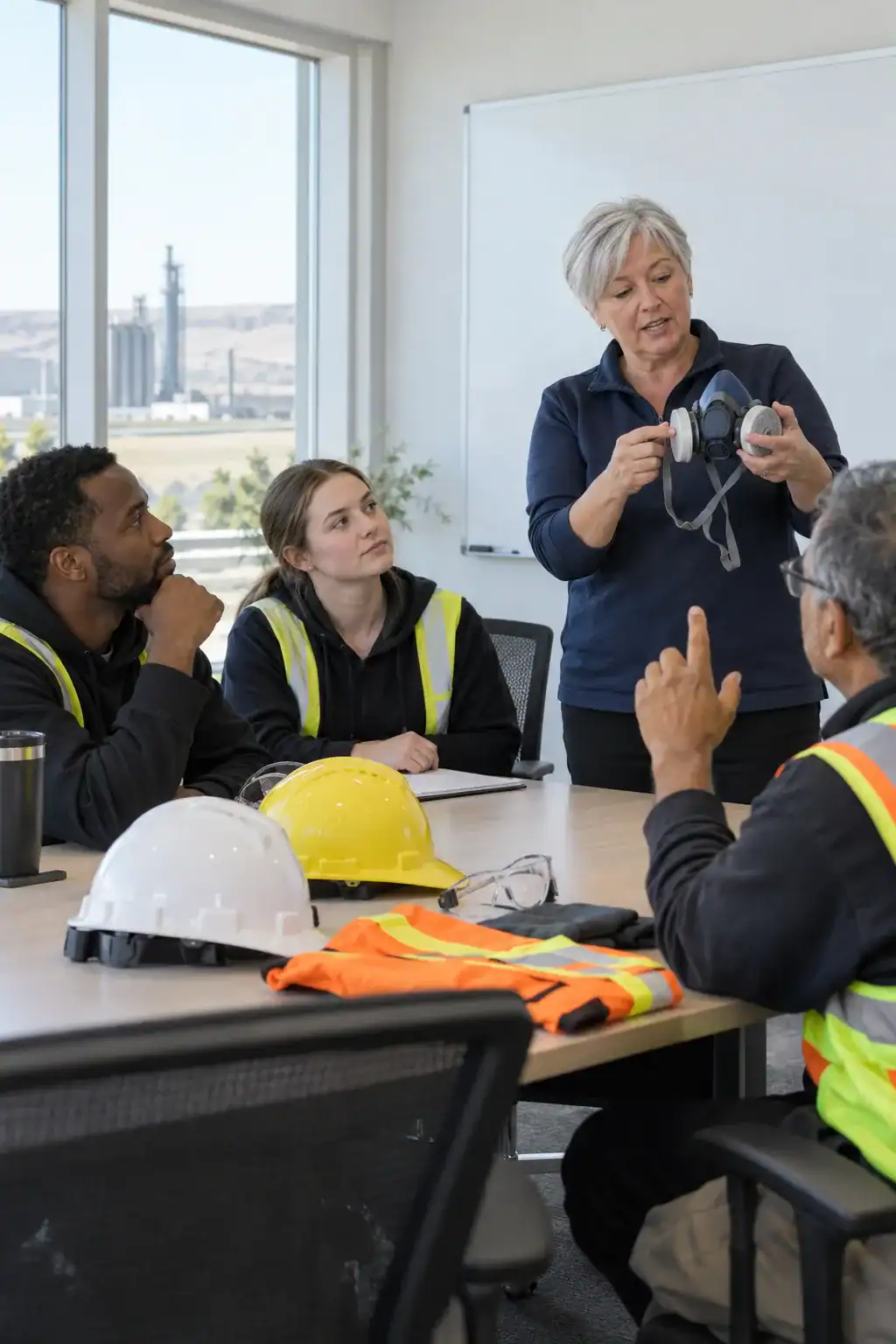
Virtual instructor-led training is useful when employers want live instruction without bringing everyone into one location. In-person training may be preferred when the topic requires discussion, hands-on learning, site-specific examples, or direct supervisor and worker engagement.
Do you provide WHMIS training?
Yes. We provide WHMIS training for workers who may use, handle, store, or be exposed to hazardous products at work. WHMIS training helps workers understand hazard classes, labels, safety data sheets, safe handling practices, storage requirements, emergency information, and their responsibilities when working around hazardous products.
Employers should also make sure workers receive workplace-specific instruction on the actual hazardous products used at their site.
Do you provide TDG training?
Yes. We provide Transportation of Dangerous Goods training for workers who may handle, offer for transport, or transport dangerous goods. TDG training helps workers understand classification, documentation, safety marks, containment requirements, emergency response information, and the responsibilities involved in moving dangerous goods safely.
Training should reflect the type of dangerous goods being handled and the worker’s actual role in the transportation process.
Can you train supervisors and managers?
Yes. We provide training for supervisors and managers who are responsible for supporting workplace safety, communicating expectations, responding to hazards, participating in incident investigations, and ensuring workers follow safe work procedures.
Supervisor and manager training is important because frontline leadership has a direct impact on worker behaviour, corrective action follow-through, documentation quality, and the overall strength of the safety program.
Can training be customized to our workplace?
Yes. Training can be customized to reflect your workplace hazards, industry, equipment, procedures, workforce, and provincial requirements. Customized training is especially useful when generic training does not fully address the real risks workers and supervisors face in the field.
This can help make training more practical, easier to apply, and more useful for improving day-to-day safety performance. Our Custom Safety Training packages start at $1,499 plus GST, delivered as PowerPoint and handouts, narrated video or hosted online.
Do you provide training for employers in Alberta, BC, and Saskatchewan?
Yes. We provide workplace safety training support for employers in Alberta, British Columbia, and Saskatchewan. Training can be delivered to support provincial OHS requirements, company safety program expectations, COR or SECOR preparation, supervisor development, and worker competency.
For employers operating across more than one province, training can also be structured to support consistency while still accounting for provincial differences.