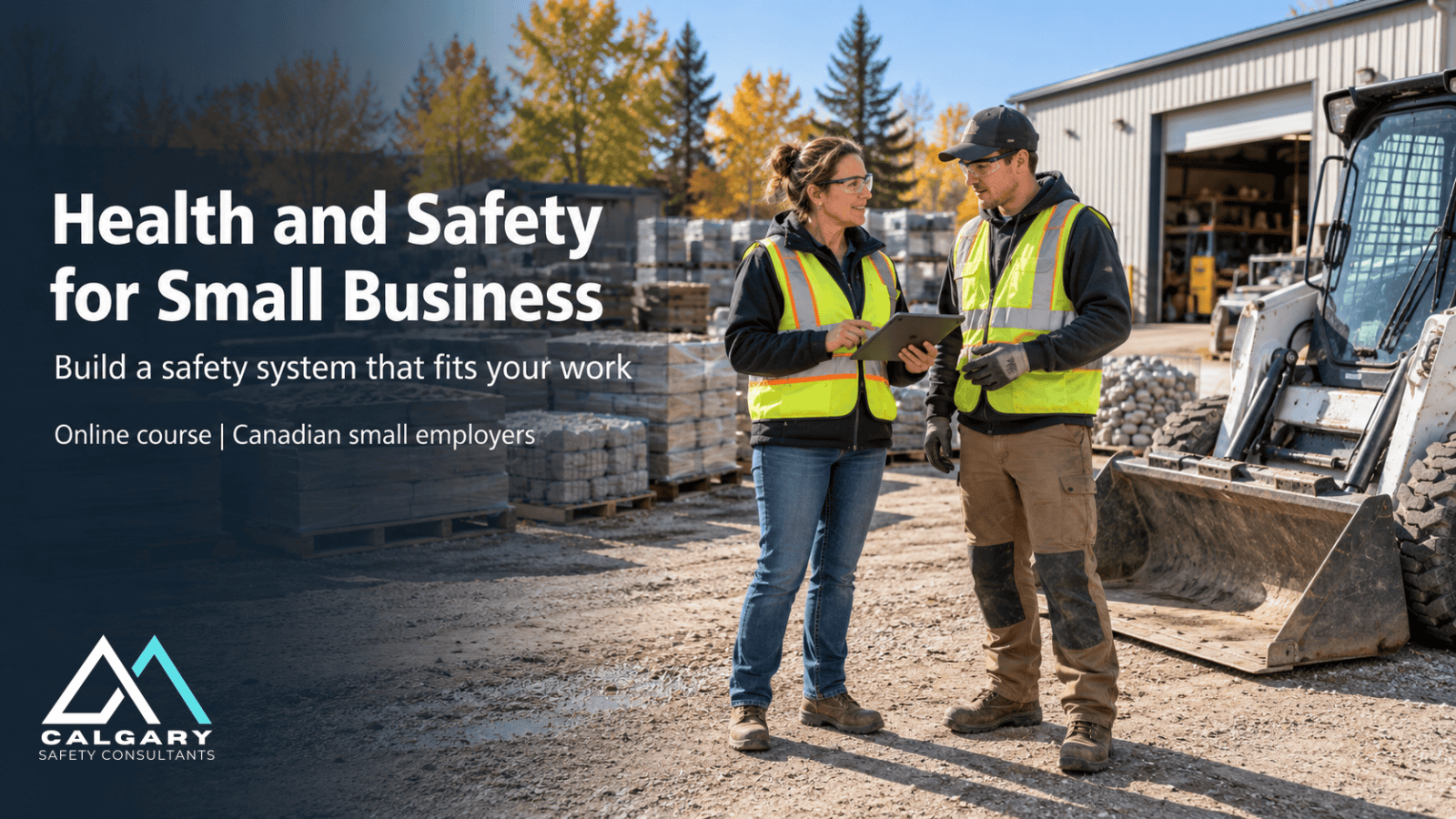
Health and Safety for Small Business
Once you have registered and enrolled, scroll to the Course Content section at the end of this page to begin your lessons.
Table of Contents
Our online small business safety training helps owners, operators, managers and supervisors build a health and safety system that fits the way their business really works. This self-paced, foundation-level course follows The Small Business Health and Safety Playbook through 24 narrated lessons: your legal duties in Canada’s 14 OH&S jurisdictions, who does what, hazard assessment, the hierarchy of controls, contractors, training and supervision, inspections and maintenance, incidents and emergencies, records and leader review, and a 30-day plan to put a working system in place.
Need training for your team? For online group training, buy your enrolments here, then complete our Group Training Student Information form so we can set up each learner’s account. If you’d like hands-on help building your program, see our workplace safety consulting services.
For an overview of what this course covers and how it helps you build a safety program for your small business, see our Small Business Health and Safety Training page.
Learn more about how our online safety training works.
Most small businesses don’t get hurt by hazards nobody knew about. They get hurt by a guard that was set aside, a hazard assessment nobody discussed, a contractor nobody briefed, or a near miss nobody followed up. A working safety system closes those gaps, and it pays off in day-to-day results: fewer serious injuries and WCB claims, less downtime, smoother client and contractor prequalification, and a clear record of the reasonable steps you took.
This is foundation-level training. It isn’t a certification, it doesn’t make anyone competent for a specific task, it isn’t legal advice, and it doesn’t replace your jurisdiction’s OH&S law or your business’s own hazard assessments, procedures and training. It isn’t approved by any regulator.
Online Small Business Safety Training Course at a Glance
Price: $79.99 CAD plus GST per learner
Delivery: 100% online and self-paced
Course format: 24 narrated video lessons in six modules, with written lesson notes, worked examples, case studies, decision points and knowledge checks
Course length (estimated): About 16 to 18 hours, including about 14.7 hours of lesson video plus the knowledge checks and final exam
Assessment: A three-question knowledge check after every lesson (100% to continue) and a 15-question final exam (80% to pass), with unlimited retries
Includes: Downloadable Student Reference Guide with a card for every teaching slide, study pages, jurisdiction reference tables and 17 supporting resources
Certificate: Certificate of Completion
Coverage: all 14 Canadian OH&S jurisdictions
What Does Online Small Business Safety Training Cover?
This small business safety training walks through a complete safety management system, one building block at a time. Each lesson connects the content to decisions owners and supervisors make every week, and ends with a practical step you can take in your own business.
You’ll learn how to:
- Explain why safety is part of running a small business, and why a clean injury record doesn’t prove your risks are controlled.
- Describe your legal duties as a small employer, how they differ across Canada’s 14 OH&S jurisdictions, and what due diligence means.
- Set up what a small employer actually needs, and give owners, supervisors, workers and contractors clear duties.
- Assess hazards at the three levels, use the seven-step method to build a job hazard analysis (JHA), and keep it current with field-level hazard assessments (FLHAs).
- Choose controls using the hierarchy of controls, verify they work, and protect the critical controls and changes that matter most.
- Manage contractors, temporary workers and shared workplaces so everyone knows who controls what.
- Build training, orientation and supervision that produce real competence, then check the work with inspections and maintenance.
- Report incidents, respond safely, find immediate and root causes, and fix them.
- Plan for emergencies, rescue and recovery, and keep the records, measures and leader reviews that show the system works.
- Avoid the common mistakes that lead to fines or incidents, know when you need outside help, and follow a 30-day implementation plan.
Every lesson includes written notes, worked examples, case studies, decision points and a knowledge check, so learners practise making sound decisions rather than memorizing rules.
Small Business Health and Safety Requirements in Canada
Canada has 14 OH&S jurisdictions: the federal government, 10 provinces and 3 territories. Most small businesses fall under the province or territory where the work happens, while banks, airlines, interprovincial trucking and other federally regulated work falls under the Canada Labour Code. In every jurisdiction, employers have a general duty to protect their workers’ health and safety, and workers have the right to know, to participate and to refuse unsafe work.
The details change with your size and location. The worker counts that trigger a written program, a joint committee or a health and safety representative differ from one jurisdiction to the next, and so do serious-incident reporting rules and maximum fines. The Criminal Code (section 217.1) also places a legal duty on anyone who directs work to take reasonable steps to prevent bodily harm. The Student Reference Guide includes jurisdiction reference tables for all of these, checked against official sources in October 2026. Laws change, so always confirm the current official text with your regulator.
Who Should Take This Small Business Safety Course?
This course is built for the people who run and supervise small businesses, in any industry and any region of Canada.
It’s suitable for:
- Small business owners, operators and senior leaders
- Managers, supervisors, forepersons and crew leads
- Office managers, administrators and HR staff who look after safety
- Safety coordinators and joint committee members or health and safety representatives in small workplaces
- Contractors and trades businesses that need a working program for clients or prequalification
- New business owners hiring their first workers
Many owners take the course with a supervisor so they can build the system together, and use the Student Reference Guide’s templates as they go.
Online Small Business Safety Training Course Features
Our online small business safety training is designed to be practical, realistic and easy to apply to the work you actually do.
Course features include:
- 100% online and self-paced
- 24 narrated video lessons in six modules
- Written lesson notes with learning objectives, worked examples, case studies and decision points
- Real Canadian small-business scenarios across many industries and regions
- A three-question knowledge check after each lesson, with feedback after each answer
- A 15-question final exam drawn from all six modules
- A downloadable Student Reference Guide with a card for every teaching slide, study pages, jurisdiction reference tables and 17 supporting resources
- A Certificate of Completion
The supporting resources include a one-page safety system map, a responsibility matrix, a CSC Energy Sources hazard prompt, JHA and FLHA templates, a contractor responsibility map, training and inspection tools, a corrective-action log, an investigation worksheet, an emergency quick sheet, a monthly safety dashboard and a 30-day implementation checklist. The course follows The Small Business Health and Safety Playbook, so learners who have the book will recognize the same tools, but the course stands on its own.
Online Small Business Safety Training Course Modules
The course is organized into six modules. Each lesson is one complete narrated video with written notes and a knowledge check.
Module One: Getting Oriented
Module One gets you oriented: why safety is part of running a small business, your legal duties as a small employer in Canada, what a small employer actually needs in a working safety system, and who does what, from the owner to supervisors, workers and contractors.
Lessons:
- Lesson One: Why Safety Matters in a Small Business
- Lesson Two: Your Legal Duties as a Small Employer in Canada
- Lesson Three: What a Small Employer Actually Needs
- Lesson Four: Roles and Responsibilities
Module Two: Finding Hazards
Module Two is about finding hazards: hazards, risk and the three levels of assessment, the seven-step hazard assessment method that produces a job hazard analysis (JHA), and field-level hazard assessments (FLHAs) that keep assessments current as conditions change.
Lessons:
- Lesson Five: Hazards, Risk and the Three Levels of Assessment
- Lesson Six: The Seven-Step Hazard Assessment Method
- Lesson Seven: Field-Level Hazard Assessments and Keeping Assessments Current
Module Three: Controlling Hazards
Module Three is about controlling hazards: the hierarchy of controls, choosing controls and verifying they work, critical controls and managing change, and keeping contractors, temporary workers and shared workplaces under control.
Lessons:
- Lesson Eight: Controlling Hazards: The Hierarchy of Controls
- Lesson Nine: Choosing Controls and Verifying They Work
- Lesson Ten: Critical Controls and Managing Change
- Lesson Eleven: Contractors, Temporary Workers and Shared Workplaces
Module Four: Building Competence and Checking the Work
Module Four builds competence and checks the work: training and competency, orientation and supervision, inspections and defect control, and maintenance that closes the loop on what inspections find.
Lessons:
- Lesson Twelve: Training and Competency
- Lesson Thirteen: Orientation, Supervision and Keeping Competence Current
- Lesson Fourteen: Inspections and Defect Control
- Lesson Fifteen: Maintenance and Closing the Loop
Module Five: Learning and Responding
Module Five covers learning and responding: reporting incidents and the first response, finding causes and fixing them, planning for emergencies, rescue, exercises and recovery, and the records, measures and leader review that show whether the system works.
Lessons:
- Lesson Sixteen: Incident Reporting and the First Response
- Lesson Seventeen: Finding Causes and Fixing Them
- Lesson Eighteen: Planning for Emergencies
- Lesson Nineteen: Rescue, Exercises and Recovery
- Lesson Twenty: Records, Measures and Leader Review
Module Six: Keeping It Working
Module Six keeps it working: why safety programs fail, the common mistakes that lead to fines or incidents, when you need outside help, and a 30-day plan to put a working system in place.
Lessons:
- Lesson Twenty-One: Why Safety Programs Fail
- Lesson Twenty-Two: Common Mistakes That Lead to Fines or Incidents
- Lesson Twenty-Three: When You Need Outside Help
- Lesson Twenty-Four: Your 30-Day Implementation Plan
Complete Your Online Small Business Safety Training
Register, enrol on this page, then work through the lessons in order at your own pace. After each video, complete the lesson’s three-question knowledge check. You need all three answers correct (100%) to move on, and you can retry as many times as you need, with feedback after each answer to help you learn.
After Lesson 24, complete the 15-question final exam, which draws on all six modules. You need 12 correct answers (80%) to pass, and you can retake it as many times as you need. Once you’ve completed all 24 lessons, their knowledge checks and the final exam, you can download your Certificate of Completion.
The certificate shows that you completed foundation-level online training in small business health and safety. It isn’t a professional designation, and it doesn’t confirm that any business’s safety program meets the law.
Frequently Asked Questions About Online Small Business Safety Training
Does this small business safety training cover every province and territory?
Yes. The course covers all 14 Canadian OH&S jurisdictions: the federal government, the 10 provinces and the 3 territories. It teaches the principles they share and shows where small-employer duties differ, and the Student Reference Guide includes jurisdiction reference tables for Acts and regulators, program and committee thresholds, hazard assessment, serious-incident reporting, fines and worker rights. Always confirm the current rules with your regulator.
Who should take small business safety training?
Owners, operators, managers, supervisors and the people who help them run safety in a small business, in any industry. It’s especially useful if you’re building a program for the first time, hiring your first workers, or need a working system for clients or prequalification.
How long does the online small business safety course take?
We estimate about 16 to 18 hours. The 24 lesson videos run about 14.7 hours in total, and the knowledge checks and final exam add time depending on your pace. You can stop and return at any time.
Do I need The Small Business Health and Safety Playbook?
No. The course stands on its own. It follows the Playbook’s chapters and tools, so learners who own the book can read further in each chapter, and each lesson’s study page in the Student Reference Guide lists the matching sections.
Will this course write my safety program for me?
No. It teaches you how to build and run a working system, step by step, and the Student Reference Guide gives you 17 templates to adapt. If you’d like help writing or reviewing your program, our consultants can help.
Is there a final exam?
Yes. After Lesson 24 there’s a 15-question final exam drawn from all six modules. You need 12 of 15 correct (80%) to pass, and you can retake it as many times as you need.
Do I receive a certificate?
Yes. You receive a Certificate of Completion after you complete all 24 lessons, their knowledge checks and the final exam. It records completion of foundation-level online training. It isn’t a professional designation, and it isn’t approved by any regulator.
Can employers purchase training for several people?
Yes. Employers can buy online training for two or more learners on this page. After placing your order, complete our Group Training Student Information form with your order number and each learner’s details so we can set up their accounts.
Additional Small Business Health and Safety Resources
The resources below help you check the requirements where you work and strengthen your own program. Use the official sources to read the current legislation and guidance, and our services when your program needs more than training.
Canada Labour Code, Part II
Issued by: Government of Canada (Justice Laws website)
The federal occupational health and safety law for federally regulated workplaces. Use it if your business is federally regulated, such as interprovincial trucking.
Canada Labour Code, Part II
Criminal Code, section 217.1
Issued by: Government of Canada (Justice Laws website)
The legal duty on anyone who directs how work is done to take reasonable steps to prevent bodily harm.
Criminal Code, section 217.1
Alberta OHS Act, Regulation and Code
Issued by: Government of Alberta
Alberta’s occupational health and safety legislation and guidance for employers.
Alberta OHS Act, Regulation and Code
WorkSafeBC
Issued by: WorkSafeBC
British Columbia’s Workers Compensation Act, OHS Regulation and guidance for employers.
WorkSafeBC
Saskatchewan workplace safety
Issued by: Government of Saskatchewan
Saskatchewan’s occupational health and safety requirements and resources for employers.
Saskatchewan workplace safety
Workplace Safety Consulting Services
Issued by: Calgary Safety Consultants
Our consulting support for safety programs, hazard assessments, safe work procedures, audits and COR and SECOR readiness across Western Canada.
Workplace Safety Consulting Services
Related courses: Understanding Canadian OH&S Legislation, Hazard Assessment and Control for Canadian Workplaces, FLHA Essentials for Workers and Working Alone and Lone Worker Safety for Canadian Workplaces.