Opens in a new tab
Health and safety consulting for employers across Alberta, British Columbia and Saskatchewan
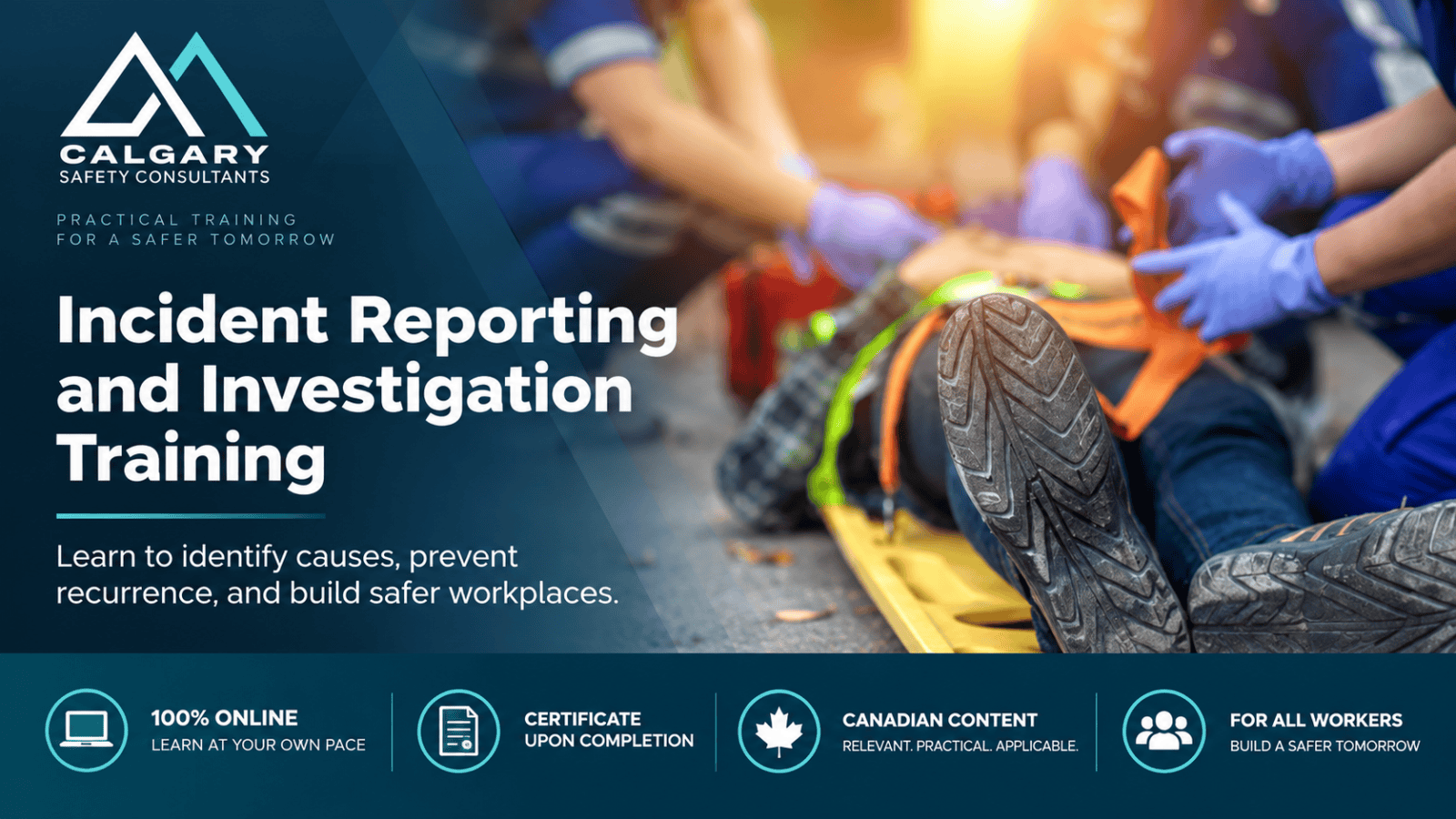
Online Incident Reporting and Investigation Training for Canadian workers
Course access and group enrolmentEach registration is for one named student. For an individual purchase, sign in to My Account using the email address and account used at checkout. For two or more students, purchase the required quantity, then submit each student’s full name and email address using our Group Training Student Information form. Separate student accounts and course-access instructions will be provided within 24 hours after we receive complete information. Training accounts must not be shared.Group discount: Buy 10 or more seats of the same course in one order and 10% comes off that course automatically at checkout.

Online Incident Reporting and Investigation Training

Go to the Course Content

Incident reporting is an important step in learning from workplace events and preventing recurrence. This online course introduces a practical framework for reporting, scene and evidence protection, cause analysis, corrective action and effectiveness review.

The self-paced program from Calgary Safety Consultants includes four modules, sixteen lessons, knowledge checks, a final assessment and a certificate upon successful completion.

Need virtual or group training for your team? For online group training, buy your enrolments here, then complete our Group Training Student Information form so we can set up each worker’s account.

For virtual or instructor-led training, explore our incident reporting and investigation training services.

Table of Contents

Course Overview

This online Incident Reporting and Investigation Training course helps workers, supervisors, managers, safety committee members, and occupational health and safety personnel build a consistent process for reporting events, gathering evidence, finding causes, and preventing recurrence.

The course is self-paced and designed for practical use in Canadian workplaces.

  • Delivery: 100% online and self-paced
  • Estimated completion time: approximately 6.5 to 8 hours, including videos, reading, and assessments
  • Assessment: a three-question knowledge check after every lesson and a six-question final assessment
  • Certificate: certificate available after all required content and assessments are successfully completed
  • Price: $49.99 CAD plus GST

This is awareness-level training. It isn’t investigator certification, regulator approval, legal advice or proof that a workplace’s training, reporting or investigation requirements have been met.

The employer and other duty holders retain their legal responsibilities.

A person leading an investigation must have the authority, knowledge, skills and jurisdiction-specific qualifications required for the event, and must involve the committee, representative, regulator, police, coroner, technical specialist or other authority where required.

What the Course Covers

The course follows an incident from the first report through authorized investigation, cause analysis, corrective action, verification, trend analysis and organizational learning.

Learners examine the loss-causation chain, reporting responsibilities, investigation scope, team roles, evidence integrity, causal analysis, corrective and preventive measures, performance indicators and the leadership behaviours that support a positive reporting culture.

Rather than treating an incident as an isolated failure, the course shows how facts can reveal gaps in procedures, supervision, training, maintenance, communication, hazard controls, and management systems.

The emphasis is on evidence, fair treatment, practical controls, and learning—not blame.

Online Incident Reporting and Investigation Training for Canadian Workers

This course uses Canadian terminology and workplace examples.

The principles apply broadly, but reporting thresholds, notification timelines, record-retention duties, worker participation requirements, and regulator expectations vary by federal, provincial, and territorial jurisdiction.

Employers must apply the requirements that govern their workplace and should consult the appropriate authority when an event may be legally reportable.

Emergency, Notification and Scene-Control Limits

Emergency response and legal notification take priority over the course workflow. Apply the workplace emergency plan and the law that governs the event:

  • Call 911 and provide first aid or rescue within the responder’s training, equipment and authority. Do not enter an unsafe scene or create another casualty.
  • Stop work and control immediate hazards when it is safe and authorized to do so. Investigation never replaces emergency response, energy isolation or other critical controls.
  • Protect the scene and preserve original evidence. Do not move equipment, alter documents, delete electronic records or disturb a legally protected scene unless the governing law or authority permits it or an immediate life-safety exception applies.
  • Make required internal and external notifications through the designated duty holder and within the applicable deadline. An internal incident report does not replace notification to a regulator, police, coroner, workers’ compensation authority, environmental authority or another agency.
  • Coordinate with the authority controlling the scene. Do not collect, remove, test or release evidence, or interview a person, in a way that conflicts with a regulator, police, coroner or other lawful direction.
  • Protect personal, medical and privileged information. Share only what is authorized and necessary, and use qualified legal, engineering, occupational hygiene, medical or technical support when the facts require it.
  • Use interim controls without waiting for the final report when credible evidence identifies an immediate risk. Verify effectiveness and update the hazard assessment, procedures, training and maintenance as needed.

The training supports a systematic occupational health and safety program by connecting incident findings with hazard assessment, inspections, training, maintenance, document control, worker participation, and management review.

Who Should Take the Course?

  • Supervisors and managers who receive reports or lead investigations
  • Health and safety committee members and worker representatives
  • Occupational health and safety coordinators and advisors
  • Operations, maintenance, human resources, and quality personnel who support investigations
  • Workers who need to understand reporting expectations and how evidence is protected
  • Employers seeking a consistent incident reporting and investigation process across locations

Online Course Features

  • Four clearly organized modules with four lessons in each module
  • Practical explanations of incident reporting, evidence, root causes, corrective actions, and trend analysis
  • Canadian workplace context with reminders to confirm jurisdiction-specific legal duties
  • Lesson videos, written summaries, workplace application prompts, and student-guide references
  • Immediate lesson-level knowledge checks with unlimited attempts
  • A final assessment that measures understanding across the full course
  • Self-paced access suitable for individual learners and employer-managed training

Course Modules

The module and lesson numbering restarts within each module so learners can follow the same four-lesson rhythm throughout the course.

Module One: Foundations of Incident Reporting

  1. Core Concepts in Incident Reporting
  2. Loss Causation Chain
  3. Organizational Responsibilities for Reporting
  4. Building a Proactive Reporting Culture

Module Two: Incident Response and Data Gathering

  1. Purpose and Scope of Investigations
  2. Investigation Team and Data / Evidence
  3. Evidence and Data Integrity
  4. Root Cause Analysis

Module Three: Developing Corrective and Preventive Actions

  1. Analyzing Immediate and Root Causes
  2. Identifying Lack of Control
  3. Designing Corrective and Preventive Measures
  4. Communicating Findings and Lessons Learned

Module Four: Performance Measurement and Continuous Improvement

  1. Using Data for Trend Analysis
  2. Measuring the Effectiveness of Corrective Actions
  3. Integrating Incident Findings into Safety Systems
  4. Leadership and the Culture of Loss Prevention

Complete Your Online Incident Reporting and Investigation Training

Work through the lessons in order, watch each available lesson video, review the written material, and complete the knowledge check before progressing. Every lesson knowledge check contains three single-choice questions and requires a perfect score.

After all required lessons are complete, finish the six-question final assessment with a score of at least 80% to meet the course assessment requirement.

Use the downloadable student guide through the protected learner workflow as a reference during training and after completion.

Employers should supplement this course with workplace-specific procedures, reporting contacts, forms, emergency arrangements, and jurisdictional requirements.

Frequently Asked Questions About Online Incident Reporting and Investigation Training

Is this Incident Reporting and Investigation training valid across Canada?

The investigation and prevention principles are broadly useful across Canada, but the course isn’t legal validation for every jurisdiction.

Reporting thresholds, notification deadlines, scene-preservation rules, investigator competency, worker participation, report content and retention duties vary by jurisdiction and industry.

The employer must confirm the requirements that govern the workplace and event.

Do I receive an Incident Reporting and Investigation certificate?

Yes. A Certificate of Completion is available after the learner completes the required content and passes the assessments. It records course completion only; it isn’t investigator certification, regulator approval or proof of legal competency or compliance.

How long does the online Incident Reporting and Investigation course take?

Plan approximately 6.5 to 8 hours for videos, written material, workplace application, and assessments. Actual time varies by experience and review needs.

Who should take Incident Reporting and Investigation training?

The course is especially useful for supervisors, managers, safety committee members, worker representatives, investigators, and occupational health and safety personnel. Workers also benefit from understanding how and why incidents and near misses should be reported.

Does the course include root cause analysis and corrective action training?

Yes. Learners distinguish immediate causes, contributing factors, underlying or root causes and control gaps, then connect the analysis to corrective and preventive measures, accountability, verification and continual improvement.

Course completion alone doesn’t establish that a learner is competent to lead every investigation or use every analytical method.

Can employers purchase training for multiple workers?

Yes. Employers can buy Incident Reporting and Investigation Training for two or more workers right here on this page.

After placing your order, please also complete our Group Training Student Information form with your order number and each learner’s name and email address, so we can set up their individual accounts.

Employers should retain completion records according to verified legal, contractual, audit and organizational requirements, including any applicable legal hold.

Does online Incident Reporting and Investigation training replace workplace-specific training?

No. This course provides core knowledge and a practical framework.

Employers must still provide workplace-specific procedures, reporting contacts, forms, site hazards, emergency arrangements and legally required instruction, then verify that assigned investigators can apply the process under representative conditions.

Additional Incident Reporting and Investigation Resources

Reporting and investigation training is most effective when learners connect the course framework to the procedures, forms and legal requirements used in their workplace. The sources below were reviewed on November 6, 2026.

They support further review but don’t replace current jurisdiction- and event-specific requirements.

Incident Reporting Forms and Workplace Reference Materials

  • Incident Management Student Guide: use the protected learner copy to review lesson concepts, key terms, loss causation, investigation methods, corrective actions, and continuous-improvement practices.
  • Workplace incident-reporting procedure: confirm who receives reports, which events must be escalated, notification timelines, scene-control responsibilities, and after-hours contacts.
  • Investigation forms and evidence tools: keep an incident report, witness statement form, interview notes, photograph and evidence log, event timeline, causal-analysis worksheet, and investigation report template ready for use.
  • Corrective-action register: record each action, assigned owner, target date, priority, completion evidence, verification method, and effectiveness review.
  • Emergency and return-to-work resources: coordinate investigation activities with emergency response, first aid, injury management, modified work, and privacy requirements.

Canadian Incident Reporting and Investigation Guidance

Reporting thresholds and investigation duties differ across Canadian jurisdictions.

Before disturbing a serious-incident scene, confirm the governing law and whether the regulator, police, coroner, committee, representative, union, workers’ compensation authority, environmental authority or another agency must be notified.

The duty holder and required process can also differ by event and industry.

Using These Resources After an Incident

  1. Provide emergency assistance and control immediate hazards within the responder’s training and authority.
  2. Make the required internal and external notifications through the designated duty holder and within the applicable legal deadline.
  3. Protect the scene. Gather physical, documentary and witness evidence only when authorized and without interfering with an authority controlling the scene.
  4. Analyze the event sequence, immediate causes, contributing factors, underlying causes and management-system gaps without defaulting to worker blame.
  5. Use the hierarchy of controls when selecting corrective actions. Assign ownership and resources, verify completion and effectiveness, protect privacy when communicating lessons, and update the management system.

Document Control, Confidentiality, and Follow-Up

Store incident-reporting and investigation records according to verified legal, workers’ compensation, insurance, contractual, audit, privacy, access and organizational requirements. Apply any litigation or legal hold and don’t destroy or overwrite relevant evidence.

Protect personal, medical and privileged information, preserve original evidence, document revisions and limit access to people with an authorized need.

Trend reviews, inspections, audits, worker feedback and management reviews should confirm whether actions remain effective and whether similar risks exist elsewhere.

Course Content

Module One – Foundations of Incident Reporting
Lesson One – Core Concepts in Incident Reporting
1 Quiz
M1L1 – Core Concepts in Incident Reporting – Knowledge Check
Lesson Two – Loss Causation Chain
1 Quiz
M1L2 – Loss Causation Chain – Knowledge Check
Lesson Three – Organizational Responsibilities for Reporting
1 Quiz
Lesson Four – Building a Proactive Reporting Culture
1 Quiz
M1L4 – Building a Proactive Reporting Culture – Knowledge Check
Module Two – Incident Response and Data Gathering
Lesson One – Purpose and Scope of Investigations
1 Quiz
M2L1 – Purpose and Scope of Investigations – Knowledge Check
Lesson Two – Investigation Team and Data / Evidence
1 Quiz
M2L2 – Investigation Team and Data / Evidence – Knowledge Check
Lesson Three – Evidence and Data Integrity
1 Quiz
M2L3 – Evidence and Data Integrity – Knowledge Check
Lesson Four – Root Cause Analysis
1 Quiz
M2L4 – Root Cause Analysis – Knowledge Check
Module Three – Developing Corrective and Preventive Actions
Lesson One – Analyzing Immediate and Root Causes
1 Quiz
M3L1 – Analyzing Immediate and Root Causes – Knowledge Check
Lesson Two – Identifying Lack of Control
1 Quiz
M3L2 – Identifying Lack of Control – Knowledge Check
Lesson Three – Designing Corrective and Preventive Measures
1 Quiz
Lesson Four – Communicating Findings and Lessons Learned
1 Quiz
Module Four – Performance Measurement and Continuous Improvement
Lesson One – Using Data for Trend Analysis
1 Quiz
M4L1 – Using Data for Trend Analysis – Knowledge Check
Lesson Two – Measuring the Effectiveness of Corrective Actions
1 Quiz
Lesson Three – Integrating Incident Findings into Safety Systems
1 Quiz
Lesson Four – Leadership and the Culture of Loss Prevention
1 Quiz
Final Quiz
Incident Reporting and Investigation – Final Assessment

Take this next

Workplace Emergency Response and Preparedness

See the course

Free Safety Guides

Related Safety Guides

Browse all Safety Guides

A practical root cause analysis method for Canadian workplaces: loss, event, immediate causes, human and job factors, system fixes, plus a free worksheet.

How a workplace incident investigation works in Canada: who to involve, witness interviews, root causes and fixes, plus a free form and quick guide.