Safety Guide
How to Complete a Formal Hazard Assessment
How to complete a formal hazard assessment in Canada: site, JHA, task and equipment assessments, legal rules by province, review cycles and free templates.
Tell us what's happening and we'll recommend the next practical step.
Once you have registered and enrolled, scroll to the Course Content section at the end of this page to begin your lessons.
Table of Contents
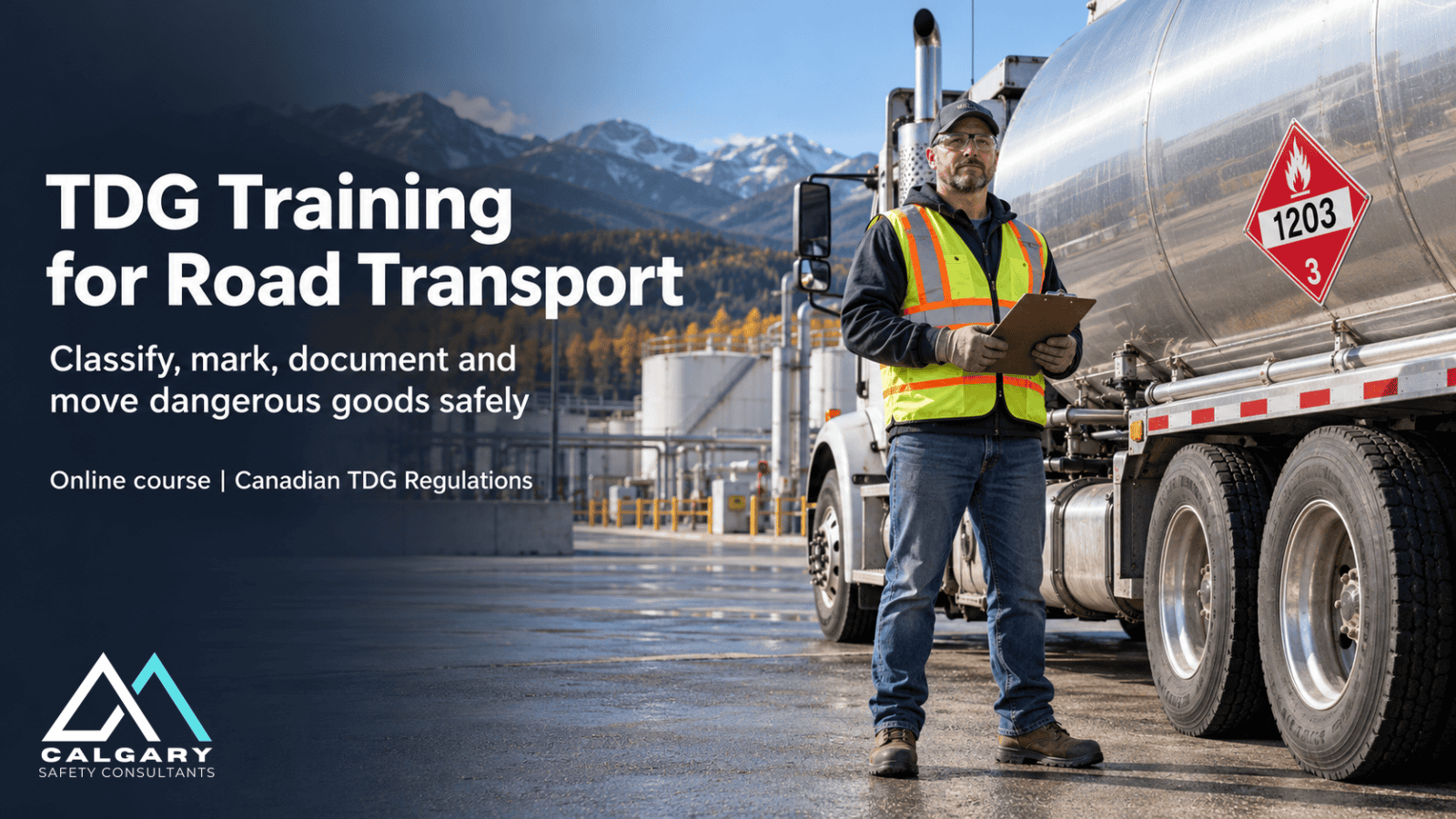
Our online TDG training teaches workers, drivers and supervisors how to handle, offer for transport, transport and receive dangerous goods by road under Canada’s Transportation of Dangerous Goods Act, 1992 and the Transportation of Dangerous Goods Regulations. This self-paced course follows a shipment from start to finish: classification and Schedule 1, the exemptions you’ll meet at work, means of containment, labels, marks and placards, shipping documents, loading and receiving, emergency response assistance plans, safe response to a release, Part 8 reporting, security and cross-border shipments. It’s current with the two 2026 amendments to the Regulations.
Need training for your team? For online group training, buy your enrolments here, then complete our Group Training Student Information form so we can set up each learner’s account. For more on TDG training options and your training duties, see our TDG training and certification page.
Learn more about how our online safety training works.
Dangerous goods move through ordinary workplaces every day: fuel in a slip tank, propane cylinders on a service truck, pails of corrosive cleaner on a pallet. When the people handling them understand classification, marks, documents and reporting, shipments move without delays, inspections go smoothly and responders get the information they need if something goes wrong. Good TDG practice can also reduce refused loads, roadside findings, and business disruption. Due diligence remains fact-specific and depends on the actual precautions, training, supervision, records, and decisions made for the shipment.
This course provides knowledge-based training for road transport. It is one input to the employer’s assessment and does not replace the current Regulations, product and shipment information, employer procedures, supervised practice, or verification that the person is adequately trained for the assigned duties. Under section 6.3 of the Regulations, the employer issues the TDG training certificate only when it has reasonable grounds to believe the employee is adequately trained and will perform the duties to which the training relates. Calgary Safety Consultants provides a Certificate of Completion, not the legal TDG training certificate, and the course is not approved by Transport Canada or another regulator because the Regulations do not establish course approval.
Delivery: 100% online and self-paced.
Course format: 24 narrated video lessons in six modules, with written lesson notes, workplace examples, decision points, and knowledge checks.
Course length (estimated): About 9.5 to 10 hours, including about 7.8 hours of lesson video plus the knowledge checks, practice worksheets, and final exam.
Assessment: A three-question knowledge check after every lesson (100% to continue) and a 25-question final exam (80% to pass), with unlimited retries.
Includes: A downloadable 154-page Student Reference Guide, quick references, safety-mark information, and 11 practice worksheets with answer keys. The Employer TDG Certificate Kit contains starting templates for the certificate, wallet card, and supporting records. The employer or self-employed person remains responsible for the adequate-training assessment, accurate completion and signature, retention, renewal, and inspector-response duties under Part 6.
Audience: Shippers, receivers, warehouse and dock workers, drivers, dispatchers, and supervisors who work with dangerous goods by road in Canada.
Price: $49.99 CAD plus GST.
This online TDG training course is organized around the decisions people make with real shipments. Each lesson explains the rule, shows it in a Canadian workplace example and asks you to apply it before you move on.
You’ll learn how to:
Every lesson includes written notes, workplace examples, decision points and a knowledge check. These exercises build understanding, but actual classification, exemption, containment, marking, documentation, reporting, and emergency decisions must use verified product and shipment information, the current Regulations, employer procedures, and the responsible duty holder’s authorization.
The Transportation of Dangerous Goods Act, 1992 and the Transportation of Dangerous Goods Regulations are federal law, administered by Transport Canada. The provinces and territories adopt the Regulations for road transport inside their own borders, so the same core rules apply to a delivery across town and to a load crossing the country. Inspectors can stop vehicles, examine goods and documents, and direct corrections.
Under Part 6 of the Regulations, anyone who handles, offers for transport or transports dangerous goods must be adequately trained and hold a training certificate, or work in the presence and under the direct supervision of someone who does. For road transport, a certificate expires 36 months after it’s issued.
Two amendments took effect in 2026: SOR/2026-112, published June 17, and SOR/2026-127, published July 1. Each includes a 12-month transitional provision, so organizations must verify which version they are using and the applicable transition end date before relying on older marks, documents, or practices. The course page was checked against the Act, the consolidated Regulations, and the two 2026 Canada Gazette amendments on November 6, 2026. The Regulations change often, so always use the current version.
This course is built for people whose work touches a dangerous goods shipment by road, whether they ship it, load it, drive it, receive it or supervise those who do.
It’s suitable for:
Employers often use the course for new hires, certificate renewal planning, and changes in duties or dangerous goods. A completion record may support a COR or SECOR audit, but it does not by itself establish adequate training, workplace implementation, audit readiness, or certification.
Our online TDG training is designed to be practical, accurate and easy to apply to your own shipments.
Course features include:
The course is organized into six modules. Each lesson is one complete narrated video with written notes and a knowledge check.
Module One explains why the TDG system exists and how the law works, who does what in a shipment, training certificates and direct supervision, and the key terms used throughout the Regulations.
Lessons:
Module Two covers the nine classes of dangerous goods, how a consignor classifies a product and assigns a packing group, and how to read Schedules 1, 2 and 3.
Lessons:
Module Three covers the quantity and special case exemptions you’ll meet at work, means of containment and their compliance marks, and how to load, secure and segregate dangerous goods.
Lessons:
Module Four covers labels and marks on packages and cylinders, placards and UN numbers on trucks, trailers, tanks and totes, placarding decisions, and keeping marks right as loads change.
Lessons:
Module Five covers preparing a shipping document, carrying, handing over and keeping documents, the carrier’s and driver’s duties on the road, and receiving and unloading dangerous goods.
Lessons:
Module Six covers emergency response assistance plans, safe initial actions at a release, Part 8 reporting of releases, losses, thefts and interference, and security and cross-border shipments. Emergency actions must follow the site and carrier plans, and people must act only within their training, equipment, authority, and ability to do so safely.
Lessons:
Register online, then work through the lessons in order at your own pace. After each video, complete the lesson’s three-question knowledge check. You need all three answers correct (100%) to move on, and you can retry as many times as you need, with feedback after each answer to help you learn.
After Lesson 24, complete the 25-question final exam, which draws on all six modules. You need 20 correct answers (80%) to pass, and you can retake it as many times as you need. Once you’ve completed all 24 lessons, their knowledge checks and the final exam, you can download your Certificate of Completion.
Your Certificate of Completion records that you completed this course. It is not the legal TDG training certificate and does not by itself prove adequate training, task authorization, regulatory compliance, or competence for every assigned duty. Under section 6.3 of the Regulations, the employer issues the legal training certificate only when it has reasonable grounds to believe the employee is adequately trained and will perform the duties to which the training relates.
Not by itself. Under section 6.3 of the TDG Regulations, your employer issues your TDG training certificate once it has reasonable grounds to believe you’re adequately trained. If you’re self-employed, you issue your own on the same test. This course provides knowledge-based training and a Certificate of Completion that the employer may consider with the person’s duties, experience, practical performance, procedures, and other training when applying the section 6.3 test.
For road transport, a TDG training certificate expires 36 months after it’s issued. For air it’s 24 months. A certificate doesn’t transfer between employers, so a new employer must assess you and issue its own.
The TDG Regulations don’t set up any course approval, so be cautious of claims that a course is government approved. What matters is that training covers your duties and that your employer is satisfied you’re adequately trained. This course is mapped to the training topics in section 6.2 of the Regulations.
Under section 6.1 of the TDG Regulations, a person who handles, offers for transport, or transports dangerous goods must be adequately trained and hold a training certificate in accordance with Part 6, or perform those activities in the presence and under the direct supervision of a person who is adequately trained and holds a certificate. That includes shippers, loaders, drivers, dispatchers and receivers.
Yes. The course was reviewed against SOR/2026-112 and SOR/2026-127, published in June and July 2026. Lesson 1 explains the changes and their transitional provisions. Users must still check the current consolidated Regulations and confirm which transition option applies to the shipment.
We estimate about 9.5 to 10 hours. The 24 lesson videos run about 7.8 hours in total, and the knowledge checks, practice worksheets and final exam add time depending on your pace. You can stop and return at any time.
No. This course covers road transport. Air and marine shipping need their own training, and Lesson 24 explains where those rules connect with a road leg to or from an airport or port.
Yes. Employers can buy online training for two or more learners on this page. After placing your order, complete our Group Training Student Information form with your order number and each learner’s name and email address. We set up each learner’s account and email course-access instructions.
The resources below help you check the current requirements and identify the information that must be verified for a shipment. Use the official sources to read the current Act and Regulations, and our services when your workplace needs more than training. The Regulations change often, so always use the current version.
Issued by: Government of Canada (Justice Laws website)
The full, current text of the Regulations, including Schedules 1, 2 and 3, the training requirements in Part 6 and the reporting requirements in Part 8.
Transportation of Dangerous Goods Regulations
Issued by: Government of Canada (Justice Laws website)
The Act that sets out the duties, inspector powers and offences behind the Regulations.
Transportation of Dangerous Goods Act, 1992
Issued by: Transport Canada
Transport Canada’s guidance, bulletins and updates on transporting dangerous goods, including training and certificates.
Dangerous goods
Issued by: Transport Canada
Canada’s national 24-hour emergency centre for dangerous goods, and the Emergency Response Guidebook used for the first actions at a release.
CANUTEC
Issued by: Calgary Safety Consultants
Our TDG training page, with an overview of who needs training, what employers must keep on file and how our training supports your certificate decisions.
TDG Training and Certification
Issued by: Calgary Safety Consultants
Our consulting support for carriers, warehouses and logistics operations, including safety programs, procedures and audit preparation.
Transportation, Warehousing and Logistics Safety Consulting
Related courses: Online WHMIS Training, Workplace Emergency Response and Preparedness, Hazard Assessment and Control for Canadian Workplaces and Understanding Canadian OH&S Legislation.
Take this next
Free Safety Guides
How to complete a formal hazard assessment in Canada: site, JHA, task and equipment assessments, legal rules by province, review cycles and free templates.
Manage driver fatigue at work: Canadian hours of service rules, OHS duties, fatigue management, trip planning and free checklists for drivers and supervisors.
Set up journey management for field crews: what a journey management plan covers, check-ins, overdue steps, working alone rules and free fillable templates.