On this page
- How WHMIS Training Online Supports Reducing Safety Violations
- Common Compliance Gaps Without WHMIS Training Online
- Why WHMIS Training Online Is More Effective Than Traditional Methods
- Integrating WHMIS Training Online Into Your Safety System
- Business Impact and Risk Considerations
- How Calgary Safety Consultants can help
- Final thoughts
- Frequently asked questions
Quick answer
What Is WHMIS Training Online and Why It Matters
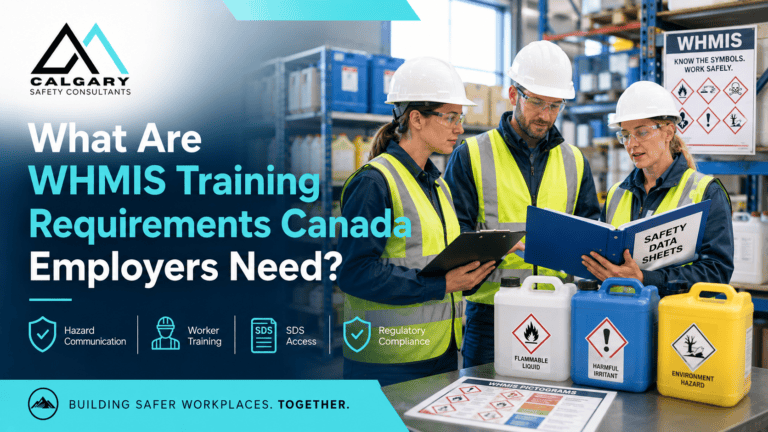
WHMIS training online refers to the delivery of Workplace Hazardous Materials Information System education through digital platforms, which allows workers to complete required training efficiently while ensuring consistent content delivery. This approach is particularly effective in Canada, where WHMIS aligns with the Globally Harmonized System and requires employers to ensure workers are educated and trained on hazardous products.
The reason this matters is straightforward. When workers do not fully understand hazard classifications, label elements, or Safety Data Sheets, they are more likely to misuse products, ignore controls, or improvise unsafe practices. As a result, incidents increase, compliance gaps widen, and organizations become exposed to regulatory penalties. Online training addresses this by standardizing knowledge and reinforcing expectations across all levels of the workforce.
How WHMIS Training Online Supports Reducing Safety Violations
WHMIS training online plays a direct role in reducing safety violations because it improves both knowledge and consistency. When training is delivered in a structured and repeatable format, it eliminates variability that often occurs with informal or inconsistent instruction.
There are several ways this translates into real-world improvement:
- Workers learn how to interpret supplier labels and workplace labels correctly, which reduces improper handling and storage of hazardous materials
- Employees gain a working understanding of Safety Data Sheets, which allows them to identify hazards, required PPE, and emergency response steps before starting work
- Supervisors can verify completion and competency, which strengthens accountability and supports enforcement of safe work procedures
- Refresher training becomes easier to implement, ensuring knowledge stays current as products and processes change
Because of this, the cause-and-effect relationship becomes clear. Better training leads to better understanding, which leads to safer decisions, which ultimately reduces violations and incidents in the workplace.
Common Compliance Gaps Without WHMIS Training Online
Organizations that rely on outdated, inconsistent, or undocumented training methods often experience recurring compliance issues. These gaps typically show up during inspections, audits, or after an incident has already occurred.
Some of the most common issues include:
- Workers unable to explain hazard symbols or label elements
- Improper storage or mixing of incompatible chemicals
- Missing or outdated Safety Data Sheets
- Inconsistent use of personal protective equipment
- Lack of documented proof of training for regulatory purposes
In Alberta, British Columbia, and Saskatchewan, these gaps are not minor. They directly relate to employer duties under occupational health and safety legislation, which requires that workers are competent and informed. When training cannot be verified or is clearly ineffective, regulators may issue orders, impose fines, or require corrective action plans.
Why WHMIS Training Online Is More Effective Than Traditional Methods
Traditional classroom-based training still has value, but it often lacks scalability, consistency, and ease of tracking. WHMIS training online addresses these limitations by providing a structured and repeatable system that aligns with modern workplace needs.
The key advantages include flexibility, documentation, and consistency. Workers can complete training at their own pace, which increases retention because they are not rushed through material. Employers can track completion and maintain records, which is critical during audits or inspections. Most importantly, every worker receives the same core information, which reduces variation in understanding.
This consistency is where reducing safety violations becomes measurable. When every worker is trained to the same standard, supervisors spend less time correcting unsafe behavior and more time reinforcing compliance. Over time, this shifts the workplace from reactive to proactive.
Integrating WHMIS Training Online Into Your Safety System
WHMIS training online should not be treated as a standalone requirement. It needs to be integrated into a broader occupational health and safety system to be effective.
In practice, this means:
- Linking training content to actual workplace hazards identified in hazard assessments
- Reinforcing training through supervision, inspections, and toolbox talks
- Updating training when new hazardous products are introduced
- Ensuring that site-specific procedures align with WHMIS requirements
When this integration is done correctly, training becomes actionable rather than theoretical. Workers understand not just what WHMIS requires, but how it applies to their specific tasks and environment.
Business Impact and Risk Considerations
The decision to implement or improve WHMIS training online has direct operational, financial, and compliance implications, which means it should be viewed as a business-critical investment rather than an administrative task.
From a business risk perspective, inadequate training leads to improper chemical handling, which increases the likelihood of spills, exposures, and injuries. These incidents disrupt operations, create downtime, and often require costly remediation. As a result, organizations may experience production delays, increased supervision requirements, and reduced efficiency.
Financially, the impact compounds quickly. Incidents involving hazardous materials often lead to higher WCB premiums, direct costs related to medical treatment or cleanup, and indirect costs such as lost productivity and retraining. In addition, regulatory fines and penalties can be significant, particularly if non-compliance is repeated or involves serious risk.
From a compliance standpoint, failure to provide effective WHMIS training exposes employers to enforcement actions under provincial legislation. This can result in orders, stop-work directives, or failed COR audits, which in turn affect eligibility for contracts and overall business credibility.
Organizations that implement structured online WHMIS training programs often see fewer minor chemical-related incidents, along with improved audit scores and fewer corrective actions. Training completion rates also tend to rise, which strengthens documentation and defensibility during inspections.
Here is an example.
Situation: A mid-sized manufacturing company in Alberta experienced repeated minor chemical spills and inconsistent PPE use, which led to inspection orders and rising WCB costs.
Action: The company implemented WHMIS training online for all workers, integrated it with their hazard assessment process, and reinforced expectations through supervision and monthly safety meetings.
Result: Within six months, spill incidents decreased, PPE compliance improved significantly, and the company achieved a higher COR audit score, which supported continued contract eligibility.
This type of outcome is common when training is properly implemented and reinforced, because it directly addresses the root causes of unsafe behavior.
How we help
How Calgary Safety Consultants can help
For organizations looking to strengthen their WHMIS program and reduce safety violations, Calgary Safety Consultants provides practical, field-focused support tailored to Canadian regulatory requirements.
Through Calgary Safety Consultants, employers can access services such as:
WHMIS training online that aligns with current legislation and real workplace conditions
COR consulting and audit preparation to ensure training and documentation meet program requirements
Hazard assessment development that connects training to actual job tasks
Compliance support to address gaps identified during inspections or internal reviews
The advantage of working with a specialized OH&S consultant is that training is not delivered in isolation. Instead, it is integrated into a complete safety system, which ensures that knowledge translates into action and measurable improvement.
Final thoughts
WHMIS training online is more than a compliance checkbox. It is a foundational tool that directly influences how workers handle hazardous materials, how supervisors enforce safe practices, and how organizations manage risk. When implemented properly, it reduces safety violations, improves operational consistency, and strengthens overall safety performance.
For employers across Alberta, British Columbia, and Saskatchewan, the message is clear. If training is inconsistent, outdated, or disconnected from real work conditions, safety violations will continue. If training is structured, accessible, and integrated into daily operations, those violations decrease, and the workplace becomes safer and more efficient.
Taking action now not only improves compliance but also protects workers, strengthens business performance, and positions your organization for long-term success.
Jurisdiction note: This article provides general occupational health and safety information. The legal requirements that apply depend on the workplace location, industry and federal, provincial or territorial jurisdiction. Verify current requirements with the applicable regulator before using the information operationally. Government of Canada overview of occupational health and safety jurisdiction.
References
- https://www.ccohs.ca/oshanswers/chemicals/whmis_ghs/whmis_intro.html
- https://www.alberta.ca/whmis.aspx
- https://www.worksafebc.com/en/health-safety/hazards-exposures/whmis
- https://www.saskatchewan.ca/business/safety-in-the-workplace/hazards-and-exposures/whmis
- https://laws-lois.justice.gc.ca/eng/regulations/SOR-2015-17/

About the author
John Duplessis, B.Sc., CRSP
John Duplessis is a Canadian Registered Safety Professional with more than 30 years of occupational health and safety experience in oil and gas, construction, green energy, midstream operations, and industrial project work.