On this page
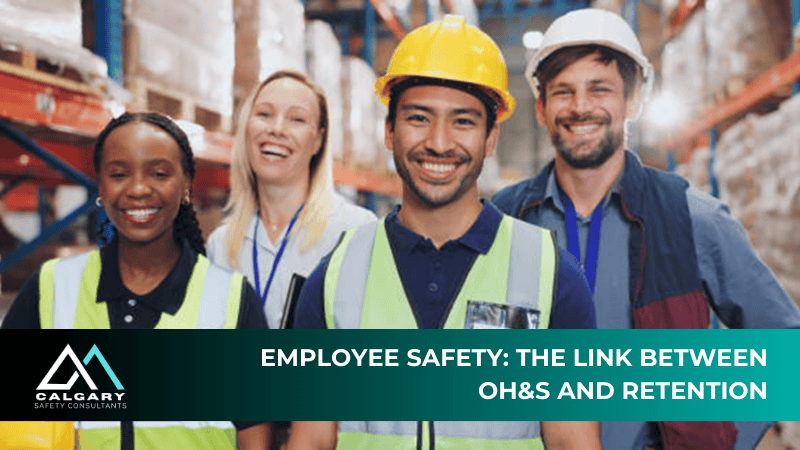
What if the real key to keeping people wasn’t just higher pay or trendy perks, but a stronger commitment to safety? Both physical and psychological safety are deeply tied to whether employees stay or leave. In this post, we’ll look at how safety connects to retention, why it matters for Canadian businesses, and how Calgary Safety Consultants can help you put safety at the heart of your retention strategy.
Why Retention Is More Than Just an HR Problem
The cost of turnover is staggering. Research summarized by the SHRM Foundation suggests direct replacement costs can reach 50–60% of an employee’s annual salary, and total turnover costs can range from 90% to 200% once you factor in recruiting, onboarding, lost productivity, and overtime for the team that’s covering while you hire (SHRM Foundation).
For small and mid-sized Canadian businesses, this cost can be crippling. Beyond money, turnover breaks trust, slows projects, and creates instability. Employees start asking: Who’s next to leave? Should I be looking, too?
Retention, then, isn’t just a human resources issue. It’s a business continuity issue. And safety plays a bigger role in this than most companies realize.
Safety as a Retention Driver
1. Physical Safety → “I’m Valued”
When a workplace invests in OH&S (Occupational Health & Safety), it sends a clear signal: we care about you. Employees notice when hazards are addressed, PPE is enforced, and safety training is real instead of a checkbox exercise.
Think about the construction worker who sees her company replacing worn-out fall protection harnesses before she has to ask. Or the warehouse staff who get new lifting equipment to prevent back injuries. These actions go beyond compliance—they show respect.
Prioritizing OH&S reduces absenteeism and turnover while also lowering insurance costs and claims (see how prioritizing safety can save you money). Engagement matters too: Gallup found that teams in the top quarter for engagement had 21% to 51% lower turnover than teams in the bottom quarter (Gallup).
When workers feel physically protected, they’re more loyal. They don’t have to wonder if management cares—they see it in action.
2. Psychological Safety → “I Belong”
Safety isn’t just about hard hats and first aid kits—it’s also about psychological safety. That’s the freedom to speak up, make suggestions, or raise concerns without fear of ridicule or retaliation (Edmondson, 1999).
Imagine a young apprentice who notices a hazard on-site but is afraid to say anything because he doesn’t want to “rock the boat.” If that fear continues, he’s not just unsafe—he’s also disengaged. Eventually, he’ll probably leave for a company where his voice matters.
Layer onto that the concept of psychosocial safety climate (PSC)—the shared belief among workers that their employer is committed to their mental health and wellbeing. Research shows that PSC shapes work pressure and emotional demands, which in turn affect psychological distress and emotional exhaustion, and that higher PSC is linked to stronger employee engagement (Dollard & Bakker, 2010).
When people feel safe in body and mind, they don’t just stay—they thrive.
Safety Culture: The Glue That Holds Teams Together
Safety culture is the collective belief that safety matters and is everyone’s responsibility. It’s not about policies sitting in a binder—it’s about daily actions.
- Leaders wearing PPE on the floor, not just expecting workers to.
- Supervisors stopping production to address hazards, even under deadline pressure.
- Teams openly reporting near-misses without fear of blame.
These small, everyday signals shape culture. And when employees believe that culture is genuine, they stay.
A strong safety culture reduces incidents, sure. But it also drives retention because people want to stay where they feel respected and protected.
Canadian Business Insights on Retention
Retention challenges in Canada often tie back to the same themes: wellbeing, support, and connection.
- A Capterra survey found Canadian employees want clear onboarding, development, and workplace culture—all areas linked to safety and trust (https://www.capterra.ca/blog/4349/employee-retention-strategies).
- TELUS Health studies show Canadian workers value flexible and preventive health benefits like telemedicine, which improve both wellness and loyalty (https://www.telus.com/en/about/news-and-events/media-releases/canadian-workplace-health-benefits-critical-for-employee-retention and https://finance.yahoo.com/news/study-canadian-workplace-health-benefits-142700488.html).
- Mental health programs specifically tied to psychological safety reduce absenteeism and turnover across Canadian workplaces (https://www.workplacestrategiesformentalhealth.com/resources/psychological-health-and-safety-statistics).
What these insights show is that safety and wellness aren’t “extra perks.” They’re retention essentials.
How we help
How Calgary Safety Consultants Can Help
So where do Calgary Safety Consultants (CSC) come in? Simple—we bridge the gap between compliance and culture. Our services help businesses across Alberta and Canada not only meet legal OH&S requirements but actually use safety as a retention tool.
Here’s how:
- Scalable OH&S Programs: We help you build safety systems that grow with your business. Policies, training, hazard assessments, inspections—it’s all structured and sustainable (see building a scalable OH&S program for growth).
- Tailored Training: No cookie-cutter courses. We customize safety training so it resonates with your workforce. When training feels relevant, it sticks—and employees appreciate it. Explore our workplace safety training and certification.
- COR Certification Support: In Alberta, COR is the gold standard for OH&S. It proves your commitment to safety and reassures employees they’re in the right place.
- ROI on Safety: From reducing absenteeism to lowering insurance costs, we show you how investing in safety pays off—not just in fewer incidents, but in better retention and loyalty (see how prioritizing safety can save you money).
CSC’s bottom line: safety is about people first, compliance second—and when people feel cared for, they stay.
Quick Playbook: Safety for Retention
Here’s a straightforward path Canadian businesses can follow:
- Check your data: turnover, absenteeism, incidents.
- Audit your safety practices: are they surface-level or authentic?
- Improve physical safety systems: hazard reporting, PPE, inspections.
- Prioritize psychological safety: encourage speaking up, train leaders to listen.
- Invest in health benefits: mental health, telemedicine, flexible supports.
- Engage Calgary Safety Consultants: get tailored OH&S programs that actually impact culture and retention.
- Track and celebrate: show your employees how safety makes their workplace better.
Final Thoughts
Employee retention isn’t just about pay—it’s about people feeling safe. In Canada’s competitive labour market, businesses that understand this will win. Safety—both physical and psychological—isn’t just compliance, it’s culture. It’s retention.
If you’re ready to strengthen retention through safety, Calgary Safety Consultants can help you turn policies into practice and keep your team where they belong—right with you.
Connect with us here and let us help you improve your OH&S practices.
Jurisdiction note: This article provides general occupational health and safety information. The legal requirements that apply depend on the workplace location, industry and federal, provincial or territorial jurisdiction. Verify current requirements with the applicable regulator before using the information operationally. Government of Canada overview of occupational health and safety jurisdiction.
References
- Allen, D. G. (2008). “Retaining Talent: A Guide to Analyzing and Managing Employee Turnover.” SHRM Foundation. https://www.shrm.org/content/dam/en/shrm/topics-tools/news/Retaining-Talent.pdf
- Calgary Safety Consultants. “Optimizing OH&S in Calgary Businesses: How Prioritizing Safety Can Save You Money.” https://calgarysafetyconsultants.ca/Optimizing-OH%26S-in-Calgary-Businesses%3A-How-Prioritizing-Safety-Can-Save-You-Money
- Edmondson, A. (1999). “Psychological Safety and Learning Behavior in Work Teams.” Administrative Science Quarterly, 44(2), 350–383. https://doi.org/10.2307/2666999
- Dollard, M. F., & Bakker, A. B. (2010). “Psychosocial safety climate as a precursor to conducive work environments, psychological health problems, and employee engagement.” Journal of Occupational and Organizational Psychology, 83(3), 579–599. https://doi.org/10.1348/096317909X470690
- Gallup. “The Relationship Between Engagement at Work and Organizational Outcomes” (Q12 Meta-Analysis). https://www.gallup.com/workplace/321725/gallup-q12-meta-analysis-report.aspx
- Capterra Canada. “Employee Retention Strategies.” https://www.capterra.ca/blog/4349/employee-retention-strategies
- TELUS. “Canadian Workplace Health Benefits Critical for Employee Retention.” https://www.telus.com/en/about/news-and-events/media-releases/canadian-workplace-health-benefits-critical-for-employee-retention
- Yahoo Finance. “Study: Canadian Workplace Health Benefits Are Critical for Employee Retention.” https://finance.yahoo.com/news/study-canadian-workplace-health-benefits-142700488.html
- Workplace Strategies for Mental Health. “Psychological Health and Safety Statistics.” https://www.workplacestrategiesformentalhealth.com/resources/psychological-health-and-safety-statistics
- Calgary Safety Consultants. “Building a Scalable OH&S Program for Growth.” https://calgarysafetyconsultants.ca/Building-a-Scalable-OH%26S-Program-for-Growth
Because a safer workplace starts with smarter policy. Let’s build it together.

About the author
John Duplessis, B.Sc., CRSP
John Duplessis is a Canadian Registered Safety Professional with more than 30 years of occupational health and safety experience in oil and gas, construction, green energy, midstream operations, and industrial project work.