On this page
- The Problem: When Lockout/Tagout Gets Skipped, People Get Hurt
- So What Is Lockout/Tagout?
- What Is Hazardous Energy? The 7 Types to Plan For
- What’s the Law Say?
- Lockout–Tagout Procedures
- Where It All Goes Sideways
- Equipment-Specific Training: The Missing Piece
- How Calgary Safety Consultants Can Help
- Want to Know Where You Stand?
- Final Word: Don’t Wait for an Injury
- Frequently asked questions
Two of the most underused—and under-trained—tools in preventing these kinds of injuries are Lockout/Tagout (LOTO) procedures and equipment-specific training. If your workplace doesn’t have a solid grip on both, it’s a serious gap in your OH&S program.
And let’s be clear—LOTO isn’t just about flipping a breaker or pulling a plug. While electricity is often the first thing that comes to mind, it’s far from the only energy hazard.
Effective Lockout/Tagout must account for all forms of hazardous energy, including hydraulic pressure, compressed air, moving parts, heat, chemical reactions and suspended loads. We break down all seven types of hazardous energy further down this page.
Each of these energy sources can be deadly if left uncontrolled. A locked-out panel doesn’t mean much if there’s still hydraulic pressure built up in a system, or if a machine has moving parts held under tension.
That’s why LOTO procedures need to be comprehensive and tailored—not only to the type of machine but also to how it’s used, maintained, and cleaned. And why workers need real training, not just a checklist taped to a cabinet.
The Problem: When Lockout/Tagout Gets Skipped, People Get Hurt
Let’s start with the uncomfortable truth—machines don’t know you’re there. They don’t pause because you’re “just doing a quick adjustment” or give you a five-second grace period to clear a jam. If equipment is energized—even partially—it has the potential to crush, cut, burn, or kill.
That’s why Lockout/Tagout (LOTO) isn’t optional. It’s not paperwork. It’s not a formality. It’s the front line of defence between workers and life-altering injuries.
LOTO exists for one reason: to keep people safe when working around hazardous energy. When it’s ignored, rushed, or done incorrectly, the consequences are often catastrophic.
The data backs this up. According to the Association of Workers’ Compensation Boards of Canada, contact with machinery continues to rank among the top causes of lost-time injury claims across all industries:
https://awcbc.org/data-and-statistics/national-work-injury-disease-statistics-program
And it’s not just high-risk manufacturing jobs. You’ll find LOTO-related risks wherever machines operate:
- Construction – from skid steers to cement mixers and even in commissioning of new equipment
- Agriculture – think augers, PTOs, and harvesters
- Facilities maintenance – HVAC units, boilers, elevators
- Warehousing and logistics – conveyors, dock plates, automated systems
- Municipal operations – water treatment, street maintenance, parks equipment
- Utilities and energy – transformers, switchgear, pressure systems
In any of these environments, stored energy—whether electrical, mechanical, hydraulic, or otherwise—can lead to serious injury or death if not properly isolated. And the most tragic part? In many cases, it could’ve been prevented with a simple lock, a clear tag, and a well-trained worker.
Here’s what that looks like on the floor:
- A worker doing maintenance on a conveyor belt without isolating the energy sources is caught in the mechanism when it restarts.
- A technician is electrocuted while repairing an electrical panel that wasn’t properly de-energized.
- Stored hydraulic pressure in a cylinder causes a sudden movement that crushes a maintenance worker’s hand.
The common thread? Each of these incidents could have been prevented with proper lockout/tagout procedures.
So What Is Lockout/Tagout?
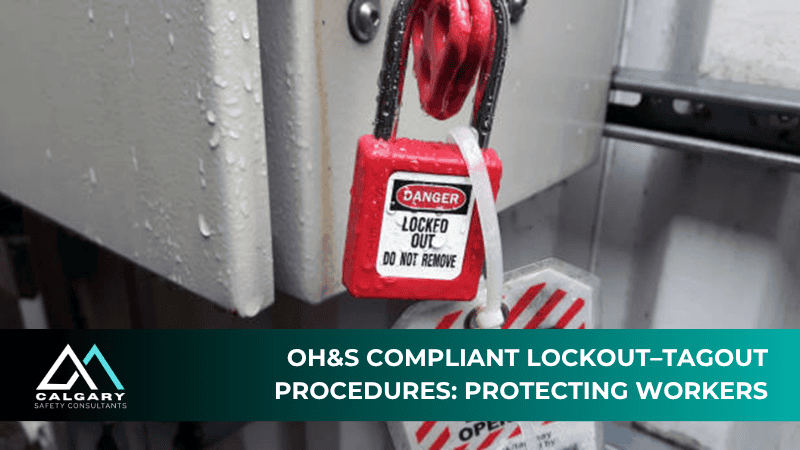
Lockout/Tagout (LOTO) is a system of procedures used to completely isolate equipment from its energy sources before work begins. That energy might be electrical, hydraulic, pneumatic, mechanical, thermal, chemical, or even gravitational.
The CSA Z460-20 standard, which is the Canadian reference for control of hazardous energy, outlines a complete framework for how to do this safely. The process usually involves:
- Shutting down the equipment properly
- Isolating all sources of energy
- Locking out (physically preventing reactivation)
- Tagging out (communicating who’s working on it and why)
- Verifying that the system is actually de-energized
Sound like overkill? Tell that to the worker whose hand got crushed because a co-worker restarted a conveyor they didn’t know was being serviced.
CSA Standard Z460-20 overview:
CSA Z460-20, Control of hazardous energy – Lockout and other methods (CSA Group)
What Is Hazardous Energy? The 7 Types to Plan For
Hazardous energy is any form of energy that can harm someone if it’s released or activated unexpectedly. CSA Z460-20 describes it broadly, so your procedures shouldn’t stop at the electrical disconnect. These are the seven types most workplace lockout procedures need to account for:
- Electrical energy – live circuits and stored charge in batteries and capacitors. Risks: electrocution, burns and fire.
- Mechanical energy – moving parts such as gears, pulleys, rotating shafts, belts under tension and spring-loaded mechanisms. Risks: crushing injuries, amputations and lacerations.
- Hydraulic energy – pressurized fluid in lifts, presses and heavy equipment. Risks: sudden equipment movement and high-pressure fluid injuries.
- Pneumatic energy – compressed air in tools, lines and storage tanks. Risks: sudden release, flying debris and uncontrolled movement.
- Thermal energy – steam, hot pipes, heated surfaces and exhaust systems. Risks: burns and heat-related injuries.
- Chemical energy – reactive substances and pressurized chemical systems. Risks: explosions, fires and toxic exposures.
- Gravitational energy – suspended loads or raised components that can drop if a support or control fails. Risks: crushing and struck-by injuries.
Hazardous energy is often “hidden.” Equipment can look like it’s off and still hold stored pressure, charge or tension. Workers who don’t know where that energy lives, or haven’t been trained to release it, can trigger it during routine maintenance, cleaning or clearing a jam.
Some operations also have radiation or other process-specific energy to plan for.
What’s the Law Say?
Under Canadian provincial and federal OHS legislation, Lockout/Tagout is not optional.
In Alberta, for example, the Occupational Health and Safety Code mandates that employers must ensure energy-isolating devices are secured, and that workers are trained in isolation procedures. Here’s the direct reference:
https://kings-printer.alberta.ca/documents/OHS/OHSCode_December_2024.pdf (see Part 15 – Managing the Control of Hazardous Energy)
The Canada Labour Code, Part II, applies to federally regulated employers (e.g., airlines, banks, telecom, rail), and it contains similar provisions for energy control during maintenance work:
https://laws-lois.justice.gc.ca/eng/acts/L-2/
Here’s where to find the rules in the western provinces we support:
- Alberta: OHS Code, Part 15 – Managing the Control of Hazardous Energy
- British Columbia: WorkSafeBC OHS Regulation, Part 10 – De-energization and Lockout
- Saskatchewan: The Occupational Health and Safety Regulations, 2020, Part 10 – Machine Safety, including section 10-6 on locking out and section 10-7 on cleaning or adjusting equipment in motion
- Federally regulated employers: Canada Labour Code, Part II
The wording and details differ from one jurisdiction to the next, so your procedures should be checked against the rules that apply where the work actually happens.
Bottom line: whether you’re provincial or federal, you have to isolate energy sources and train your people.
What a workable hazardous energy control program includes
Whatever province you’re in, a program that holds up in practice usually has five things in place:
- Written, equipment-specific procedures that set out each step needed to isolate every energy source safely.
- Training so workers and supervisors understand hazardous energy risks and can apply the procedures correctly.
- The right hardware—locks, tags and energy-isolating devices—supplied and maintained by the employer.
- Consistent application, with supervisors checking that procedures are followed every time, not just when someone is watching.
- Records, such as training logs and lockout audits, that show the program is working.
Lockout Tagout Procedures
CSA Z460-20 gives you the framework. In practice, a workable procedure breaks it down into these steps:
- Identify energy sources. Know every source connected to the equipment, including secondary and residual energy.
- Notify affected workers. Tell everyone in the area that a lockout is about to happen.
- Shut down the equipment using its normal operating controls.
- Isolate energy sources with the correct valves, switches or disconnects.
- Apply locks and tags. Secure each isolation point with a personal lock and attach a tag that shows who applied it and why.
- Release or restrain stored energy. Bleed hydraulic and pneumatic lines, discharge capacitors, block raised parts and relieve spring tension.
- Verify isolation. Test for zero energy—try the controls and confirm the equipment won’t start or move—before anyone begins work.
- Perform the work only after isolation has been confirmed.
- Remove locks and tags safely. When the work is done, make sure tools are cleared and everyone is clear of the equipment. Only the worker who applied a lock should remove it.
Where It All Goes Sideways
Here’s the reality in many workplaces:
- Lockout kits are dusty or half-missing
- Procedures are generic, outdated, or written in technical language no one reads
- No formal verification step
- Tags are used on their own where a lock is needed—a tag warns people, but a lock physically prevents the equipment from being re-energized
- Affected workers aren’t told that a lockout is underway
- Workers haven’t been fit tested for the PPE they’re using
- Contractors are doing their own thing
- New hires get a five-minute “LOTO crash course” and are expected to be good to go
This kind of half-measure doesn’t just lead to injuries—it opens your business to liability, stop work orders, and fines. And in Alberta, OHS officers will ask for your written procedures, training records, and proof that your system works in practice—not just on paper.
Equipment-Specific Training: The Missing Piece
Even if you’ve nailed your LOTO procedures, it won’t matter if your people don’t understand the machines they’re working with.
Equipment-specific training is the second half of the safety puzzle. Every machine is different. Each has its own quirks, risks, and required steps for safe shutdown and reactivation. Your team needs to know:
- Which energy sources are present (some have more than one!)
- How to shut down this specific machine safely
- Where to apply locks, tags, and blocks
- How to test for zero energy before starting work
- What to do if something goes wrong during the job
This isn’t stuff you can cover with a one-size-fits-all handout. It requires tailored training that addresses the actual models your team uses, the environment they work in, and the tasks they perform.
Refresher training matters just as much, especially when you have worker turnover, bring in new equipment, or change how a job is done.
For a self-paced starting point, our online Lockout and Tagout Awareness course covers hazardous energy, lockout law across Canada and the 15-step CSC Lockout and Tagout Workflow. It’s awareness-level training, so equipment-specific training is still needed.
How we help
How Calgary Safety Consultants Can Help
At Calgary Safety Consultants, we’ve worked with businesses across Alberta to build real-world Lockout/Tagout programs aligned with CSA Z460-20 and deliver equipment-specific training that sticks.
Here’s what we offer:
- Custom Written LOTO Procedures – Developed for your exact machines, tasks, and layout
- On-Site Hazard Assessments – We identify energy hazards and control gaps in your operations
- CSA Z460-20-Aligned Training – Delivered in person or online, with hands-on examples and verification steps
- Practical Workshops – We teach workers how to lock out safely, test for residual energy, and document it
- Contractor Safety Integration – Ensuring third-party workers are trained, authorized, coordinated, and accounted for
- Refresher & Supervisor Training – For managers and leads who need to enforce the rules and coach others
We don’t believe in cookie-cutter programs. Our approach is grounded in legislation, real experience, and a no-nonsense mindset. Because safety isn’t just compliance—it’s capability.
Want to Know Where You Stand?
We’ll be honest with you—most companies think they have LOTO under control, but few can confidently pass an unannounced inspection or audit. If you’re not sure where your program stands, we can help you figure it out.
Start with a Gap Analysis or a site-specific program review, and we’ll give you a clear, jargon-free plan to close the gaps—without blowing your budget or creating a pile of paperwork no one reads.
Connect with us here: book a free 30-minute consultation.
Final Word: Don’t Wait for an Injury
If you’re still in the “we’ve never had a problem” mindset, that’s luck—not a plan. It only takes one missed lock, one untrained contractor, or one forgotten energy source to change a life forever.
Lockout/Tagout and equipment-specific training are two of the most critical, most enforceable, and most neglected areas in workplace safety. You don’t need a safety buzzword strategy—you need a real program.
And if you need help, we’ve got your back. Contact Calgary Safety Consultants for your complimentary consult to explore tailored OH&S solutions that drive real results.
We don’t just talk safety—we build systems that work.
References:
- CSA Group: CSA Z460-20 Standard
https://www.csagroup.org/store/product/2427899/ - Alberta OHS Code – Part 15: Managing the Control of Hazardous Energy
https://search-ohs-laws.alberta.ca/legislation/occupational-health-and-safety-code/part-15-managing-the-control-of-hazardous-energy/ - WorkSafeBC – OHS Regulation Part 10: De-energization and Lockout
https://www.worksafebc.com/en/law-policy/occupational-health-safety/searchable-ohs-regulation/ohs-regulation/part-10-de-energization-and-lockout - Government of Saskatchewan – The Occupational Health and Safety Regulations, 2020
https://publications.saskatchewan.ca/api/v1/products/112399/formats/126367/download - Canadian Centre for Occupational Health and Safety (CCOHS) – Hazardous Energy Control Programs
https://www.ccohs.ca/oshanswers/hsprograms/hazardous_energy.html - Association of Workers’ Compensation Boards of Canada – Injury Statistics
https://awcbc.org/data-and-statistics/national-work-injury-disease-statistics-program - Canada Labour Code, Part II
https://laws-lois.justice.gc.ca/eng/acts/L-2/

About the author
John Duplessis, B.Sc., CRSP
John Duplessis is a Canadian Registered Safety Professional with more than 30 years of occupational health and safety experience in oil and gas, construction, green energy, midstream operations, and industrial project work.