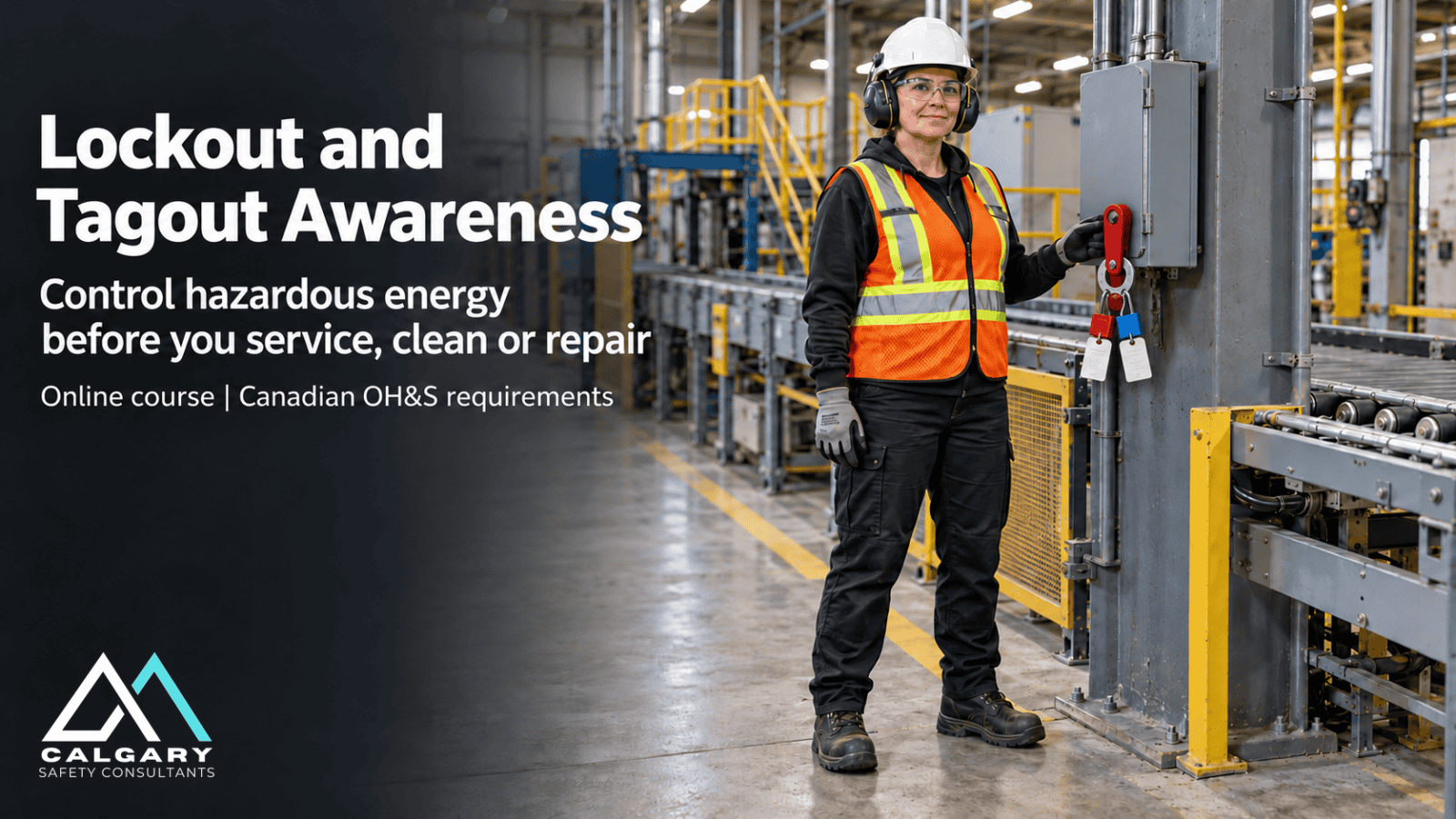
Lockout and Tagout Awareness
Once you have registered and enrolled, scroll to the Course Content section at the end of this page to begin your lessons.
Our online lockout tagout training helps workers, supervisors, maintenance staff and contractors understand how hazardous energy is controlled before anyone services, cleans, adjusts or repairs equipment. This self-paced awareness course covers recognizing hazardous energy with the 12 CSC Energy Sources, lockout law across Canada’s 14 OH&S jurisdictions and CSA Z460, the hazardous energy control program, the 15-step CSC Lockout and Tagout Workflow, equipment-specific lockout procedures, and the special situations where lockouts most often go wrong.
Need training for your team? For online group training, buy your enrolments here, then complete our Group Training Student Information form so we can set up each learner’s account. For live virtual or onsite group sessions, see our Lockout and Tagout Training page. If your workplace needs equipment-specific lockout procedures written or reviewed, see our Safe Work Procedures and Job Hazard Analysis Development services.
Learn more about how our online safety training works.
Most lockout incidents don’t happen because people have never heard of lockout. They happen when a stop button is mistaken for isolation, a second energy source is missed, stored pressure is left in a line, or production pressure makes a shortcut feel normal. When workers and supervisors share the same understanding of hazardous energy control, those gaps close. Good lockout practice also shows up in day-to-day results: fewer serious injuries and WCB claims, less unplanned downtime, cleaner audits, and better evidence of due diligence.
This is awareness-level training. It doesn’t authorize anyone to lock out equipment, and it doesn’t replace your employer’s lockout program, its equipment-specific procedures, or the hands-on training and authorization your employer provides. It isn’t approved by any regulator.
Online Lockout Tagout Training Course at a Glance
Delivery: 100% online and self-paced
Course format: 13 narrated video lessons in four modules, with written lesson notes, workplace examples, decision points and knowledge checks
Course length (estimated): About 5.5 to 6 hours, including about 4.6 hours of lesson video plus the knowledge checks and final exam
Assessment: A three-question knowledge check after every lesson (100% to continue) and a 10-question final exam (80% to pass), with unlimited retries
Includes: Downloadable Student Reference Guide with jurisdiction reference tables, the CSC Lockout and Tagout Workflow and nine worksheets and forms, plus a Certificate of Completion
Audience: Workers who operate, clean or maintain equipment, supervisors, maintenance staff, contractors and joint committee members across Canada
Price: $29.99 CAD plus GST
What Does Online Lockout Tagout Training Cover?
This lockout tagout training follows the life of a lockout, from recognizing the energy in a machine to removing the last lock and returning the equipment to service. Each lesson connects the content to decisions people make on real Canadian worksites, and asks you to compare it with your own employer’s program.
You’ll learn how to:
- Recognize hazardous energy with the 12 CSC Energy Sources, including the stored and hidden energy people miss.
- Tell an energy-isolating device apart from a stop button, E-stop, selector switch, interlock or PLC command.
- Explain how lockout law works across Canada’s 14 OH&S jurisdictions, and where CSA Z460 fits.
- Describe what a hazardous energy control program includes, from roles and hardware to training and audits.
- Follow the 15-step CSC Lockout and Tagout Workflow, including its two decision points.
- Isolate, lock, tag and release stored energy, then verify zero energy before work starts.
- Read and help write equipment-specific lockout procedures from the main lockout program.
- Understand group lockout, shift changes, contractors, testing under lockout and alternative methods.
- Explain why only the owner removes a lock, how the controlled removal procedure works, and what a strong lockout culture looks like.
Every lesson includes written notes, workplace examples, decision points and a knowledge check, so learners practise making sound decisions rather than memorizing a list.
Lockout Requirements Across Canada
Canada has 14 OH&S jurisdictions: the federal government, 10 provinces and 3 territories. OH&S law across Canada generally requires hazardous energy to be controlled before servicing and maintenance work, but each jurisdiction writes its own rules. British Columbia, Alberta, Newfoundland and Labrador, Yukon and Nova Scotia each have a regulation Part dedicated to lockout or hazardous energy. Others, such as Saskatchewan, Manitoba and Ontario, place lockout with their machine rules, and the details differ on written procedures, personal locks, group lockout, shift changes and removing another person’s lock.
CSA Z460:20 (R2025), Control of hazardous energy: Lockout and other methods, is the voluntary National Standard of Canada for lockout. It becomes enforceable only where a regulation adopts or references it, but regulators, employers and auditors widely use it as the benchmark for good practice. This course teaches the principles that apply across Canada and shows where the jurisdictions differ, with examples checked against official government and regulator sources in October 2026. The Student Reference Guide includes a reference table for each jurisdiction. Requirements change, so always confirm the current official version for your workplace.
Who Should Take This Lockout Tagout Training?
This course is built for anyone who works on, around or near powered equipment, from a new operator learning why the stop button isn’t enough to a supervisor responsible for a full lockout program.
It’s suitable for:
- Operators and workers who clean, clear, adjust or set up equipment
- Maintenance staff, millwrights, mechanics and electricians
- Supervisors, forepersons, lead hands and crew leads
- Contractors and the host employers who coordinate their work
- Joint health and safety committee members and health and safety representatives
- Safety coordinators and advisors who maintain the lockout program and procedures
Employers often use the course as awareness training before hands-on, equipment-specific lockout training, as orientation for new workers and contractors, when they update their lockout program, or as preparation for a COR or SECOR audit that looks at hazardous energy control.
Online Lockout Tagout Training Course Features
Our online lockout tagout training is designed to be practical, realistic and easy to apply to the equipment you actually work on.
Course features include:
- 100% online and self-paced learning
- 13 narrated video lessons, each about 17 to 27 minutes long
- Written lesson notes with learning objectives, workplace examples, decision points and key takeaways
- Downloadable Student Reference Guide with lesson summaries, reflection questions and a jurisdiction reference table for all 14 jurisdictions
- The 15-step CSC Lockout and Tagout Workflow and nine worksheets and forms, including an Energy Source Identification Worksheet, an Equipment-Specific Lockout Procedure Template and a Group Lockout Sign-In Log
- A knowledge check after every lesson and a 10-question final exam
- Certificate of Completion
The course focuses on what people need to do: find every energy source, isolate it at the right device, apply their own lock and tag, release stored energy, verify zero energy, and never remove someone else’s lock outside the controlled procedure.
Online Lockout Tagout Training Course Modules
The course is organized into four modules. Each lesson is one complete narrated video with written notes and a knowledge check.
Module One: Understanding Hazardous Energy
Module One explains why hazardous energy control matters, how to recognize every kind of hazardous energy with the 12 CSC Energy Sources, and how primary, stored and multiple energy sources behave once a machine is shut down.
Lessons:
- Lesson One: Why Hazardous Energy Control Matters
- Lesson Two: Recognizing Hazardous Energy with CSC Energy Sources
- Lesson Three: Primary, Stored and Multiple Energy Sources
Module Two: Lockout Law and Program Requirements
Module Two defines lockout, tagout and hazardous energy control, maps lockout law across Canada’s 14 OH&S jurisdictions and CSA Z460, and sets out what a hazardous energy control program includes, from roles to hardware.
Lessons:
- Lesson Four: Lockout, Tagout and Hazardous Energy Control
- Lesson Five: Lockout Law Across Canada
- Lesson Six: The Hazardous Energy Control Program
Module Three: The Lockout Workflow and Procedures
Module Three walks through the 15-step CSC Lockout and Tagout Workflow, from planning and isolation to verifying zero energy and restoring equipment, and shows how equipment-specific procedures are written from the lockout program.
Lessons:
- Lesson Seven: The Lockout and Tagout Workflow
- Lesson Eight: Isolating, Locking, Tagging and Releasing Stored Energy
- Lesson Nine: Verifying Zero Energy and Restoring Equipment Safely
- Lesson Ten: Writing Equipment-Specific Lockout Procedures
Module Four: Special Situations
Module Four covers special situations: group lockout, shift changes and contractors, complex lockouts, testing and alternative methods, abandoned lock removal, and the culture that keeps lockout working.
Lessons:
- Lesson Eleven: Group Lockout, Shift Changes and Contractors
- Lesson Twelve: Complex Lockouts, Testing and Alternative Methods
- Lesson Thirteen: Abandoned Locks, Emergency Lock Removal and Lockout Culture
Complete Your Online Lockout Tagout Training
Register online, then work through the lessons in order at your own pace. After each video, complete the lesson’s three-question knowledge check. You need all three answers correct (100%) to move on, and you can retry as many times as you need, with feedback after each answer to help you learn.
After Lesson 13, complete the 10-question final exam, which draws on all four modules. You need 8 correct answers (80%) to pass, and you can retake it as many times as you need. Once you’ve completed all 13 lessons, their knowledge checks and the final exam, you can download your Certificate of Completion.
The certificate shows that you completed awareness-level online training in lockout and tagout. It isn’t a professional designation, it doesn’t authorize you to lock out any equipment, and it doesn’t confirm that any workplace’s lockout program meets the law.
Frequently Asked Questions About Online Lockout Tagout Training
Does this lockout tagout training cover every province and territory?
Yes. The course covers all 14 Canadian OH&S jurisdictions: the federal government, the 10 provinces and the 3 territories. It teaches the principles they share and shows where their lockout requirements differ, and the Student Reference Guide includes a reference table for each jurisdiction. Always confirm the current official version of the rules that apply to your workplace.
Who should take lockout tagout training?
Anyone who operates, cleans, clears, adjusts or maintains powered equipment, plus the supervisors, contractors and committee members who plan and check that work. Everyone in or near the danger zone benefits from understanding how hazardous energy is controlled.
How long does the online lockout tagout training course take?
We estimate about 5.5 to 6 hours. The 13 lesson videos run about 4.6 hours in total, and the knowledge checks and final exam add time depending on your pace. You can stop and return at any time.
Does this course authorize me to lock out equipment?
No. This is awareness-level training. Your employer is responsible for training and authorizing you on its own lockout program and on the equipment-specific procedures for the machines you work on. The course prepares you for that training and helps you ask the right questions.
Does the course cover CSA Z460?
Yes. Lesson 5 explains CSA Z460:20 (R2025), the voluntary National Standard of Canada for controlling hazardous energy, how it relates to the regulations in each jurisdiction, and why it’s widely used as the benchmark for lockout programs. The course doesn’t reproduce the standard, so employers building a program should obtain the current edition from CSA Group.
Does this course help us write equipment-specific lockout procedures?
Yes. Lesson 10 shows how equipment-specific procedures are written from the main lockout program, and the Student Reference Guide includes an Equipment-Specific Lockout Procedure Template and an Energy Source Identification Worksheet you can adapt. If you’d like expert help, our consultants can develop or review your procedures with you.
Do I receive a certificate?
Yes. You receive a Certificate of Completion after you complete all 13 lessons, their knowledge checks and the final exam. It records completion of awareness-level online training. It isn’t a professional designation, it doesn’t authorize you to lock out equipment, and it isn’t approved by any regulator.
Can employers purchase training for several people?
Yes. Employers can buy online training for two or more learners on this page. After placing your order, complete our Group Training Student Information form with your order number and each learner’s name and email address. We set up each learner’s account and email course-access instructions. Orders of 10 or more seats of this course receive a 10% discount automatically at checkout.
Additional Lockout and Tagout Resources
The resources below help you check the requirements where you work and strengthen your own program. Use the official sources to read the current legislation and guidance, and our services when your procedures need more than training. Requirements change, so always use the current version.
Canada Occupational Health and Safety Regulations
Issued by: Government of Canada (Justice Laws website)
The federal regulations for federally regulated workplaces, including the electrical safety requirements in Part VIII and the machine guarding requirements in Part XIII. Use it if your employer is federally regulated.
Canada Occupational Health and Safety Regulations
OHS Regulation Part 10, De-energization and Lockout
Issued by: WorkSafeBC
British Columbia’s lockout requirements, including written procedures, personal locks and group lockout. Use it for work in British Columbia.
OHS Regulation Part 10, De-energization and Lockout
Alberta OHS Act, Regulation and Code
Issued by: Government of Alberta
Search Alberta’s OHS Act, Regulation and Code, including Part 15 of the OHS Code, Managing the Control of Hazardous Energy. Use it for work in Alberta.
Alberta OHS Act, Regulation and Code
Regulation 851, Industrial Establishments
Issued by: Government of Ontario (e-Laws)
Ontario’s rules for industrial establishments, including the machine lockout requirements in sections 75 and 76 and the electrical requirements in section 42. Use it for work in Ontario.
Regulation 851, Industrial Establishments
CSA Z460:20 (R2025), Control of hazardous energy: Lockout and other methods
Issued by: CSA Group
The National Standard of Canada for controlling hazardous energy, widely used as the benchmark for lockout programs.
CSA Z460:20 (R2025), Control of hazardous energy: Lockout and other methods
Safe Work Procedures and Job Hazard Analysis Development
Issued by: Calgary Safety Consultants
Our consulting support for writing and reviewing safe work procedures and job hazard analyses, including equipment-specific lockout procedures.
Safe Work Procedures and Job Hazard Analysis Development
OH&S Compliant Lockout and Tagout Procedures: Protecting Workers
Issued by: Calgary Safety Consultants
Our article on building lockout and tagout procedures that protect workers and stand up to an audit.
OH&S Compliant Lockout and Tagout Procedures: Protecting Workers
Related courses: Hazard Assessment and Control for Canadian Workplaces, FLHA Essentials for Workers, Online Workplace Inspection Training and Understanding Canadian OH&S Legislation.