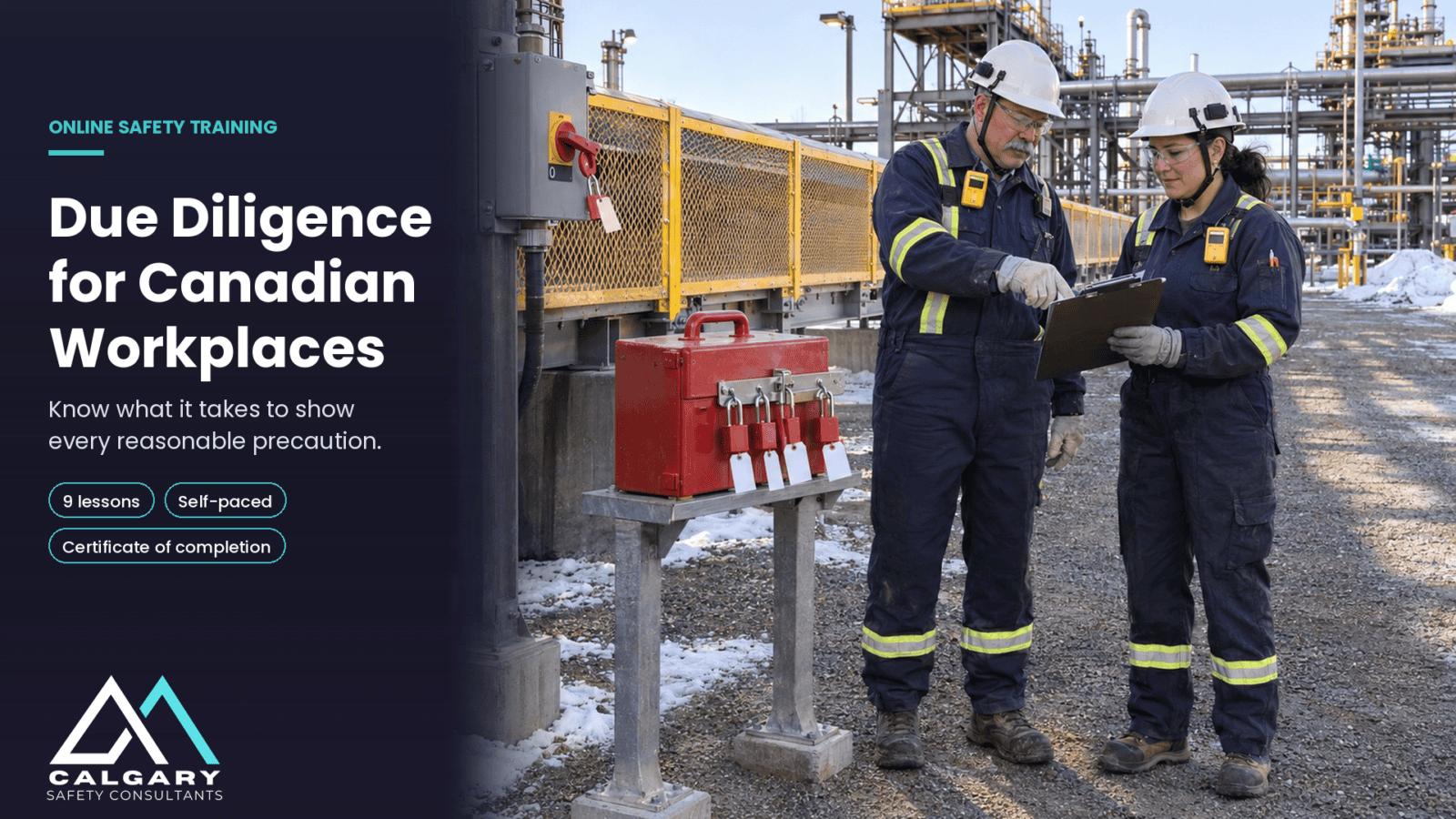
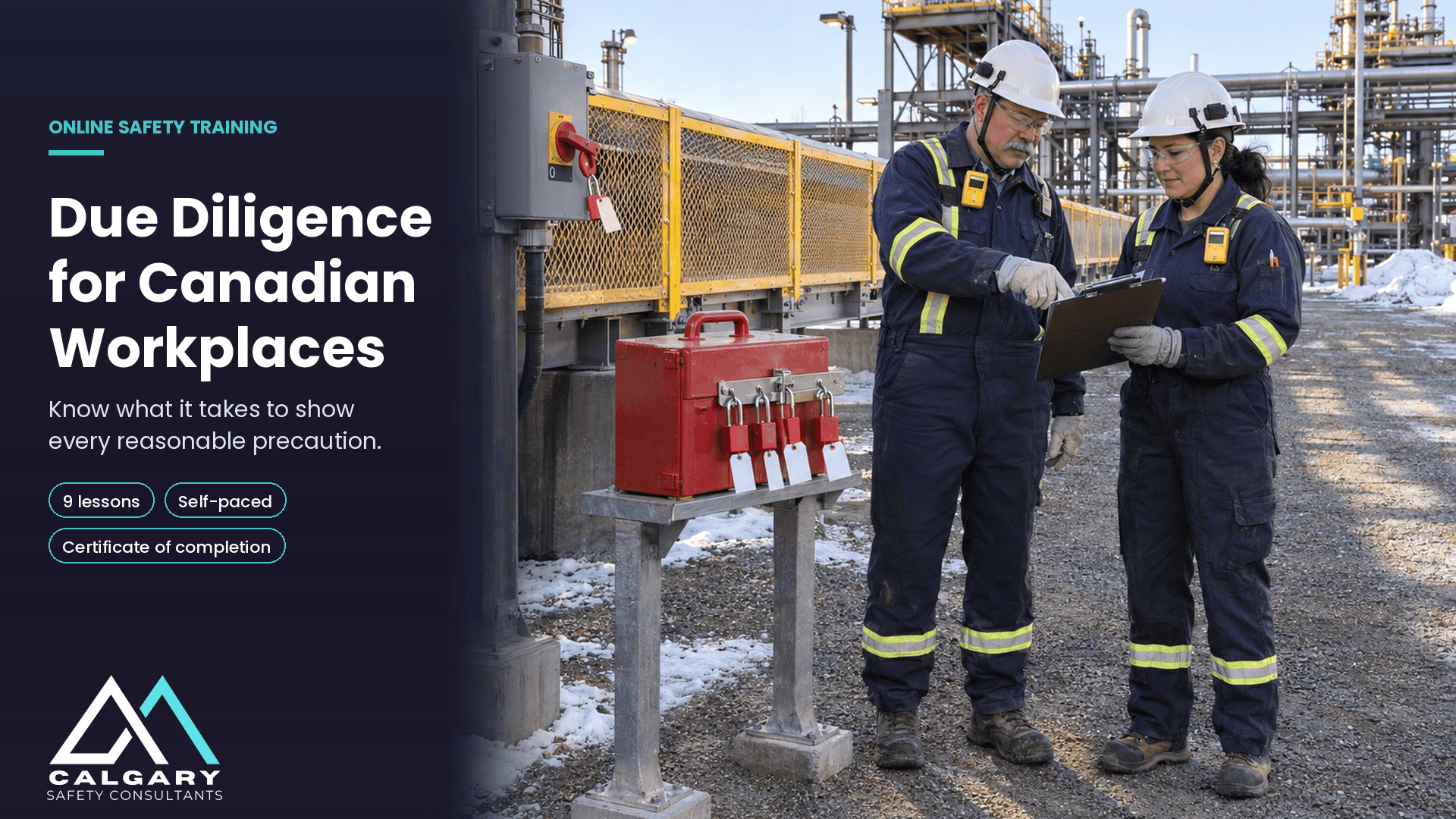
Due Diligence for Canadian Workplaces
Once you have registered and enrolled, scroll to the Course Content section at the end of this page to begin your lessons.
Our online due diligence training explains what due diligence means in Canadian occupational health and safety law, who carries it, how courts judge it and how to build it into everyday work. It follows one fictional case, a conveyor injury during a turnaround at an Alberta upgrader, from the morning of the incident through the investigation, the trial and the sentence, with examples from workplaces across Canada.
Training a team? For online group training, buy your enrolments here, then complete our Group Training Student Information form so we can set up each learner’s account.
Learn more about how our online safety training works.
Most OH&S offences don’t require proof that anyone meant harm. Once the Crown proves the prohibited act, the accused avoids a conviction only by showing it took every reasonable precaution in the circumstances. That defence can’t be built after an incident. It comes from the hazard assessments, training, supervision, enforcement and records that were in place before anything went wrong, and the same work prevents injuries, protects people and keeps operations running.
This course is awareness-level training. It isn’t legal advice, it doesn’t certify anyone or prove due diligence on its own, and it doesn’t replace your jurisdiction’s OH&S law, your employer’s procedures or advice from a lawyer about your own situation.
Due Diligence Training at a Glance
Price: $39.99 CAD plus GST per learner
Delivery: 100% online and self-paced
Course format: 9 narrated video lessons in four modules, built around one fictional case study, with a knowledge check after every lesson and a final exam
Course length (estimated): About 4.5 hours, including just under 4 hours of lesson video
Includes: A downloadable 79-page Student Reference Guide with a card for every teaching slide, lesson summaries, Canada-wide reference tables, official sources and 9 worksheets and checklists
Certificate: Certificate of Completion and Training Record
Coverage: Federal, provincial and territorial OH&S law and the Criminal Code of Canada, with Alberta used for the case study
What Does This Due Diligence Training Cover?
This due diligence training moves from the law to the evidence to the daily work that produces it, then across the organization from contractors to the boardroom.
You’ll learn how to:
- Explain what due diligence means in Canadian OH&S law and why most OH&S offences are strict liability offences.
- Identify who carries due diligence duties, including employers, supervisors, workers, contractors, owners, directors and officers.
- Describe the Criminal Code duty on everyone who directs work, added by the Westray Law.
- Apply the reasonable precautions test and the factors courts weigh, such as foreseeability, gravity of harm and control.
- Recognize the records that prove due diligence, and the gaps and after-the-fact changes that undermine them.
- Explain how a well-structured safety management system turns hazards, controls, training and checks into a traceable record.
- Connect hazard assessment, the hierarchy of controls and verification to due diligence, especially for hazardous energy.
- Show competence, supervision and consistent enforcement, not just training attendance.
- Coordinate owners, prime contractors and contractors on shared sites, and describe leadership and board oversight.
- Explain enforcement, prosecution and sentencing, and how to build a system that keeps working.
Lessons follow the Brightwater crew, Halvorsen’s operators and their leaders through one incident, and add short examples from workplaces across Canada, such as a sawmill near Prince George, a substation in Moncton or a fish plant in St. John’s.
Due Diligence in Canadian OH&S Law
In R. v. Sault Ste. Marie (1978), the Supreme Court of Canada recognized strict liability offences. For these offences, the Crown must prove the prohibited act beyond a reasonable doubt but doesn’t have to prove intent. The accused then avoids conviction by proving, on a balance of probabilities, that it took all reasonable care, or that it reasonably believed in a mistaken set of facts that would have made the act innocent. Most OH&S offences across Canada work this way, though each jurisdiction writes its Act differently.
Due diligence is judged against the particular event charged, and it’s judged party by party. An employer, a supervisor, a prime contractor and a director can each have their own duties and their own defence. Since 2004, section 217.1 of the Criminal Code has also placed a legal duty on everyone who directs, or has authority to direct, how another person does work to take reasonable steps to prevent bodily harm.
The Student Reference Guide’s reference tables summarize where each jurisdiction’s OH&S law sits, how the defence works in each one, director and officer liability, maximum penalties, key court decisions and the Criminal Code provisions, checked against official sources in October and November 2026. Laws and penalty amounts change, so read the current official text before you rely on a requirement.
Who Should Take This Due Diligence Training?
This course is built for everyone with a duty at work, in any Canadian jurisdiction and industry.
It’s suitable for:
- Supervisors, foremen and lead hands who direct work
- Managers, superintendents and operations leaders
- Safety advisors, coordinators and HSE professionals
- Owners, contractors and prime contractors who share work sites
- Directors, officers and senior leaders responsible for oversight
- Workers and joint committee or safety representative members who want to understand the law behind the rules
Employers often pair this due diligence training with our Hazard Assessment and Control, Supervisor Safety Essentials and Lockout and Tagout Awareness courses.
Due Diligence Training Course Features
Our online due diligence training combines the legal framework with the practical systems that make a defence real.
Course features include:
- 100% online and self-paced
- 9 narrated video lessons in four modules
- One fictional case study followed from the incident to sentencing
- Workplace examples and decision points from across Canada
- Plain-English explanations of strict liability, the reasonable precautions test and the Criminal Code
- A three-question knowledge check after each lesson, with feedback after each answer
- A 10-question final exam
- A downloadable Student Reference Guide with Canada-wide reference tables
- A Certificate of Completion and Training Record
The Student Reference Guide includes 9 worksheets and checklists:
- Due Diligence Self-Check for Any Workplace Party
- Reasonable Precautions Worksheet
- Due Diligence Evidence Checklist
- Safety Management System Traceability Check
- Hazardous Energy Verification Checklist
- Competency Verification Record
- Contractor and Shared-Site Interface Checklist
- Questions for Directors and Senior Leaders
- After an Incident: Due Diligence Do’s and Don’ts
They’re practical aids in our own words, not legal forms. For more depth on the systems behind due diligence, see our safety management training and COR and SECOR training pages.
Due Diligence Training Modules
Four modules follow the path of a due diligence defence, from the law that creates it to the system that sustains it. Each lesson is one narrated video with a knowledge check.
Module One: The Law of Due Diligence
Module One explains what due diligence is, why most OH&S offences are strict liability offences, and who carries due diligence duties, including directors, officers and anyone who directs work under the Criminal Code.
Lessons:
- Lesson One: What Due Diligence Is and Why It Matters
- Lesson Two: Who Carries Due Diligence Duties
Module Two: Proving Due Diligence
Module Two covers how courts judge reasonable precautions and how due diligence is proved, from the evidence that counts to the gaps that undermine a record.
Lessons:
- Lesson Three: The Reasonable Precautions Test
- Lesson Four: Evidence and the Due Diligence Record
Module Three: Building Due Diligence into Daily Work
Module Three builds due diligence into daily work: safety management systems, hazard assessment and controls, training, competence, supervision and enforcement.
Lessons:
- Lesson Five: Safety Management Systems and Due Diligence
- Lesson Six: Hazard Assessment and Controls
- Lesson Seven: Training, Competence, Supervision and Enforcement
Module Four: Due Diligence Across the Organization
Module Four looks across the organization: contractors, shared sites and leadership oversight, then prosecution, sentencing and building a system that lasts.
Lessons:
- Lesson Eight: Contractors, Shared Sites and Leadership Oversight
- Lesson Nine: Prosecution, Sentencing and Building a Lasting System
Complete Your Online Due Diligence Training
Enrol on this page, then work through the lessons in order. After each video, complete the lesson’s three-question knowledge check. You need all three answers correct (100%) to move on, with feedback after each answer and unlimited retries.
After Lesson 9, complete the 10-question final exam, with questions in random order. You need 8 correct answers (80%) to pass, and you can retake it as often as you need. Once you’ve completed all 9 lessons, their knowledge checks and the final exam, you can download your Certificate of Completion and Training Record.
Frequently Asked Questions About Due Diligence Training
What is due diligence in occupational health and safety?
Due diligence is the legal defence to most OH&S offences in Canada. Once the Crown proves the prohibited act, the accused avoids conviction by proving, on a balance of probabilities, that it took every reasonable precaution in the circumstances, or that it reasonably believed in facts that would have made the act innocent.
Who needs due diligence training?
Anyone with a legal duty at work benefits: employers, supervisors, managers, safety professionals, contractors, owners, directors and officers. Workers also have duties, and understanding due diligence helps everyone see why procedures, checks and records matter.
Does this course cover my province or territory?
Yes. The course explains the defence under federal, provincial and territorial OH&S law and the Criminal Code of Canada. The case study is set in Alberta, and the reference tables compare every jurisdiction. Always read your own jurisdiction’s current law.
Will this course prove my company’s due diligence?
No. Training is one part of a due diligence record, but a course certificate doesn’t prove that reasonable precautions were taken for any particular hazard. The course shows how to build the systems and records that can.
How long does the online due diligence training take?
We estimate about 4.5 hours: just under 4 hours of lesson video, plus the knowledge checks and final exam. You can stop and return at any time.
Do I receive a certificate?
Yes. You receive a Certificate of Completion and Training Record after you complete all 9 lessons, their knowledge checks and the 10-question final exam (8 of 10 correct, 80%, with unlimited retakes).
Can employers purchase training for a whole team?
Yes. Employers can buy online training for two or more learners on this page. After placing your order, complete our Group Training Student Information form so we can set up each learner’s account.
Is this course legal advice?
No. It’s awareness-level training with general information about Canadian law. For advice about a specific incident, charge or situation, speak with a lawyer.
Additional Due Diligence Resources
These official sources sit behind this due diligence training. Always read the current versions.
Criminal Code of Canada
Issued by: Justice Laws Website, Government of Canada
Includes section 217.1 and the organizational liability provisions added by the Westray Law.
Criminal Code, R.S.C. 1985, c. C-46
The Westray Law
Issued by: Justice Canada
Background on the 2004 Criminal Code amendments on workplace safety.
Westray and Bill C-45
Canada Labour Code, Part II
Issued by: Justice Laws Website, Government of Canada
Occupational health and safety for federally regulated workplaces.
Canada Labour Code
Alberta OHS legislation
Issued by: Government of Alberta
The law used in the course’s case study.
Alberta OHS Act, Regulation and Code
Court decisions
Issued by: Canadian Legal Information Institute
Free access to Canadian court decisions, including the cases the course discusses.
CanLII
Related courses: Hazard Assessment and Control for Canadian Workplaces, Supervisor Safety Essentials, Lockout and Tagout Awareness, Understanding Canadian OH&S Legislation and COR and SECOR Readiness for Employers.