On this page
- What Does “100% Tie-Off” Mean?
- Why Is 100% Tie-Off Important?
- When Is 100% Tie-Off Required? Alberta, BC and Saskatchewan
- Personal Fall Arrest System Requirements
- How to Stay 100% Tied Off When Moving Between Anchors
- Why 100% Tie-Off Must Be More Than a Rule
- How to Write Safe Work Procedures for 100% Tie-Off
- Common Gaps with 100% Tie-Off
- Employer Responsibilities
- Business Impact and Risk Considerations
- How Calgary Safety Consultants Can Help
- Final Thoughts: The Real Meaning of 100% Tie-Off
- Frequently asked questions
Quick answer
What Does “100% Tie-Off” Mean?
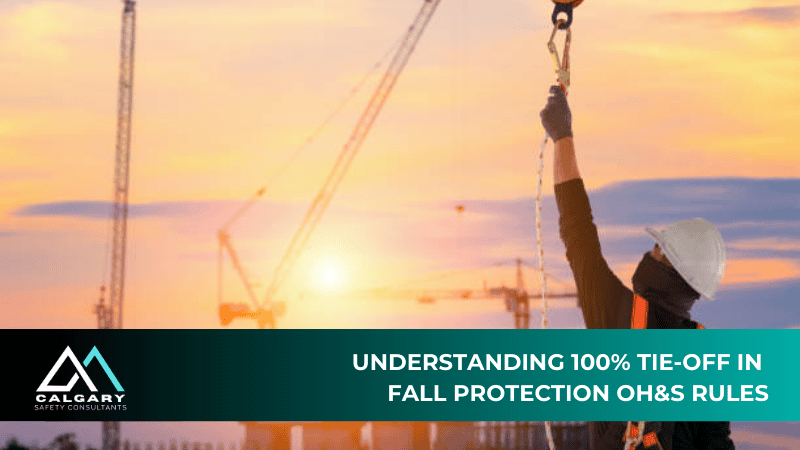
In simple terms, 100% tie-off means that a worker must be connected to a fall protection system at all times when they are working in an area where there is a risk of falling. There should be no moment—even for a few seconds—when the worker is unprotected.
This concept is critical when working at heights (typically 3 metres or more in most jurisdictions), such as on scaffolding, ladders, rooftops, or structural steel. If a worker needs to move from one anchor point to another, they must use equipment (like a double-lanyard system or a Y-lanyard) that allows them to stay connected before they disconnect from the first point. This constant connection ensures that if a slip or misstep happens, the fall protection system is in place to stop a potentially life-threatening fall.
100% tie-off is more than just a best practice—it’s a core principle of fall protection safety and is often a legal requirement under provincial or federal workplace safety regulations.
By staying continuously tied off, workers are always protected, no matter where they’re moving or working. It’s one of the simplest ways to reduce serious injuries or fatalities related to falls from heights.
For more details, check out:
http://safewaze.com/helpie_faq/what-does-the-term-100-percent-tie-off-in-fall-protection-refer-to/
Why Is 100% Tie-Off Important?
Falls are one of the leading causes of serious work-related injuries and deaths. Making 100% tie-off mandatory reduces risks and protects both workers and businesses from tragic accidents and legal trouble.
For more statistics on fall hazards, visit:
http://www.osha.gov/fall-protection
For Canadian figures, see the WorkSafeBC data in the business impact section below.
When Is 100% Tie-Off Required? Alberta, BC and Saskatchewan
100% tie-off applies whenever a worker is exposed to a fall hazard that requires fall protection. The height and details differ a little by province, so check the rules for the province where the work is happening.
Alberta’s OH&S Requirements for Fall Protection
In Alberta, fall protection is a critical component of workplace safety, especially for industries such as construction, oil and gas, and industrial maintenance. The Occupational Health and Safety (OHS) Code outlines clear responsibilities for employers and workers when it comes to working at heights.
Under Part 9 of Alberta’s OHS Code, employers are required to implement a fall protection system any time a worker is exposed to a fall of 3 metres (10 feet) or more, or where there is a risk of injury from a fall, regardless of the height. This includes open edges, elevated platforms, unguarded roofs, or scaffolding.
More specifically, employers and supervisors must ensure a worker is protected from falling if the worker may fall 3 metres or more, less than 3 metres where there is an unusual possibility of injury, into or onto a hazardous substance or object, or through an opening in a work surface. Alberta also requires a fall protection plan where a worker may fall 3 metres or more and is not protected by guardrails. That plan must address fall hazards, the fall protection system, anchors, clearance distances, inspection and use procedures, and it must be reviewed with workers before work begins.
British Columbia’s Fall Protection Requirements
In British Columbia, WorkSafeBC requires fall protection where work is being done at a place from which a fall of 3 metres or more may occur, or where a fall from less than 3 metres involves a greater risk of injury. BC’s regulation also follows a practical control sequence: use guardrails or similar fall restraint where practicable, then fall restraint, then fall arrest or rope access where other options are not practicable. Workers must be instructed before entering an area where a fall risk exists, and workers must use the system provided.
Saskatchewan’s Fall Protection Requirements
In Saskatchewan, a written fall protection plan is required where a worker may fall 3 metres or more and workers are not protected by a guardrail or similar barrier. The plan must describe the fall hazards and the fall protection system used at the worksite.
Personal Fall Arrest System Requirements
When a personal fall arrest system is used, it should include the following components, used as one compatible system:
- ✔️ A full-body harness that distributes the force of a fall across the worker’s thighs, shoulders, and pelvis
- ✔️ A lanyard with a shock absorber or a self-retracting lifeline (SRL) to reduce the impact forces in the event of a fall
- ✔️ Anchors with the strength the regulation requires. In Alberta, fall arrest anchors need a minimum breaking strength of 16 kN per attached worker, or two times the maximum arresting force where the anchor is designed and used to the manufacturer’s or a professional engineer’s specifications. In British Columbia and Saskatchewan, permanent fall arrest anchors generally need about 22 kN (5,000 lbf) per worker. Check the regulation for the province where the work is happening.
These components must be used together, and be inspected regularly, in accordance with the manufacturer’s specifications and the employer’s fall protection program.
How to Stay 100% Tied Off When Moving Between Anchors
Moving is where most 100% tie-off failures happen. A worker is protected at one location, then briefly unprotected while repositioning, climbing past an obstruction, or moving to the next work area. To keep the worker attached to a fall protection system at all times while exposed to a fall hazard:
- Workers may use double-lanyard systems (Y-lanyards) or dual SRLs that allow one connection to be maintained while the other is moved.
- Anchor points must be properly planned and available throughout the work area to support continuous protection.
- Fall protection training must emphasize hazard awareness, safe movement, and proper equipment use to ensure tie-off is never compromised.
Failing to maintain 100% tie-off is a common and dangerous mistake in the field. Where fall protection is required, a worker who disconnects while still exposed is unprotected, and the employer may be out of compliance with the fall protection rules in its province.
Why 100% Tie-Off Must Be More Than a Rule
A simple rule that says “workers must maintain 100% tie off” is not enough by itself. Workers need to know exactly where to connect, when to connect, what equipment to use, what not to connect to, and what to do when the normal method does not work.
This matters because fall protection failures are often procedural failures, not just equipment failures. The equipment may be sitting in the truck. The harness may be fitted correctly. The worker may even intend to tie off. The real issue is that the procedure does not match the task, the anchor points are unclear, or the work sequence forces workers to improvise.
A good fall protection process starts before the worker reaches the edge. Employers should ask: Can the work be done from the ground? Can guardrails be installed? Can the worker be kept away from the edge using travel restraint? If fall arrest is required, has the employer confirmed anchor strength, compatibility, swing fall risk, free-fall distance, rescue access, and clearance below the worker?
How to Write Safe Work Procedures for 100% Tie-Off
Employers often ask how to write safe work procedures that actually work in the field. The answer is to write the procedure around the task, not around generic wording copied from a manual.
A safe work procedure for 100% tie off should explain the actual job sequence. It should identify when the worker becomes exposed to a fall hazard, what system is used, where the worker connects, how the worker moves while staying connected, and who verifies the setup before work begins.
The procedure should also explain limitations. For example, a worker should know whether the system is for travel restraint or fall arrest. They should know whether the anchor is engineered, temporary, manufacturer-specified, or restricted to a specific piece of equipment. They should understand that tying off to a handrail, pipe, scaffold component, guardrail, or random structural member may not be acceptable unless it has been assessed and approved for that use.
A strong procedure should include pre-use inspection, equipment compatibility, weather and surface conditions, rescue steps, supervisor responsibilities, and stop-work expectations. If the worker cannot stay connected through the whole task, the procedure is not finished.
If you need a full site plan rather than a single procedure, see our step-by-step guide to fall protection plans.
Common Gaps with 100% Tie-Off
One of the most common gaps with 100% tie off in fall protection is treating it as a behaviour issue when it is actually a planning issue. Telling workers to “tie off” is easy. Giving them a practical way to stay tied off is harder.
Common problems include unclear anchor locations, poor rescue planning, lanyards that are too long for the available clearance, workers using fall arrest when travel restraint would be better, missing inspection records, incomplete training records, and supervisors not verifying the setup before the job starts.
Another issue is transition points. Workers may be tied off in an aerial lift but disconnect while stepping onto a roof. They may be protected while working on one section of a structure but exposed while moving to the next section. They may connect to one anchor, finish that part of the task, then disconnect before reaching the next anchor. These short transition moments need to be built into the procedure.
Employer Responsibilities
Employers must:
- Develop and implement a fall protection plan for any work site where workers are exposed to fall hazards
- Ensure that workers are trained in fall protection systems, including how to achieve 100% tie-off
- Provide and maintain approved fall protection equipment
- Conduct regular inspections of harnesses, lanyards, anchor points, and lifelines
For Alberta’s fall protection laws, visit:
https://search-ohs-laws.alberta.ca/legislation/occupational-health-and-safety-code/part-9-fall-protection/
Business Impact and Risk Considerations
When fall protection is vague, workers improvise. When workers improvise at height, the business risk increases quickly. The immediate risk is obvious: serious injury or fatality. The operational effect is also serious. Work stops, supervisors are pulled away from production, equipment may be shut down, emergency response may be required, and the project schedule can be disrupted.
The financial risks can include regulatory penalties, WCB claim costs, increased premiums, replacement labour, retraining, investigation time, rework, legal costs, and lost contracts. In BC construction alone, WorkSafeBC reported more than 5,400 injury claims from falls from elevation from 2020 to 2024, including almost 1,900 serious injuries and 35 fatalities. WorkSafeBC also issued 152 administrative penalties for inadequate fall protection in 2024, totalling $1,069,720.
The compliance risk is just as important. Poor fall protection documentation can affect COR audits, client prequalification, contractor management, and regulatory due diligence. If a fall protection plan does not match the work, if workers have not reviewed it, or if training records and inspections are missing, the employer may have difficulty proving that the system was understood, implemented, and monitored.
Measurable performance should focus on leading indicators the employer can verify. Examples include 100% fall protection training completion for exposed workers, documented pre-use equipment inspections before work at height, 95% or higher completion of supervisor field observations, correction of high-risk fall protection deficiencies within 24 to 48 hours, and closure of non-urgent corrective actions within 30 days. These are defensible because they can be tracked through training records, inspection forms, site observations, corrective action logs, and audit files.
Situation: A mid-sized contractor working across Alberta and Saskatchewan had a generic fall protection procedure that told workers to maintain 100% tie off, but it did not identify task-specific anchor points or transition methods.
Action: The employer updated the fall protection plan, created task-specific safe work procedures, identified approved anchors, added a supervisor verification checklist, refreshed worker training, and completed a rescue drill.
Result: Within two months, the company had complete training records for exposed workers, documented weekly inspections, and reduced repeat fall protection deficiencies from eight observations in the first month to one in the second month. The company also had clearer documentation available for client review and audit preparation.
How we help
How Calgary Safety Consultants Can Help
Navigating fall protection requirements doesn’t have to be overwhelming—that’s where Calgary Safety Consultants comes in! We help employers turn fall protection requirements into practical field systems that supervisors and workers can actually use, across Alberta, British Columbia and Saskatchewan. Here’s how we can help your business:
✅ Customized Fall Protection Plans and Procedures – We assess your worksite and develop a tailored safety strategy and safe work procedures that support 100% tie-off.
✅ Training Programs – We provide hands-on safety training so your team knows how to properly use fall protection gear and never work unprotected.
✅ Equipment Selection & Inspection – We help you choose the right equipment and establish regular inspections to keep your workers safe.
✅ OH&S Compliance Audits – Regular audits help identify safety gaps, improve workplace safety, and confirm you meet the OH&S rules that apply to your sites.
We can also review existing safety manuals, support hazard assessments, and help with COR and SECOR preparation, audit readiness, corrective action tracking, training records, and inspections. For employers that work at height, the goal is not paperwork for the sake of paperwork. The goal is a safety system that shows what workers are expected to do, how supervisors verify it, and how the employer can prove due diligence when it matters.
Final Thoughts: The Real Meaning of 100% Tie-Off
100% tie-off isn’t just a rule on a safety checklist—it’s a life-saving principle that should be part of every worker’s mindset when working at heights. While compliance with fall protection regulations is essential, the true purpose behind these rules is to prevent serious injuries and fatalities.
It has to be planned into the job before workers reach the fall hazard. When employers confirm the hazards, equipment, anchor points, procedures, training, supervision, and rescue process, they create a system workers can actually use in the field.
Leaders, supervisors, and workers all share the responsibility of making sure fall protection systems are in place, properly used, and continuously monitored. That includes proper training, inspections, planning, and communication.
At the end of the day, the goal of 100% tie-off is simple: to make sure every worker goes home safe. When that principle becomes part of your workplace culture, you don’t just meet the standard—you raise it.
Stay safe, Calgary!
Jurisdiction note: This article provides general occupational health and safety information. The legal requirements that apply depend on the workplace location, industry and federal, provincial or territorial jurisdiction. Verify current requirements with the applicable regulator before using the information operationally. Government of Canada overview of occupational health and safety jurisdiction.
References
- Canadian Centre for Occupational Health and Safety, Fall Protection Legislation:
https://www.ccohs.ca/oshanswers/hsprograms/fall/fall_protection_legislation.html - Canadian Centre for Occupational Health and Safety, Fall Protection Hierarchy of Control:
https://www.ccohs.ca/oshanswers/hsprograms/fall/fall_protection_hierarchy.html - Canadian Centre for Occupational Health and Safety, Fall Protection – Legislation for Anchor Strength:
https://www.ccohs.ca/oshanswers/hsprograms/fall/fall_protection_leg_anchor_strength.html - Government of Alberta, Occupational Health and Safety Code, Part 9 Fall Protection:
https://search-ohs-laws.alberta.ca/legislation/occupational-health-and-safety-code/part-9-fall-protection/ - WorkSafeBC, Occupational Health and Safety Regulation, Part 11 Fall Protection:
https://www.worksafebc.com/en/law-policy/occupational-health-safety/searchable-ohs-regulation/ohs-regulation/part-11-fall-protection - CanLII, Saskatchewan Occupational Health and Safety Regulations, 2020:
https://www.canlii.org/en/sk/laws/regu/rrs-c-s-15.1-reg-10/latest/rrs-c-s-15.1-reg-10.html - Association of Workers’ Compensation Boards of Canada, WorkSafeBC urges construction employers to prevent falls from heights:
https://awcbc.org/about-us/our-members/news/worksafebc-urges-construction-employers-to-prevent-falls-from-heights - Association of Workers’ Compensation Boards of Canada, 2024 provincial workplace injury statistics released:
https://awcbc.org/about-us/our-members/news/2024-provincial-workplace-injury-statistics-released

About the author
John Duplessis, B.Sc., CRSP
John Duplessis is a Canadian Registered Safety Professional with more than 30 years of occupational health and safety experience in oil and gas, construction, green energy, midstream operations, and industrial project work.