On this page
- Why Jurisdiction Is a Safety-System Decision
- When Federal OHS Law Applies
- When Provincial or Territorial Law Applies
- A Practical Jurisdiction Test
- What Changes After You Identify the Law
- Managing Employees in More Than One Province
- Due Diligence Requires Implementation
- Put Jurisdiction into Change Management
- Why This Matters for Your Business
- Workplace Scenario
- How Calgary Safety Consultants Can Help
- Final Thoughts
- Frequently asked questions
Why Jurisdiction Is a Safety-System Decision
Canadian OHS laws share familiar goals: prevent injury and illness, identify hazards, involve workers, train and supervise, investigate incidents and maintain records. The legal mechanisms are not interchangeable. Definitions, committee thresholds, refusal procedures, reporting deadlines, prescribed forms, training requirements and enforcement powers can differ.
A well-written program can therefore be operationally strong yet legally incomplete. A policy copied from an Alberta operation may name the wrong regulator for a British Columbia site. A federally regulated carrier may use a provincial refusal flow that omits a required federal step. Jurisdiction should be treated as foundational data for the safety management system.
When Federal OHS Law Applies
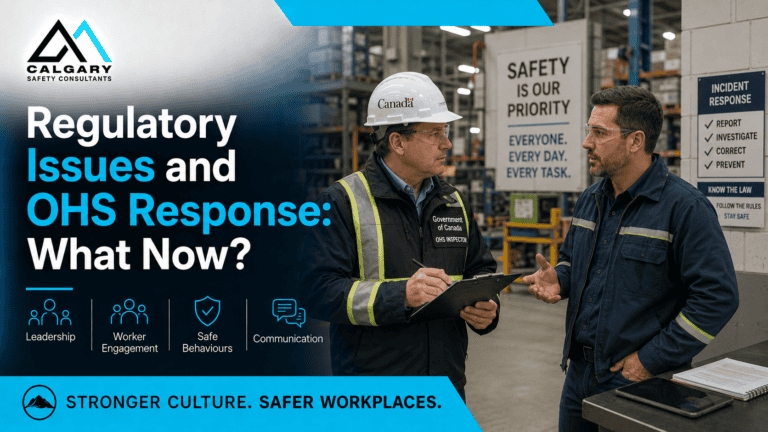
Part II of the Canada Labour Code applies to employees and employers in federally regulated industries and workplaces. Examples identified by the Government of Canada include interprovincial and international transportation, banks, telecommunications, postal services, broadcasting, certain port and airport activities, pipelines crossing borders, and many First Nations band councils and Indigenous self-government activities.
The list requires careful reading. A trucking business that operates across provincial or international boundaries may be federal, while a local carrier operating only within one province is generally provincial. A contractor working inside an airport is not automatically federally regulated simply because the facility has a federal connection. The employer's undertaking and the specific employment relationship matter.
Federal jurisdiction also does not mean every local rule disappears. Building, fire, environmental, workers' compensation and public-safety requirements may still apply through other legal channels. OHS jurisdiction is one part of a broader compliance map.
When Provincial or Territorial Law Applies
Most Canadian workplaces are provincially or territorially regulated. Retail, restaurants, local construction, manufacturing, municipal services and many professional operations ordinarily follow the law of the province or territory where employees work.
In Alberta, the framework includes the Occupational Health and Safety Act, Regulation and Code. In British Columbia, occupational health and safety duties are found in the Workers Compensation Act and the Occupational Health and Safety Regulation. Saskatchewan's framework includes The Saskatchewan Employment Act and The Occupational Health and Safety Regulations, 2020. If you need help applying these rules, our BC safety consultants and Saskatchewan safety consultants pages explain how we support employers in each province.
Those names matter when policies refer to rights, duties or reportable events. A national template should use adaptable language and include jurisdiction schedules instead of pretending that every site has the same regulator, legislative citation or process.
Quick answer
A Practical Jurisdiction Test
Start with evidence about the business rather than assumptions about its name or ownership. Work through these questions:
- What is the employer's essential undertaking or operation?
- Does that undertaking fall within a federally regulated industry identified by the Government of Canada?
- Is the work interprovincial or international in a way that is integral to the undertaking?
- Where are workers physically located, including remote and temporary assignments?
- Are employees part of one operation or distinct business units with different functions?
- Has a regulator, legal adviser or formal decision already addressed the employer's status?
Mixed operations deserve special attention. A corporate group can contain separate employers, and one may be federally regulated while another is provincial. Contractors and subcontractors may have a different jurisdiction from the client whose site they enter. The contract does not, by itself, transfer a worker from one legal regime to another.
When the answer remains uncertain, document the facts and obtain competent legal or regulatory advice. Guessing is risky because the error spreads into every dependent part of the program.
What Changes After You Identify the Law
Map the correct statute, regulations, regulator and workers' compensation authority to each location or operation. Then check the actual requirements for the employer's size, industry and hazards. Do not stop at a general-duty clause when a regulation prescribes a specific committee, training, exposure-control, equipment or reporting rule.
At minimum, review:
- Employer, supervisor and worker duties.
- Worker rights to know, participate and refuse dangerous work.
- Committee or representative requirements and training.
- Incident, injury and occupational-disease reporting.
- Hazard assessment, prevention plans and required written procedures.
- Workplace inspections, first aid and emergency arrangements.
- Record retention, postings and regulator notices.
Assign ownership for monitoring changes. Laws and guidance evolve, and a correct jurisdiction map can still produce stale procedures if no one tracks amendments or regulator publications.
Managing Employees in More Than One Province
A multi-province employer needs a common management system plus controlled local variations. Corporate principles can define minimum expectations for leadership, hazard control, worker involvement, competency and assurance. Jurisdiction appendices can then state local contacts, terminology, committee rules, reporting triggers and statutory references.
This structure is more reliable than maintaining unrelated manuals for every office. It also prevents the opposite problem: a single national policy so generic that supervisors cannot use it. Document control should show which location each appendix covers, when it was reviewed and who approved it.
Remote work does not remove the question. Identify where the employee is employed and performing work, what operation they support, and which authority has jurisdiction. Address home-office hazards, incident reporting, working alone and emergency contact within the applicable framework.
Due Diligence Requires Implementation
Correct citations are not the finish line. Due diligence is demonstrated through reasonable precautions that are actually implemented: competent supervision, meaningful training, functioning controls, timely correction and reliable records. A binder labelled for the right province does not compensate for hazards that remain unmanaged.
Audits should sample both system design and field practice. Interview workers about refusal and reporting procedures, observe whether supervisors apply local requirements, and trace incidents through notification and corrective action. If the company holds COR or SECOR, use audit findings to strengthen implementation; certification is not immunity and does not replace legal compliance.
Put Jurisdiction into Change Management
Create a jurisdiction review trigger for business changes before they reach the field. New routes, customers, subsidiaries, remote-work locations, acquisitions and contract models can alter the facts used in the original decision. Procurement and business-development teams should know when to involve safety and legal specialists.
Use a short decision record stating the operation reviewed, evidence considered, conclusion, reviewer and next review date. Link that record to the affected manual appendices, training and regulator contacts. If the conclusion is provisional, state the interim controls and the person responsible for obtaining confirmation.
Communicate a change directly to supervisors and worker representatives. Replacing a document in an online library is not enough when reporting, committee or refusal steps change. Confirm understanding through a briefing, sample question or exercise before relying on the revised process.
Why This Matters for Your Business
Using the wrong law can cause missed reports, invalid forms, poorly constituted committees, incorrect postings and delayed responses to worker concerns. Those gaps can attract orders or penalties and weaken the employer's ability to show reasonable care after an incident.
Jurisdiction clarity also improves efficiency. Teams know who to call, leaders can budget for the correct training and committees, and national documents can be updated systematically. Acquisitions, new provinces, new transport routes and reorganizations are easier to manage when a jurisdiction review is built into change management.
Workplace example
Workplace Scenario
Situation: A growing service company opened operations in Alberta, British Columbia and Saskatchewan and added a unit that transported equipment across provincial borders. Its original manual named one provincial regulator and used the same incident and work-refusal instructions everywhere.
Action: The company mapped each legal employer, location and core undertaking. It confirmed which operations remained provincial and escalated the interprovincial transport question for formal advice. Corporate requirements were retained, while controlled appendices were created for the applicable law, regulator contacts, reporting and worker-participation processes.
Result: Document review showed each site could identify its governing framework and current local procedure. Interviews verified that supervisors knew which escalation and reporting route applied to their operation. The review created traceable jurisdiction decisions without claiming that one template satisfied every law.
How we help
How Calgary Safety Consultants Can Help
Calgary Safety Consultants supports employers across Canada, including Alberta, British Columbia and Saskatchewan, with jurisdiction-aware programs. OH&S Regulatory Support can help organizations identify applicable requirements and translate them into practical actions.
Safety Program Assessments and Policy Development can test whether corporate and local documents align. Employers expanding or restructuring can use Safety Program Development Services. For ongoing document control and compliance follow-through, see Safety Program Maintenance and Compliance Support below.
Final Thoughts
There is no single occupational health and safety act employers can apply to every operation. Begin with the nature of the business, confirm whether federal or provincial law governs, and build location-specific requirements into one controlled safety system.
Review jurisdiction whenever the business changes its routes, services, legal employers or work locations. That early decision prevents a quiet classification error from becoming a system-wide compliance gap.
References
- https://www.canada.ca/en/employment-social-development/services/health-safety/workplace-safety.html
- https://www.canada.ca/en/services/jobs/workplace/federally-regulated-industries.html
- https://laws-lois.justice.gc.ca/eng/acts/l-2/FullText.html
- https://www.alberta.ca/ohs-act-regulation-code
- https://www.worksafebc.com/en/law-policy/occupational-health-safety/workers-compensation-act-ohs-provisions
- https://www.worksafebc.com/en/law-policy/occupational-health-safety/searchable-ohs-regulation
- https://www.saskatchewan.ca/business/safety-in-the-workplace
- https://publications.saskatchewan.ca/api/v1/products/70351/formats/78194/download

About the author
John Duplessis, B.Sc., CRSP
John Duplessis is a Canadian Registered Safety Professional with more than 30 years of occupational health and safety experience in oil and gas, construction, green energy, midstream operations, and industrial project work.