Don’t Guess on WHMIS: Why Online Training is Smart
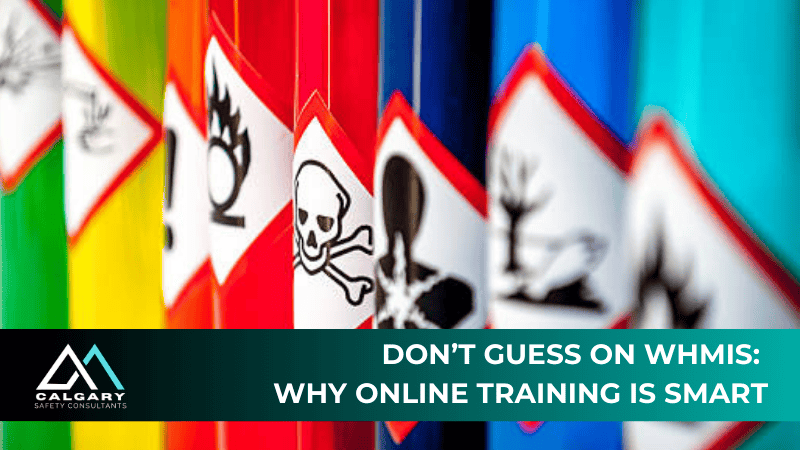
Here’s the truth—hazardous products aren’t limited to labs or factories. They’re tucked away in janitor closets, stocked in auto shops, used daily in clinics, salons, and just about everywhere else. If your workplace handles cleaners, adhesives, paints, fuels, or anything bearing a WHMIS label, you’ve got legal obligations. And training is at the top of that list.
Too many businesses in Canada still treat WHMIS like it’s optional—or worse, a one-and-done chore. IT’S NOT. It’s mandatory. And getting it wrong can cost you in more ways than one.
So let’s break down what WHMIS is, why online training works (and works well), and how Calgary Safety Consultants makes it easy to stay compliant without burning time or budget.
First off: What Exactly is WHMIS?
WHMIS stands for the Workplace Hazardous Materials Information System. It’s Canada’s national communication standard for hazardous products in the workplace. Every province and territory has adopted it into their occupational health and safety laws. The system is meant to ensure that workers:
- Understand the hazards of products they’re working with
- Know how to use them safely
- Can locate and interpret Safety Data Sheets (SDS)
- Recognize and understand WHMIS labels
WHMIS was updated in 2015 to align with the Globally Harmonized System (GHS), so if you’re still running on outdated training from before then—you’ve already got a compliance problem.
You can read more from Canada’s official source here:
https://www.canada.ca/en/health-canada/services/environmental-workplace-health/occupational-health-safety/workplace-hazardous-materials-information-system.html
Who Needs WHMIS Training?
Short answer: almost every workplace in Canada.
Longer answer: If you have any hazardous product on-site—whether it’s bleach, acetone, compressed gases, or corrosives—you’re required to provide WHMIS education and training.
This applies to:
- Construction crews using sealants and adhesives
- Dental and medical clinics using disinfectants
- Cleaning companies handling industrial cleaners
- Manufacturing sites with lubricants and chemicals
- Even office spaces with printer toner and batteries
Every employer must ensure that workers who use or are exposed to hazardous products receive proper WHMIS training. That’s spelled out in both federal and provincial legislation.
For federally regulated businesses (like banks, telecom, airlines), here’s the law:
https://laws-lois.justice.gc.ca/eng/regulations/SOR-2016-141/page-2.html
In Alberta, check this out:
https://www.alberta.ca/whmis-requirements.aspx
What Happens if You Skip It?
Let’s not sugarcoat it—non-compliance can land you in hot water. Think:
- Administrative penalties
- Stop work orders
- Hefty fines
- Loss of contracts due to audit failures
- Damaged company reputation
What is the worst-case scenario? A serious chemical incident where you can’t prove training was done properly. You don’t want to be explaining that to a government officer—or a judge.
Why Online WHMIS Training Just Makes Sense
Old-school, in-person WHMIS sessions are fine—but they’re also outdated for most workplaces. Here’s why online WHMIS training is the better move for businesses across Canada:
Flexibility
Your team can complete the training when it fits their schedule. No booking boardrooms or shutting down operations. Workers can train from a desktop, laptop, or even their phones.
Consistency
Everyone gets the same info, the same standards, and the same level of instruction. That means fewer gaps in understanding—and better results in the field.
Trackability
Online training platforms let you keep records, track completions, issue certificates, and send reminders when training needs to be refreshed. It’s compliance made visible.
Cost-Efficiency
No travel. No instructor fees. No overtime. Just effective, certified WHMIS training for a fraction of the cost of traditional classroom sessions.
But Watch Out: Not All WHMIS Courses Are Created Equal
Here’s where it gets sketchy. There are plenty of $10 “WHMIS certificate” sites online that give you a PDF after a three-question quiz. But if the training:
- Doesn’t align with WHMIS 2015/GHS
- Isn’t Canadian-compliant
- Doesn’t include education + workplace-specific training guidance
- Doesn’t offer tracking or records for employers
…it’s not valid.
If an inspector asks for proof and you point to one of these discount sites, you’ll be out of luck. Worse, you’ll be out of compliance.
No matter what, your workplace will still need to fill in the gaps with site-specific training—covering the actual hazardous materials used on-site. Providing that awareness, and documenting it properly, is a key part of demonstrating due diligence.
How Calgary Safety Consultants Can Help
At Calgary Safety Consultants, we offer online WHMIS training designed by certified OH&S professionals who know the legislation inside and out. Our platform is clean, mobile-friendly, and tailored for real workplaces.
Here’s what you get with us:
- WHMIS 2015 / GHS-compliant content
- Interactive modules with built-in quizzes
- Immediate certification upon completion
- Access for desktop and mobile
- Ongoing support and refresher scheduling
We also help employers go beyond generic training. Need workplace-specific WHMIS instruction? We can build a custom training module or give your supervisors tools to deliver it themselves.
Get started or learn more here:
https://calgarysafetyconsultants.ca/online-whmis-training/
Checkout our other WHMIS offerings at:
https://learnformula.com/course/whmis-2015
Don’t Forget Workplace-Specific Training
We mentioned it above, but a lot of companies think an online WHMIS course is enough. It’s not the whole picture.
The law says you also need to provide site-specific training. That includes:
- Where to find Safety Data Sheets at your location
- What to do in case of a spill, leak, or exposure
- What PPE is required for your specific products
- Emergency procedures unique to your site
We help businesses create those procedures. Whether you’re a one-location business or a multi-site operation, we can help you get—and stay—compliant.
How Often Should You Renew WHMIS Training?
It’s not a “set-it-and-forget-it” deal. Most provinces recommend annual reviews and require re-training when:
- New hazardous products are introduced
- Workers change roles
- Procedures or legislation changes
Calgary Safety Consultants offers annual reminders and bulk re-certification options to make this simple.
Final Word: Safety Isn’t a Checkbox—It’s a Culture
If you’re managing people, you’re responsible for their health and safety. That includes giving them the tools, knowledge, and training to work safely around hazardous products. Online WHMIS training is a low-effort, high-impact way to do just that.
And you don’t have to do it alone. Need help making the difference? Calgary Safety Consultants is here to guide you! Contact Calgary Safety Consultants for your complimentary consult to explore tailored OH&S solutions that drive real results.
We’ll help you get compliant—and stay that way.
References
- Health Canada: WHMIS Overview
https://www.canada.ca/en/health-canada/services/environmental-workplace-health/occupational-health-safety/workplace-hazardous-materials-information-system.html - Alberta WHMIS Requirements
https://open.alberta.ca/publications/whmis-2015-information-for-workers - WorkSafeBC WHMIS Guidelines
https://www.worksafebc.com/en/health-safety/hazards-exposures/whmis - Ontario Ministry of Labour – WHMIS
https://www.ontario.ca/page/workplace-hazardous-materials-information-system-whmis
Frequently Asked Questions
Is WHMIS training legally required in Canada?
Yes. Canadian workplaces that use, handle, store, or may expose workers to hazardous products must provide WHMIS education and workplace-specific training. Online WHMIS training can support the general education portion, while employers must ensure workers also understand the hazardous products, SDSs, labels, controls, and procedures used at their specific workplace.
Does Calgary Safety Consultants offer valid WHMIS training?
Yes. Calgary Safety Consultants provides WHMIS 2015 compliant online training for Canadian workplaces, along with customized support and documentation for compliance.
How often should WHMIS training be refreshed?
WHMIS education and training should be reviewed at least annually and updated when workplace conditions, hazardous products, SDSs, labels, procedures, roles, or hazard information change. Employers should also confirm any refresher or evaluation requirements that apply in their province or territory.