
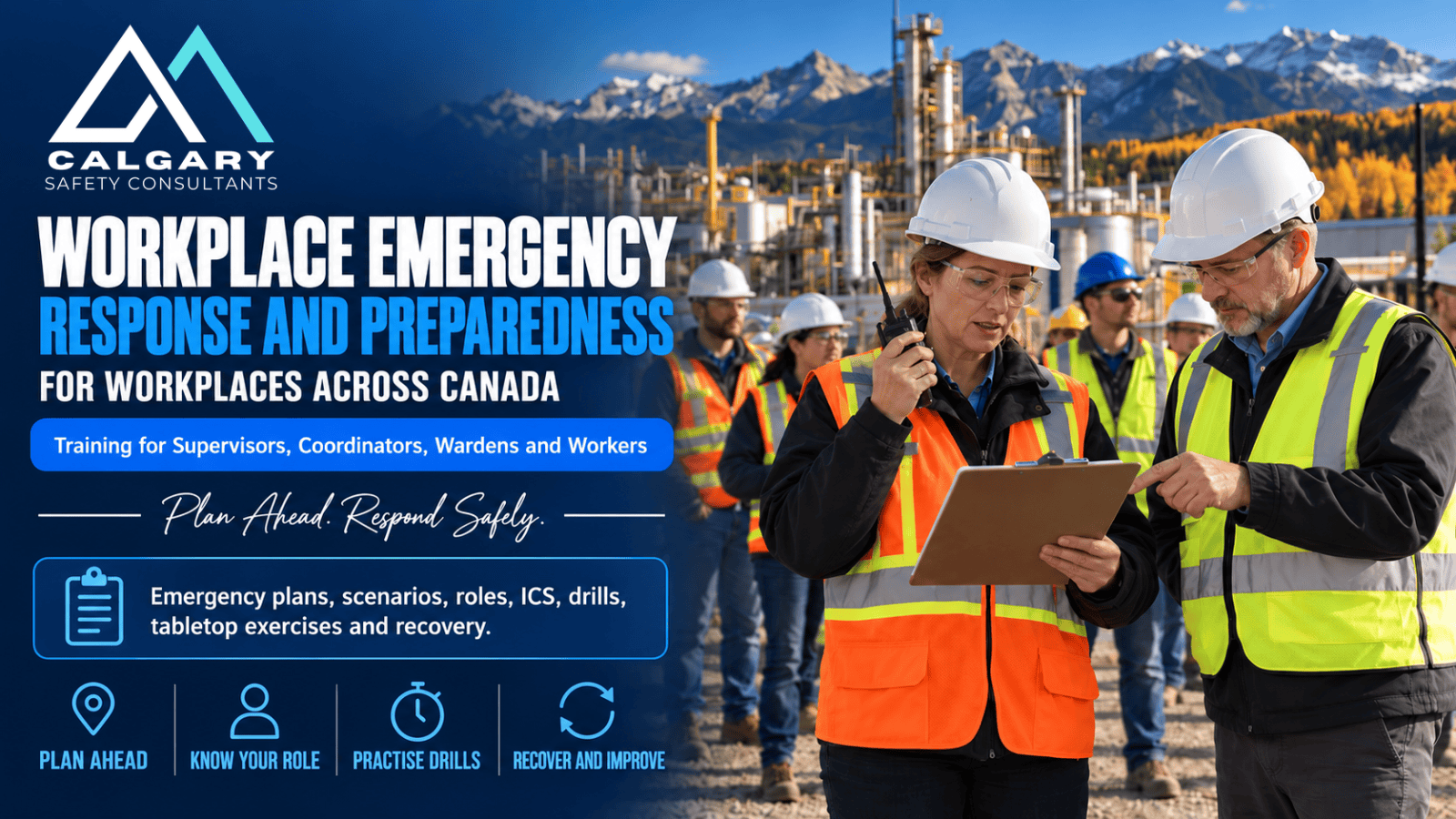
Workplace Emergency Response and Preparedness
Once you have registered and enrolled, scroll to the Course Content section at the end of this page to begin your lessons.
Our online emergency response training helps supervisors, managers, emergency coordinators, wardens and workers with assigned emergency roles prepare for the emergencies their workplace could realistically face, and respond safely when one starts. This self-paced course covers recognizing an emergency, the emergency planning requirements in Canada’s 14 OH&S jurisdictions, vulnerability assessment, building and coordinating an emergency response plan (ERP), emergency scenarios, roles and alternates, the Incident Command System (ICS), communication and accountability, response to common workplace and industry emergencies, drills, tabletop exercises, and recovery and continuous improvement.
Need training for your team? For online group training, buy your enrolments here, then complete our Group Training Student Information form so we can set up each learner’s account. If your workplace needs a plan built or reviewed, see our emergency response planning and ERP development services. For live virtual or classroom sessions for your team, see our incident and emergency management training.
Learn more about how our online safety training works.
An emergency plan only works if people know it, trust it and can carry it out under pressure. When your leaders and assigned responders share the same understanding, the first few minutes go better: alarms are raised sooner, people are accounted for, responders get a clear briefing, and the site recovers in a controlled way. Good preparation also shows up in day-to-day results, with fewer surprises during audits and inspections, drills that find real gaps, and less disruption, cost and claims after an event.
This is awareness-level training. It doesn’t replace your workplace’s emergency response plan, site-specific orientation, role training and drills, or the legislation, fire code and local requirements that apply to you. It doesn’t qualify anyone for a specialized response role such as rescue, firefighting or hazardous materials response, and it isn’t approved by any regulator.
Online Emergency Response Training Course at a Glance
Delivery: 100% online and self-paced
Course format: 14 narrated video lessons in four modules, with written lesson notes, workplace examples, decision points and knowledge checks
Course length (estimated): About 5 to 5.5 hours, including about 4.4 hours of lesson video plus the knowledge checks and final exam
Assessment: A three-question knowledge check after every lesson (100% to continue) and a 10-question final exam (80% to pass), with unlimited retries
Includes: Downloadable Student Reference Guide with jurisdiction reference tables, 16 worksheet masters and three exercise tools, and a Certificate of Completion
Audience: Supervisors, managers, emergency coordinators and alternates, wardens, joint committee members and workers with assigned emergency roles across Canada
Price: $29.99 CAD plus GST
What Does Online Emergency Response Training Cover?
This emergency response training follows the life of an emergency, from the planning that happens long before an event to the recovery and review that follow it. Each lesson connects the content to decisions people make at real workplaces, and asks you to compare it with your own site’s plan.
You’ll learn how to:
- Recognize when an incident is becoming an emergency, and know the limits of your own response role.
- Identify the emergency planning requirements that apply in your jurisdiction, and record them in a legal register.
- Assess credible emergency scenarios, their consequences and the weak points in your response.
- Develop an emergency response plan with procedures people can follow under pressure.
- Build realistic emergency scenarios that link to your procedures, training and exercises.
- Assign workable emergency roles with alternates across shifts, contractors and shared buildings.
- Apply the basic principles of the Incident Command System and give responding agencies a clear, verified briefing.
- Communicate warnings, choose protective actions that fit the conditions, and keep everyone accounted for.
- Take safe first actions in fire, hazardous materials, medical, security, severe weather and remote work emergencies.
- Plan and evaluate drills and tabletop exercises, then coordinate a safe recovery and verify the improvements.
Every lesson includes written notes, workplace examples, decision points and a knowledge check, so learners practise making sound decisions rather than memorizing a procedure.
Emergency Planning Requirements Across Canada
Canada has 14 OH&S jurisdictions: the federal government, 10 provinces and 3 territories. Each one sets its own emergency planning and drill requirements, and fire codes, municipal bylaws and other legislation, such as transportation of dangerous goods rules, can add more. Some jurisdictions spell out what a written emergency plan must contain and how often drills must be held. Others set more general duties that depend on the hazards and the workplace.
This course teaches the principles that apply across Canada and shows where the jurisdictions differ, with examples checked against official government and regulator sources in October 2026. The Student Reference Guide includes jurisdiction reference tables for regulators and legislation, emergency planning and drills, and first aid and serious incident reporting. Requirements change, so always confirm the current rules for your own workplace. Our emergency management safety guides are a good place to start.
Who Should Take This Emergency Response Training?
This course is built for the people who plan for emergencies, lead the first response or hold an assigned role in the plan, from a new floor warden to a manager responsible for several sites.
It’s suitable for:
- Supervisors, forepersons and crew leads
- Managers, superintendents and site leads
- Emergency coordinators and their alternates
- Fire wardens, area leads and muster point coordinators
- Joint health and safety committee members and health and safety representatives
- Safety coordinators, advisors and HR staff who help maintain the emergency plan
Employers often use the course when they build or update an ERP, as orientation for people taking on emergency roles, before a drill or tabletop exercise, or as preparation for a COR or SECOR audit that looks at emergency preparedness.
Online Emergency Response Training Course Features
Our online emergency response training is designed to be practical, realistic and easy to apply to your own site.
Course features include:
- 100% online and self-paced learning
- 14 narrated video lessons, each about 15 to 29 minutes long
- Written lesson notes with learning objectives, workplace examples, decision points and key takeaways
- Downloadable Student Reference Guide with lesson summaries, reflection questions and jurisdiction reference tables
- 16 worksheet masters, including a legal requirements register, scenario worksheets, a roles and alternates matrix, a responder briefing form, drill and tabletop planning forms and an ERP review checklist
- A worked tabletop exercise delivery plan and a high-hazard industry adaptation guide
- Realistic examples from many Canadian industries, provinces and territories
- A three-question knowledge check after every lesson, with feedback and unlimited retries
- A 10-question final exam covering all four modules
- Certificate of Completion
- Group enrolment for employers training several people
The course focuses on what people need to do: when to act, who decides, how to communicate, how to account for everyone, and when to step back and let trained responders take over.
Online Emergency Response Training Course Modules
The course is organized into four modules. Each lesson is one complete narrated video with written notes and a knowledge check.
Module One: Emergency Preparedness and Canadian Legal Responsibilities
Module One explains what turns an incident into an emergency, the four connected phases of emergency management, the emergency planning requirements across Canada’s 14 OH&S jurisdictions, and how a vulnerability assessment identifies the credible emergencies your plan has to cover.
Lessons:
- Lesson One: Understanding Workplace Emergencies
- Lesson Two: Emergency Planning Requirements Across Canada
- Lesson Three: Identifying Emergencies and Conducting a Vulnerability Assessment
Module Two: Developing and Coordinating the Workplace Emergency Response Plan
Module Two walks through developing and coordinating the workplace emergency response plan: writing procedures people can follow, building realistic scenarios, assigning roles and alternates, working within the Incident Command System and with government agencies, and keeping communication, protective actions and accountability under control.
Lessons:
- Lesson Four: How to Develop a Workplace Emergency Response Plan
- Lesson Five: Developing Emergency Scenarios for Your ERP
- Lesson Six: Workplace Emergency Roles and Responsibilities
- Lesson Seven: Introduction to ICS and Working with Government Agencies
- Lesson Eight: Communication, Protective Actions and Accountability
Module Three: Responding to Workplace and Industry Emergencies
Module Three applies the plan to the emergencies workplaces most often face, including fire, explosion, hazardous materials and industrial emergencies, medical emergencies, violence and security threats, and severe weather, natural hazards, transportation incidents and remote work.
Lessons:
- Lesson Nine: Fire, Explosion, Hazardous Materials and Industrial Emergencies
- Lesson Ten: Medical Emergencies, Violence and Security Threats
- Lesson Eleven: Severe Weather, Natural Hazards, Transportation and Remote Work
Module Four: Training, Exercises, Recovery and Improvement
Module Four covers keeping the plan ready and improving it: matching training and drills to assigned duties, planning and running a tabletop exercise, and coordinating recovery, reporting and continuous improvement after an emergency.
Lessons:
- Lesson Twelve: Emergency Training and Practical Drills
- Lesson Thirteen: How to Plan and Conduct a Tabletop Exercise
- Lesson Fourteen: Emergency Recovery, Reporting and Continuous Improvement
Complete Your Online Emergency Response Training
Register online, then work through the lessons in order at your own pace. After each video, complete the lesson’s three-question knowledge check. You need all three answers correct (100%) to move on, and you can retry as many times as you need, with feedback after each answer to help you learn.
After Lesson 14, complete the 10-question final exam, which draws on all four modules. You need 8 correct answers (80%) to pass, and you can retake it as many times as you need. Once you’ve completed all 14 lessons, their knowledge checks and the final exam, you can download your Certificate of Completion.
The certificate shows that you completed awareness-level online training in workplace emergency response and preparedness. It isn’t a professional designation, it doesn’t qualify you for a specialized response role, and it doesn’t confirm that any workplace’s plan meets the law.
Frequently Asked Questions About Online Emergency Response Training
Does this emergency response training cover every province and territory?
Yes. The course covers all 14 Canadian OH&S jurisdictions: the federal government, the 10 provinces and the 3 territories. It teaches the principles they share and shows where their emergency planning and drill requirements differ, and the Student Reference Guide includes jurisdiction reference tables. Always confirm the current requirements for your own workplace.
Who should take emergency response training?
Supervisors, managers, emergency coordinators and their alternates, fire wardens, joint committee members and workers with assigned emergency roles. Anyone who helps plan for emergencies or leads the first response benefits from understanding how a workplace emergency plan should work.
How long does the online emergency response training course take?
We estimate about 5 to 5.5 hours. The 14 lesson videos run about 4.4 hours in total, and the knowledge checks and final exam add time depending on your pace. You can stop and return at any time.
Will this course qualify me for rescue, firefighting or first aid?
No. This is awareness-level training. Rescue, firefighting, hazardous materials response and first aid each need their own role-specific training, equipment and authorization through your employer. The course helps you understand how those roles fit into the plan and when to call for them.
Does the course cover the Incident Command System?
Yes. Lesson 7 introduces the key principles and basic functions of the Incident Command System (ICS) and how a workplace works alongside responding agencies. It’s an introduction, not formal ICS certification, so check with your employer whether your role needs a recognized ICS course.
Does this course help us build our own emergency response plan?
Yes. The lessons walk through vulnerability assessment, plan development, scenarios, roles, drills and tabletop exercises, and the Student Reference Guide includes 16 worksheet masters you can adapt. If you’d like expert help, our consultants can build or review your ERP with you.
Do I receive a certificate?
Yes. You receive a Certificate of Completion after you complete all 14 lessons, their knowledge checks and the final exam. It records completion of awareness-level online training. It isn’t a professional designation and it isn’t approved by any regulator.
Can employers purchase training for several people?
Yes. Employers can buy online training for two or more learners on this page. After placing your order, complete our Group Training Student Information form with your order number and each learner’s name and email address. We set up each learner’s account and email course-access instructions.
Additional Emergency Response Resources
The resources below help you check the requirements where you work and strengthen your own plan. Use the official sources to read the current legislation and guidance, and our services when your plan needs more than training. Requirements change, so always use the current version.
Canada Occupational Health and Safety Regulations
Issued by: Government of Canada (Justice Laws website)
Part XVII sets out emergency procedures, evacuation plans and drill requirements for federally regulated workplaces. Use it if your employer is federally regulated.
Canada Occupational Health and Safety Regulations
OHS Regulation Part 4, General Conditions
Issued by: WorkSafeBC
British Columbia’s requirements for emergency preparedness and response, including risk assessment, written procedures and drills. Use it for work in British Columbia.
OHS Regulation Part 4, General Conditions
Alberta OHS Act, Regulation and Code
Issued by: Government of Alberta
Search Alberta’s OHS Act, Regulation and Code, including the emergency preparedness and response requirements in Part 7 of the OHS Code. Use it for work in Alberta.
Alberta OHS Act, Regulation and Code
Emergency Response Assistance Plans (ERAPs)
Issued by: Transport Canada
Explains when an ERAP is required for dangerous goods and how it works with a workplace’s own emergency plan.
Emergency Response Assistance Plans (ERAPs)
About ICS Canada
Issued by: ICS Canada
Background on the Incident Command System as it’s used in Canada, and the organizations that maintain it.
About ICS Canada
Emergency Response Planning and ERP Development Services
Issued by: Calgary Safety Consultants
Our consulting support for building, reviewing and testing your emergency response plan, including vulnerability assessments, drills and tabletop exercises.
Emergency Response Planning and ERP Development Services
Basic Site Emergency Response Plan
Issued by: Calgary Safety Consultants
A site emergency response plan prepared for smaller workplaces that need a clear, practical plan without a full consulting project.
Basic Site Emergency Response Plan
Related courses: Working Alone and Lone Worker Safety, Hazard Assessment and Control for Canadian Workplaces, Understanding Canadian OH&S Legislation and Incident Reporting and Investigation Training.