How to Investigate a Workplace Incident
How to secure the scene, gather the facts, find the causes and fix them, with a clear, step-by-step investigation process and report.
Coming soon
Practical guides to handling workplace incidents well: what to report and when, how to investigate and find the real causes, and how to stop the next one. Written for employers, supervisors and safety committees anywhere in Canada.
Prepared by Calgary Safety Consultants, led by John Duplessis, B.Sc., CRSP.
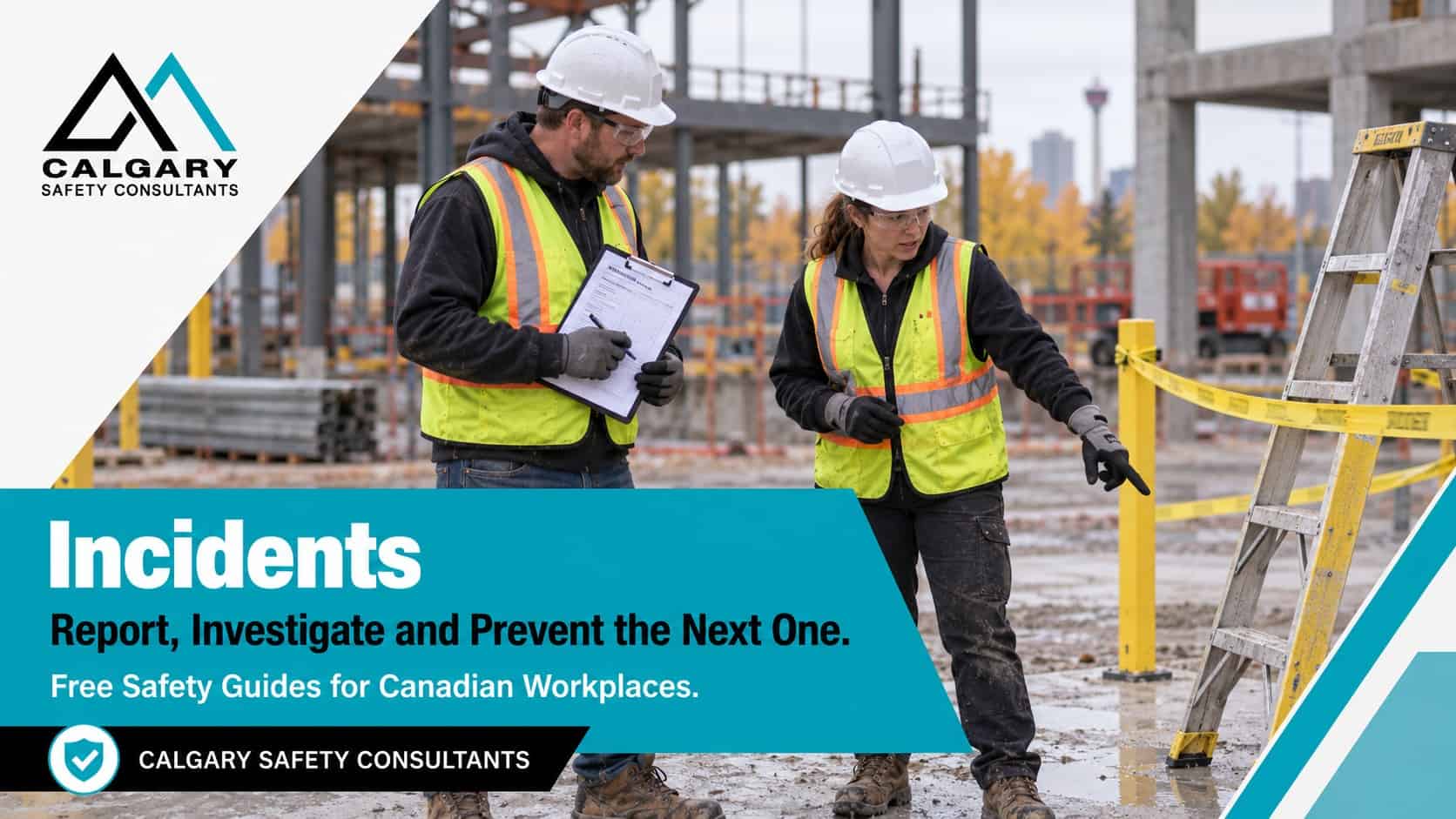
Incident guides
Every guide in this category explains how a part of managing workplace incidents is done well, with the legal requirements linked at the point they matter and free downloads you can adapt. Guides marked coming soon open here as they're published.
How to secure the scene, gather the facts, find the causes and fix them, with a clear, step-by-step investigation process and report.
Coming soonHow to look past the immediate cause to the system failures behind an incident, using tools such as the five whys and cause diagrams.
Coming soonWhat must be reported, to whom and how quickly in each province and territory, and how OHS reports differ from compensation claims.
Coming soonHow to get workers reporting near misses and close calls, and how to turn those reports into fixes before someone gets hurt.
Coming soonAbout workplace incidents
A workplace incident is any unplanned event that injured someone, made someone ill or damaged property, or could easily have done so.
Every one of them is information. An injury, a near miss or a damaged piece of equipment tells you something about how the work is really being done, which controls are weaker than they look and where the next, more serious event is likely to come from. Handled well, workplace incidents become some of the most useful lessons a business ever gets.
The words matter less than the response, but it helps to agree on them. The UK Health and Safety Executive's guide to investigating accidents and incidents, HSG245, defines an accident as an event that results in injury or ill health, and a near miss as an event that causes no harm but could have. The US Occupational Safety and Health Administration's incident investigation guidance prefers incident for both, because accident implies something that couldn't have been prevented.
Managing workplace incidents has four parts: responding and making the area safe, reporting to the right people on time, investigating to find the causes, and fixing those causes so the same thing doesn't happen again. Most of the legal requirements, and most of the problems we see, sit in the last three.
The payoff goes well beyond compliance. Every lost-time injury brings claim costs, lost production and pressure on your premiums, and a serious incident can bring an OHS investigation, orders and hard questions from clients who prequalify their contractors. A business that investigates well, and can show what it changed, is in a much stronger position in all of those conversations.
Research on investigation itself is worth knowing. A study of eight investigation manuals by Lundberg, Rollenhagen and Hollnagel, published in Safety Science, found that each manual carried its own model of how accidents happen, and that model shaped the causes investigators found: what you look for is what you find. A review in BMJ Quality & Safety by Peerally and colleagues described common problems with root cause analysis, including the myth of a single root cause, weak fixes and a failure to learn across incidents.
How it works
Whether it's a near miss or a serious injury, workplace incidents call for the same five steps.
Get first aid or medical help to anyone who's hurt, call emergency services if needed and make the area safe so no one else is injured. After a serious incident, secure the scene and leave it undisturbed except to help the injured, prevent further harm or protect property in danger.
Notify the regulator right away if the incident is reportable, and file any workers' compensation report separately. Tell the joint committee or representative and senior management. If you're not sure whether an incident must be reported, call the regulator and ask.
Start promptly, while the scene is intact and memories are fresh. Photograph and sketch the scene, interview the people involved and any witnesses one at a time, and collect records such as training, maintenance, hazard assessments and procedures. Involve a worker representative as your jurisdiction requires.
Build a timeline, then work back from the immediate cause to the conditions, decisions and system gaps that made it possible. Most incidents have several causes. Stopping at worker error tells you who was there, not why the system allowed it.
Choose corrective actions with the hierarchy of controls, give each one an owner and a due date, and check that it worked. Share what you learned with crews and the committee, and review incident trends regularly so patterns show up before the next serious event.
These steps line up closely with HSG245, which sets out four: gather the information, analyse it, identify risk controls, then make and carry out an action plan. OSHA's guide to root cause investigations, written with the US Environmental Protection Agency, describes a root cause as a fundamental, underlying, system-related reason an incident occurred, and lists tools such as timelines, logic trees and causal factor charts.
Closer to home, WorkSafe Saskatchewan's guidance on investigations describes root causes as the underlying problems that set events in motion, recommends investigating near misses, and advises prioritizing corrective actions according to risk.
What the law expects
Every Canadian jurisdiction requires serious workplace incidents to be reported and investigated, but what counts as serious, who must be told and how fast differ from one to the next.
In Alberta, the prime contractor, or the employer if there isn't one, must report deaths, hospital admissions, serious unplanned fires, explosions or floods, crane and hoist collapses and structural failures to OHS as soon as possible, as the province explains on its serious incident reporting page. Potentially serious incidents, those with a likelihood of causing serious injury or illness, must be investigated and then reported online. Investigation reports go to the committee or representative and are kept for at least two years.
British Columbia's incident reporting rules require immediate notice of serious injuries and deaths, major structural failures, major releases of hazardous substances, dangerous fires or explosions, and blasting incidents that cause injury. WorkSafeBC's guide to conducting an employer investigation sets out the stages: a preliminary investigation within 48 hours with interim corrective action, then a full investigation report within 30 days. Employers and supervisors must not try to stop anyone from reporting.
Saskatchewan requires notice of deaths, hospital admissions of 72 hours or more and listed dangerous occurrences as soon as is reasonably possible, and its OHS Regulations, 2020 set out what an investigation report must contain. Federally regulated employers must investigate, record and report hazardous occurrences, and some must be reported within 24 hours. In Ontario, a death or critical injury is reported immediately, with a written report to follow within 48 hours.
| Jurisdiction | Reporting to the regulator | Investigation and records |
|---|---|---|
| Alberta | As soon as possible: deaths, hospital admissions, serious unplanned explosions, fires or floods, crane or hoist collapses and structural failures. Potentially serious incidents are reported online after they're investigated. | The prime contractor or employer investigates with the committee or representative. The written report is kept for at least two years. |
| British Columbia | Immediately: serious injuries and deaths, major structural failures, major hazardous releases, dangerous fires or explosions and blasting incidents causing injury. | The employer and a worker representative take part. Preliminary investigation within 48 hours, full report within 30 days. |
| Saskatchewan | As soon as is reasonably possible: deaths, hospital admissions of 72 hours or more, and listed dangerous occurrences. | Accidents that cause, or may cause, death or a hospital stay of 24 hours or more are investigated, with a written report of causes and corrective actions. |
| Ontario | A death or critical injury immediately, with a written report within 48 hours. Disabling injuries within four days. | Construction and mining occurrences have their own two-day notice rules. Check the Act and its regulations for details. |
| Federal | Within 24 hours for deaths, disabling injuries to two or more employees, permanent impairments, explosions and other listed occurrences. | A qualified person investigates. The record is made within 72 hours, and certain written reports are due within 14 days. Records are kept for 10 years. |
Workers' compensation reporting is a separate duty. In Alberta, employers report injuries to WCB-Alberta within 72 hours of becoming aware of them, and WorkSafeBC is clear that its injury report doesn't replace the duty to report certain incidents immediately. A good procedure covers both, so nothing falls between the two.
Because the details differ, start by confirming which law applies to your workplace. Our OHS Legislation category links the Act, regulations and regulator for all 14 jurisdictions in Canada, and explains how to read them.
From our audits
When the same kinds of workplace incidents keep happening, the problem is usually in how they're investigated and followed up, not in how they're reported.
Each of these is fixable once you see it. The guides on this page show how to handle workplace incidents well, from the first phone call to the last corrective action.
Free downloads
Use these free tools to report and follow up on workplace incidents consistently, then adapt them to your work and the law that applies to you.
From the blog
August 6, 2026

March 9, 2026
February 9, 2026
July 21, 2025
When to bring in help
The guides are written so you can act on them yourself. Sometimes it helps to have an experienced safety professional involved, especially after a serious incident, when an OHS officer is investigating or when the same problems keep coming back.
Calgary Safety Consultants helps employers handle workplace incidents well. We support investigations after serious incidents, train supervisors and committee members to investigate and find root causes, review your reporting procedures and investigation records, and help you set up near-miss reporting that workers actually use. Our consulting focuses on Alberta, British Columbia and Saskatchewan, and our online training and free downloads are available anywhere in Canada.
We help employers prepare for COR and SECOR audits, but we don't issue certificates. CORs and SECORs are issued through the applicable certifying partner.
Common questions
Answers to the questions employers, supervisors and committee members ask most often about reporting and investigating workplace incidents.
An accident is an event that results in injury or ill health. A near miss is an event that didn't cause harm but could have. Many safety professionals and regulators now use incident for both because, as the US Occupational Safety and Health Administration points out, accident suggests something that couldn't have been prevented. Whatever you call them, both deserve attention.
It depends on the jurisdiction, but most require prompt reporting of deaths, serious injuries or hospital admissions, structural collapses, major hazardous releases, and dangerous fires or explosions. Alberta also requires potentially serious incidents to be reported, and Saskatchewan lists specific dangerous occurrences. Each regulator publishes its own list, so check yours and keep the reporting number where supervisors can find it.
Faster than most people expect. Alberta requires reporting as soon as possible, British Columbia immediately and Saskatchewan as soon as is reasonably possible. Ontario requires an immediate report of a death or critical injury, then a written report within 48 hours, and federally regulated employers report certain occurrences within 24 hours. If you're unsure whether an incident is reportable, call the regulator and ask.
The employer is responsible, but the law often requires others to take part. Alberta involves the joint committee or representative, British Columbia requires the employer and a worker representative to participate, Saskatchewan has the committee co-chairs or the employer and representative investigate, and federally regulated employers appoint a qualified person. Investigators should be trained, and it helps to include someone who wasn't involved.
At minimum: what happened, where and when, who was involved, the sequence of events, the immediate and underlying causes, and the corrective actions taken or planned, with owners and dates. Saskatchewan's regulations, for example, call for a description, supporting evidence such as photographs, the causes, and both immediate and long-term corrective action. Write it in plain language, so workers and managers can act on it.
Some jurisdictions set them. In British Columbia, a preliminary investigation is due within 48 hours and the full report within 30 days. Federally regulated employers must record the investigation within 72 hours and file certain written reports within 14 days. Where no deadline is set, start right away, while the scene is intact and memories are fresh, and finish once you've found the causes.
A root cause analysis looks past the immediate cause of an incident, such as a slip or a dropped load, to the underlying reasons it was possible. OSHA describes a root cause as a fundamental, underlying, system-related reason an incident occurred, and the UK Health and Safety Executive notes that root causes are generally management, planning or organizational failings. Fixing them prevents more than one incident.
Use the method that fits the incident. The five whys works well for simpler events and often takes three to five questions to reach a useful cause. Cause-and-effect, or fishbone, diagrams help a team sort causes into groups such as equipment, environment, procedures and people. Timelines and event trees suit more complex incidents. Most incidents have several causes, so be wary of any method that stops at one.
They should be. Near misses share the same causes as workplace incidents that hurt people, and the UK Health and Safety Executive notes they're as useful and much easier to investigate. In British Columbia, incidents that had the potential to cause serious injury must be investigated, and in Alberta, potentially serious incidents must be investigated and reported. A good process makes reporting easy and shows workers what changed.
No. A workers' compensation report and an OHS incident report are separate duties to separate organizations. In Alberta, the employer reports an injury to WCB within 72 hours of becoming aware of it, while serious incidents must also be reported to OHS. WorkSafeBC notes that its injury report doesn't meet the duty to report certain incidents immediately. Make sure your procedures cover both.
Not right away. After a serious incident, the scene generally can't be disturbed until an OHS officer or the police allow it, except to help injured people, prevent further injury or protect property in danger. Alberta, Saskatchewan and federal law all set rules like this. Secure the area, take photos, record conditions and check with the regulator before moving anything else.
It varies. Alberta requires investigation reports to be kept for at least two years, British Columbia first aid records for three years, Saskatchewan's first aid register for five years, and federally regulated employers' hazardous occurrence records for ten years. Where your jurisdiction is silent, keep records of workplace incidents and investigations long enough to show due diligence and support trend analysis.
Incident reporting and investigation is one of the elements a COR audit examines. Auditors look for a clear reporting procedure, trained investigators, completed reports with real causes, corrective actions that were closed and evidence that lessons were shared. A strong incident process produces those records. We help employers prepare, but we don't issue certificates. CORs and SECORs are issued through the applicable certifying partner.
Yes. We support investigations after serious incidents, train supervisors and committee members to investigate and find root causes, review your reporting procedures and records, and help you set up near-miss reporting. Our consulting focuses on Alberta, British Columbia and Saskatchewan, while our guides, free downloads and online training are available anywhere in Canada. Book a free consultation to talk it through.
Talk to a safety consultant
Whether you're dealing with a serious incident now, improving how you investigate or setting up near-miss reporting, we'll help you work out the next practical step. Complete the form below or book a 30-minute consultation.