What Is a Safety Professional?
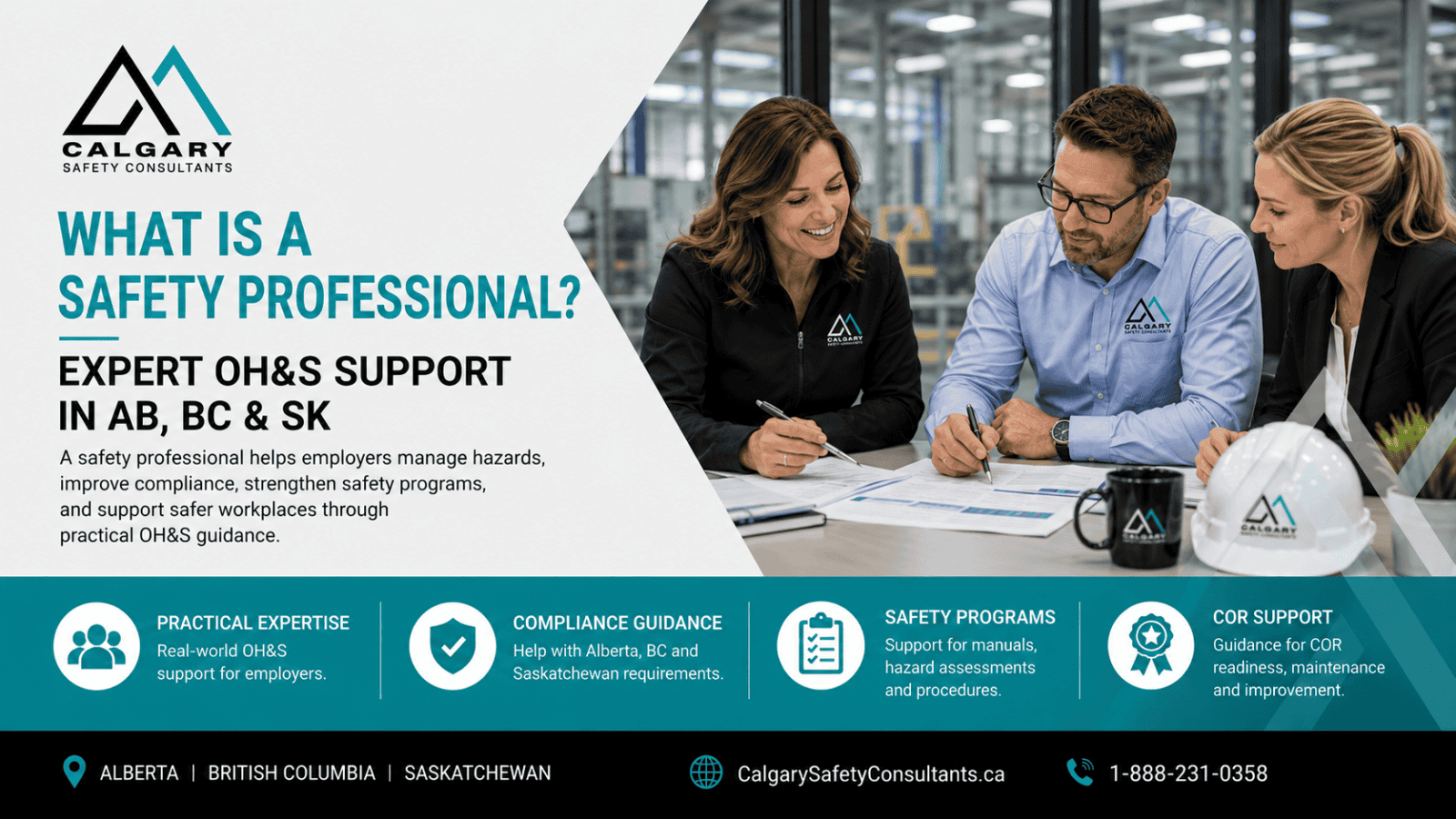
A safety professional helps employers identify workplace hazards, assess risk, implement controls, meet occupational health and safety requirements, and keep the safety program working in day-to-day operations.
In practical terms, a professional support helps turn OH&S requirements into usable workplace systems. This may include safety manuals, hazard assessments, workplace inspections, training records, incident investigations, corrective action tracking, COR and SECOR support, supervisor guidance, contractor safety documentation, and ongoing safety program maintenance.
Calgary Safety Consultants provides practical safety pro support for employers in Calgary and across Alberta, British Columbia, and Saskatchewan. We help construction companies, transportation businesses, warehouses, manufacturers, agricultural employers, healthcare organizations, municipal operations, utilities, contractors, and growing businesses improve safety documentation, compliance, and day-to-day safety performance.
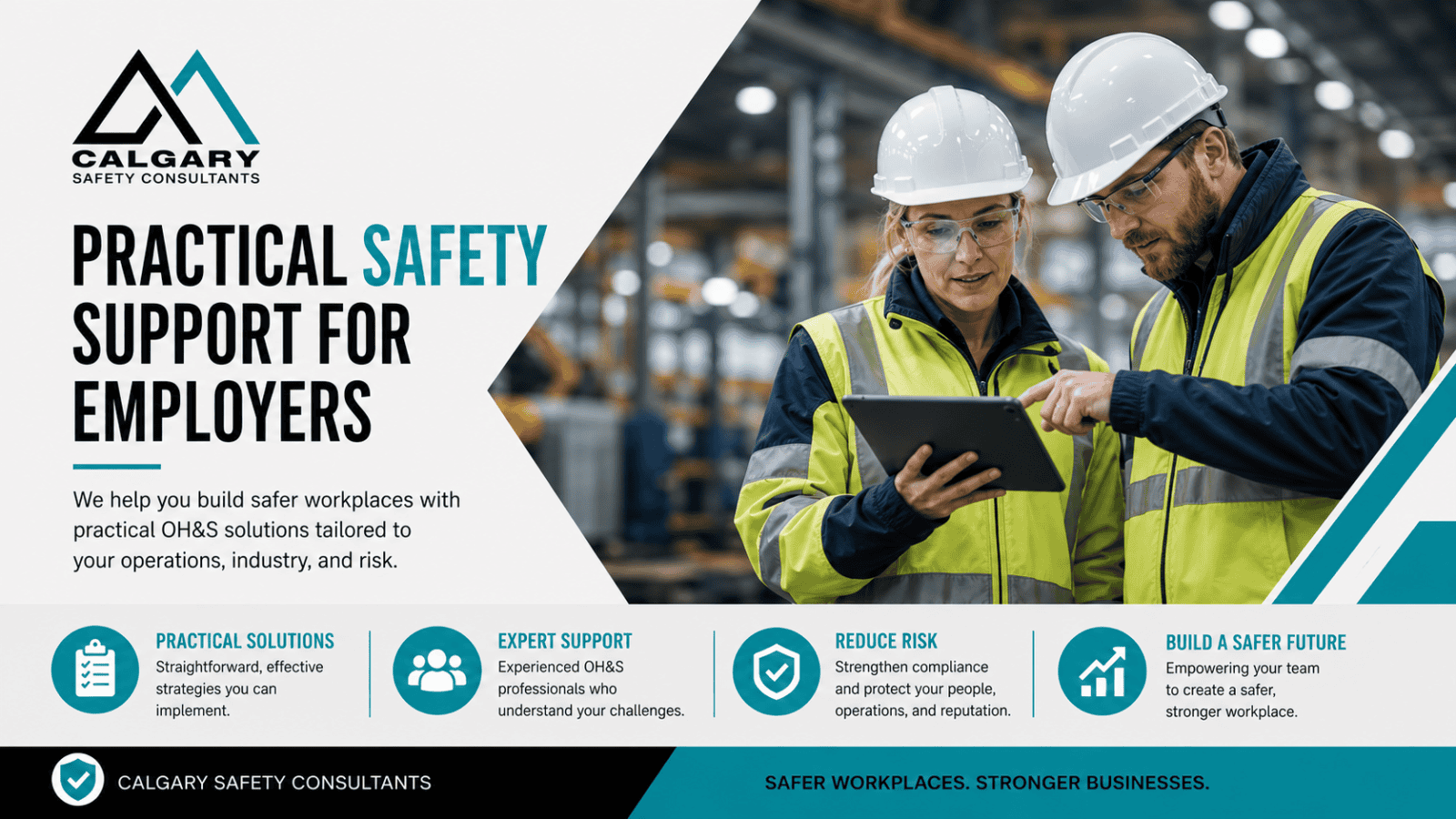
Practical Safety Professional Support for Employers
Most employers want to keep workers safe, but many safety programs become outdated, incomplete, or disconnected from the work being performed. A professional helps the employer close that gap by reviewing what exists, identifying what is missing, and creating practical steps that support compliance, supervision, training, documentation, and risk control.
A safety manual may exist, but the forms may not be used. Hazard assessments may be started, but not reviewed. Training records may be scattered across emails, spreadsheets, and certificates. Corrective actions may be discussed after an incident, but never formally tracked to completion.
That is where practical safety professional support can help. The value is not just knowing legislation. The value is helping the employer apply OH&S requirements in a way that works for the actual workplace.
A qualified advisor brings structure, clarity, and practical direction to the safety program. The role is not only about knowing legislation. It is about helping the employer apply safety requirements in a way that works for managers, supervisors, workers, contractors, clients, and auditors.
When the safety program is organized and actively maintained, the business is in a better position to prevent incidents, manage claims, support productivity, meet client expectations, and demonstrate due diligence during audits, inspections, or regulatory reviews.
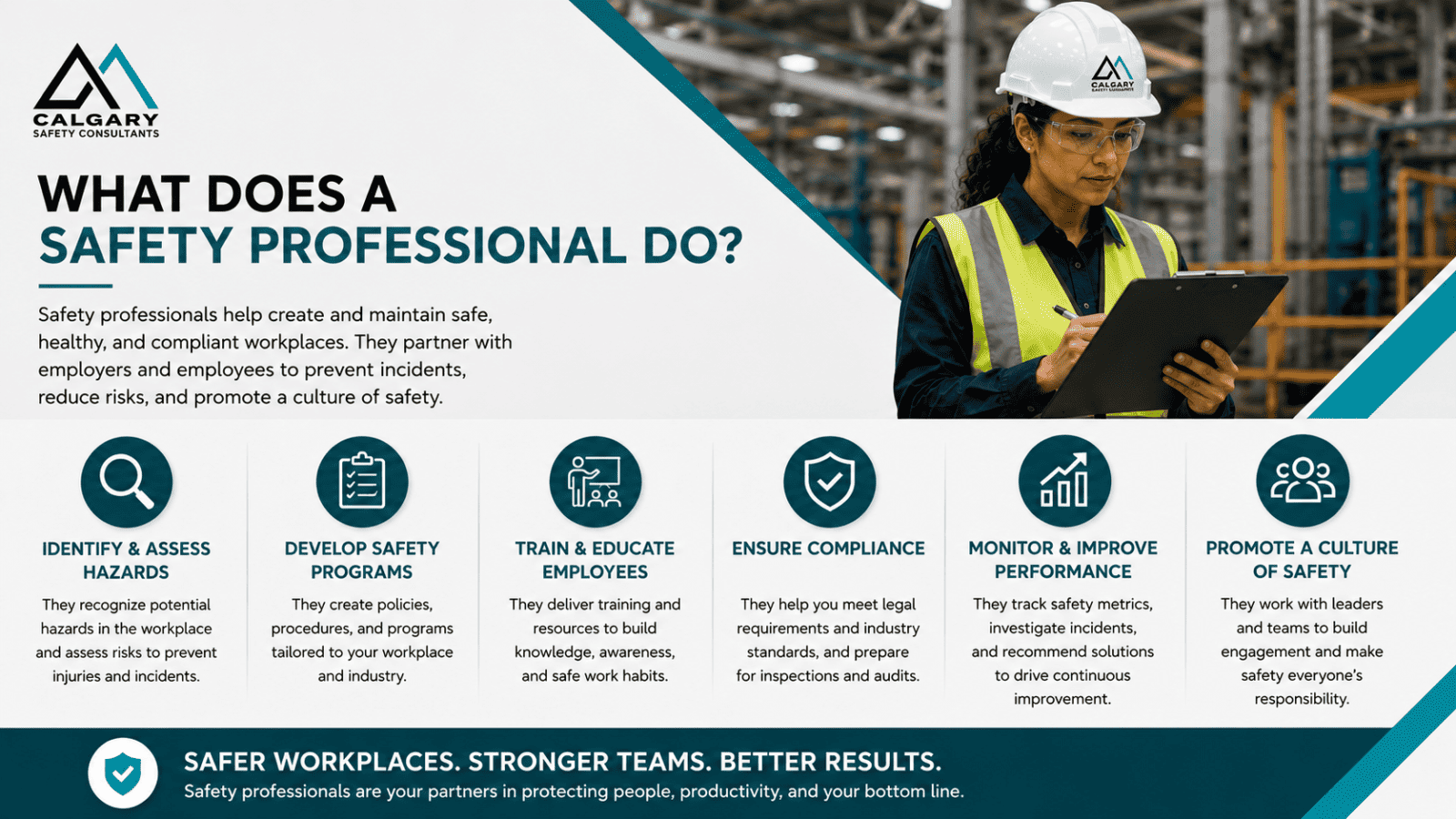
What Does a Safety Professional Do for Employers?
A safety pro helps close the gap between written OH&S requirements and actual workplace practice. For many employers, the challenge is not knowing that safety matters. The challenge is building a system that supervisors can apply, workers can follow, and management can verify.
This support may include reviewing safety manuals, improving hazard assessments, organizing training records, completing workplace inspections, supporting incident investigations, tracking corrective actions, preparing for COR or SECOR, responding to OHS orders, improving contractor safety documentation, and helping supervisors understand their safety responsibilities.
Employers may benefit from external OH&S support when:
- Their safety manual is outdated, generic, or not aligned with current work.
- Hazard assessments, inspections, training records, or corrective actions are incomplete.
- The company is preparing for COR, SECOR, a client audit, or a compliance review.
- Supervisors are unsure how to apply the safety program in daily operations.
- There have been incidents, near misses, claims, or recurring safety concerns.
- The company is growing and the safety program has not kept up.
- The employer needs practical OH&S support but is not ready to hire a full-time safety employee.
- The employer has received an OHS order or needs help responding to regulatory concerns.
When these gaps are ignored, the business may face higher risk, weaker audit performance, more claims exposure, lower productivity, and greater difficulty demonstrating due diligence.
What Qualifications Does a Safety Pros Have?
Not every safety professional follows the same career path. Some safety pros come from construction, manufacturing, transportation, warehousing, healthcare, agriculture, municipal operations, utilities, or resource-sector work. Others begin through formal OH&S education, auditing, training, investigations, compliance, or safety leadership roles.
Employers often look for safety pros who combine practical workplace experience with formal safety training and professional development. This may include occupational health and safety certificates, diplomas, degrees, auditor training, incident investigation training, COR or SECOR experience, regulatory knowledge, and professional designations such as CRSP.
Credentials matter, but practical application matters just as much. A safety pro needs to understand how work is actually performed, how supervisors make decisions, how records are maintained, and how safety requirements affect operations.
The strongest safety professional support helps employers connect legislation, hazard assessments, inspections, training, investigations, corrective actions, contractor management, and due diligence into a system that can be explained, used, and maintained.
Why Safety Pro Support Matters for Business Risk
A weak safety program can create problems long before a serious incident occurs. Employers may see warning signs through repeat inspection findings, missing training records, incomplete hazard assessments, unresolved corrective actions, client documentation requests, or supervisors who are unsure how to apply the safety program.
Missing inspection records, incomplete training files, outdated procedures, poor hazard assessments, unclear supervisor responsibilities, and unresolved corrective actions can all create risk for the employer.
These gaps may affect more than compliance. They can contribute to injuries, equipment damage, downtime, WCB claims, failed audits, client concerns, enforcement action, and confusion among supervisors and workers.
A strong safety program helps the business operate with more control. Workers understand expectations. Supervisors know what to verify. Records are easier to maintain. Hazards are addressed earlier. Corrective actions are tracked. Management has better visibility into what is working and what needs attention.
The value of qualified OH&S support is practical. It helps the employer move from uncertainty to action.
Common Safety Program Problems a Safety Professional Helps Solve
Many employers request a professional support because the safety program exists, but it is not working as clearly as it should.
Common examples include:
- Safety manuals that have not been reviewed for several years.
- Hazard assessments that do not reflect current tasks or equipment.
- Training records that are scattered across emails, spreadsheets, certificates, and supervisor files.
- Workplace inspections that are completed inconsistently.
- Corrective actions that are discussed but not formally tracked.
- Incident investigations that focus on the immediate event but miss deeper contributing factors.
- Supervisors who are expected to enforce safety requirements without clear guidance.
- Contractor safety documentation that does not meet client expectations.
- COR or SECOR audit findings that remain unresolved.
- OHS orders or inspection findings that require a structured response.
This support is especially useful for employers in construction, transportation, warehousing, manufacturing, agriculture, resource support, healthcare, municipal operations, utilities, and contractor-based work.
A safety pro helps identify these gaps and create practical solutions. The goal is to improve compliance, reduce risk, support supervisors, strengthen documentation, and help the employer demonstrate that the safety program is active.
How Calgary Safety Consultants Provides Safety Professional Support
Calgary Safety Consultants helps employers understand what is required, what is missing, and what needs to happen next. Our safety pro support is designed for employers that need practical OH&S guidance without adding unnecessary paperwork or complexity.
We start by learning about your business, the work being performed, your current safety concerns, your operating locations, your industry risks, and any deadlines related to audits, client requirements, COR, SECOR, OHS orders, contractor prequalification, or internal improvement goals.
We can review your safety manual, policies, procedures, hazard assessments, training records, inspection forms, incident reports, emergency response documents, meeting records, and corrective action tracking.
From there, we identify what is missing, outdated, unclear, duplicated, impractical, or not aligned with your workplace activities.
We then help develop a practical action plan that explains what needs to be created, updated, organized, implemented, verified, or maintained.
Where needed, we can also help supervisors understand how to apply the safety program in real work. This may include training support, toolbox meeting guidance, inspection coaching, hazard assessment instruction, incident investigation support, or corrective action follow-up.
After the initial work is complete, Calgary Safety Consultants can help maintain the safety program so documentation, training, inspections, hazard assessments, and corrective actions stay current.
Calgary Safety Consultants supports employers in Calgary, Okotoks, Edmonton, Red Deer, Fort McMurray, Vancouver, Surrey, Burnaby, Kelowna, Kamloops, Regina, Saskatoon, Prince Albert, Moose Jaw, Yorkton, and rural or remote worksites across Western Canada. Support can be delivered virtually for many documentation, training, program review, and advisory needs, with in-person support considered where site conditions or project scope require it.
What Qualifications Does a Safety Professional Have?
External safety pros support can be useful when an employer needs senior OH&S guidance but does not require a full-time safety manager.
This is common for small and mid-sized employers, growing companies, contractors, multi-site organizations, and businesses preparing for audits or client prequalification. It is also common when an employer has experienced an incident, received an OHS order, identified repeat inspection gaps, or realized that the safety program has not kept pace with operations.
External support can help the employer address a defined problem without adding a permanent position. It can also provide an objective review of the safety program, which is useful when internal staff are too close to the existing system or too busy with daily operations.
For employers in Alberta, British Columbia, and Saskatchewan, external safety professional support can also help identify where provincial OH&S requirements, audit expectations, and client documentation requirements may differ.
Industries That Commonly Use Safety Professional Support
Safety pros support is commonly used by employers that face practical workplace risks, client requirements, regulatory expectations, or audit pressure.
Common industries include:
- Construction and trades.
- Transportation and logistics.
- Warehousing and distribution.
- Manufacturing and fabrication.
- Agriculture and agri-business.
- Resource support services.
- Healthcare and community services.
- Municipal operations.
- Utilities and infrastructure work.
- Property management and facility services.
- Contractors and subcontractors.
These employers often need help with safety program development, safety manuals, hazard assessments, inspections, incident investigations, COR and SECOR preparation, contractor prequalification, OHS regulatory response, safety training, and ongoing safety program maintenance.
Related Pages
Use these related pages to connect this overview to specific OH&S consulting services:
Frequently Asked Questions
What is a safety professional?
A safety professional is a trained and competent person who helps employers identify hazards, assess risk, implement controls, meet OH&S requirements, and maintain a functioning workplace safety program. The role is practical. It connects written requirements to real workplace tasks, records, supervision, training, and corrective action.
Is a safety professional the same as a safety consultant?
Not always. A safety professional may be an internal employee, while a safety consultant is usually an external professional hired to provide specific support. Calgary Safety Consultants provides external safety professional support for employers that need practical OH&S help without hiring a full-time safety employee.
When should a business hire or contract a safety pro?
A business should consider hiring or contracting a safety professional when its safety program is outdated, records are incomplete, supervisors are unsure what to do, incidents are occurring, COR or SECOR requirements are approaching, client audit expectations need to be met, or regulatory compliance concerns have been identified.
Do small businesses need a safety pro?
Small businesses may not need a full-time safety professional, but they still need a working safety system. External safety professional support can help small and mid-sized employers organize records, assess hazards, train workers, improve documentation, and meet safety expectations without creating an overly complicated program.
Can a safety professional help with COR or SECOR preparation?
Yes. A safety professional can help employers prepare for COR or SECOR by reviewing safety program gaps, updating documentation, organizing audit evidence, improving hazard assessments, supporting corrective action tracking, and helping supervisors understand how to apply the safety program in daily work.
Can safety professional support be provided virtually?
Yes. Many safety program reviews, documentation updates, training record reviews, audit preparation meetings, and consultation services can be completed virtually. In-person support may be recommended when site conditions, workplace inspections, field verification, or task-specific assessments are required.
Can a safety professional help after an OHS order?
Yes. A safety professional can help review the OHS order, identify required corrective actions, update documentation, support implementation, and help the employer organize evidence of compliance. This can help the business respond more clearly and reduce the risk of missed follow-up.
What industries commonly use your support?
Construction, transportation, warehousing, manufacturing, agriculture, resource support, healthcare, municipal operations, utilities, and contractors commonly use safety professional support to manage workplace hazards, improve documentation, prepare for audits, support supervisors, and maintain OH&S compliance.
What is the difference between a safety professional and an OH&S consultant?
A safety professional may work internally or externally to support workplace health and safety. An OH&S consultant is typically an external safety professional who provides advisory support, program reviews, documentation updates, training support, audit preparation, investigations, or compliance assistance.
Can You help improve our safety manual?
Yes. A safety professional can review and update a safety manual so it better reflects current work activities, hazards, responsibilities, training requirements, inspections, incident reporting, emergency response, contractor management, and corrective action expectations.
Can You support multiple company locations?
Yes. Safety professional support can be provided to employers with multiple locations across Alberta, British Columbia, Saskatchewan, or other Canadian jurisdictions. The goal is to keep the safety program consistent while accounting for local work conditions, provincial requirements, and site-specific hazards.
Can You help after an incident or near miss?
Yes. A safety professional can help review what happened, organize investigation information, identify contributing factors, develop corrective actions, and improve the safety system so similar incidents are less likely to happen again.