MSI Prevention Training and Certification
Musculoskeletal injuries can affect workers in almost every industry. Lifting, repetitive movement, forceful exertion, awkward or prolonged postures, poorly designed workstations, manual handling, and other physical demands can contribute to discomfort, reduced ability to perform work, lost time, and longer-term injury.
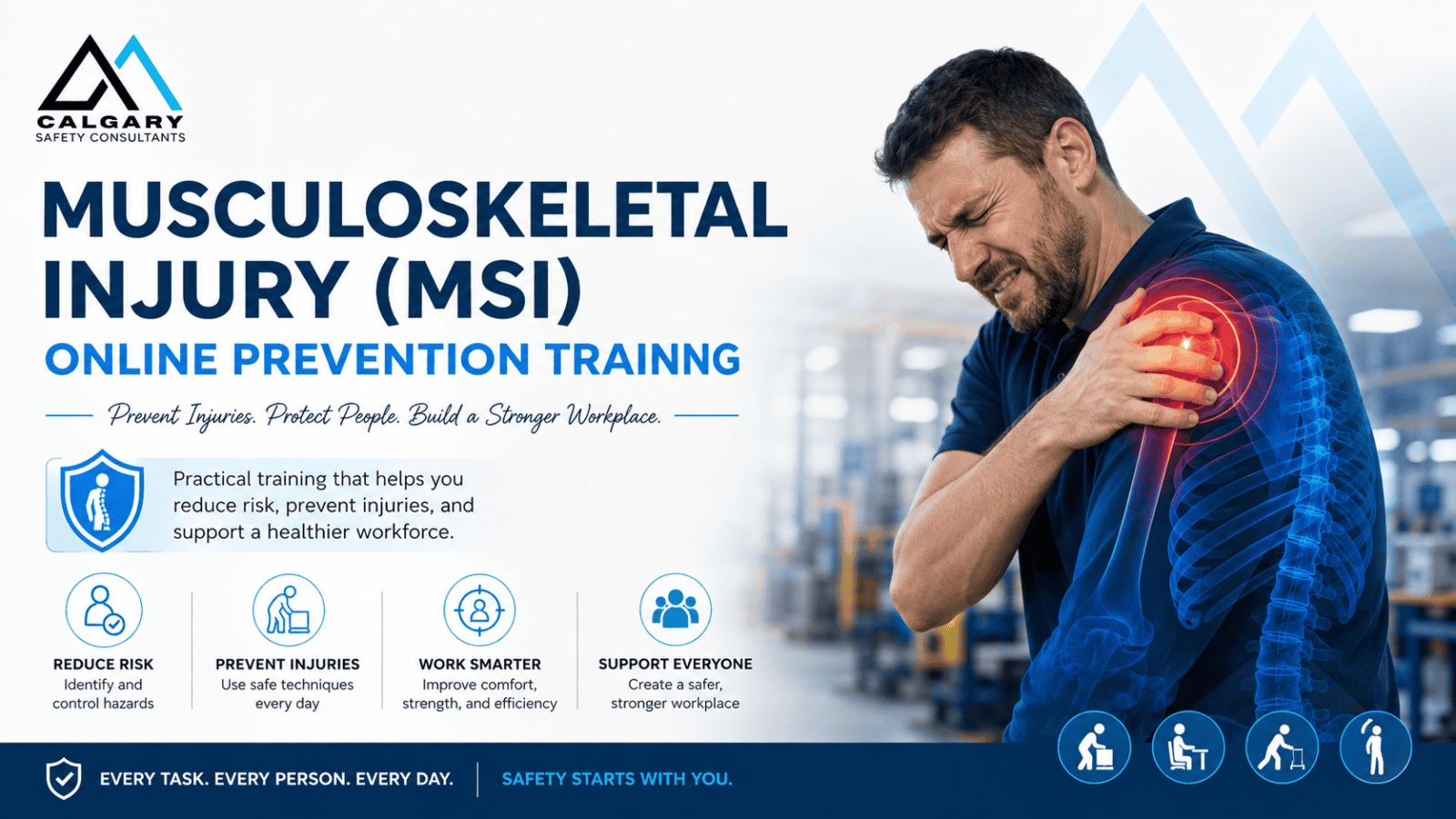
Our Online MSI Prevention Training course provides workers, supervisors, and employers with practical information for recognizing musculoskeletal injury hazards and reducing the risk of injury before problems become more serious.
Whether you are completing MSI training for a new position, meeting an employer training requirement, supporting workplace injury-prevention efforts, or refreshing your existing knowledge, this one-hour online course explains how musculoskeletal injuries develop and what workers and employers can do to reduce exposure to common risk factors.
The course focuses on practical workplace application rather than simply reviewing legislation. Participants learn how to identify MSI risk factors in real tasks, recognize early warning signs, improve lifting and movement practices, apply basic ergonomic principles, and use stronger controls to reduce physical demands.
Work-related musculoskeletal disorders are associated with factors such as forceful exertion, repetition, awkward or static postures, and the pace and organization of work. Ergonomics aims to better match work demands and workplace conditions to the capabilities of the people performing the work.
Specific occupational health and safety requirements for musculoskeletal injury prevention, ergonomics, hazard assessment, training, and controls vary across Canadian jurisdictions. Employers must continue to assess their own workplace requirements and provide any job-specific instruction, procedures, supervision, equipment, and controls required by the applicable legislation and actual work being performed.
Upon successful completion, participants receive a downloadable MSI Prevention Training Certificate of Completion as evidence that the online course has been completed.
If you require virtual or group training we can assist – click here
For more information on our online course – click here
Course at a glance
Delivery: 100% online and self-paced
Availability: Accessible 24 hours a day
Course format: Video lessons, visual examples, workplace scenarios, and quizzes
Certificate: Issued after successful completion
Price: $24.99 plus applicable tax
Audience: Canadian workers, supervisors, contractors, and new employees
Workplace training: Employer-provided workplace-specific instruction is still required
What Does Online MSI Prevention Training Cover?
This Online MSI Prevention Training course explains how musculoskeletal injuries can develop and how workplace conditions, physical demands, equipment, work methods, and task design can influence MSI risk.
Participants learn to recognize hazards before they contribute to pain, reduced function, injury, lost productivity, or time away from work.
The course addresses common work-related factors associated with musculoskeletal disorders, including awkward and static postures, repetitive work, forceful exertion, and other physical demands.
Participants learn how to:
- Define musculoskeletal injuries and recognize commonly affected areas of the body.
- Understand the difference between sudden injuries and injuries that develop through cumulative exposure.
- Identify force, repetition, awkward posture, static posture, and overexertion as potential MSI risk factors.
- Recognize how workstation design, tools, equipment, work pace, and task organization can affect physical demands.
- Recognize early signs and symptoms of musculoskeletal injury.
- Understand the importance of reporting discomfort and emerging concerns early.
- Break work into individual tasks when identifying MSI hazards.
- Recognize high-risk lifting, carrying, pushing, pulling, reaching, and repetitive activities.
- Apply safer movement and material-handling practices.
- Use team lifting or mechanical assistance when appropriate.
- Apply basic ergonomic principles to workstations, equipment, tools, and work areas.
- Understand neutral posture, reach zones, positioning, and workplace setup.
- Apply the hierarchy of controls to MSI hazards.
- Recognize the value of mechanical aids and engineering controls.
- Understand the role and limitations of administrative controls and personal protective equipment.
- Understand worker, supervisor, and employer roles in preventing musculoskeletal injuries.
- Recognize the need to review controls when tasks, equipment, conditions, or worker concerns change.
Interactive lessons, visual examples, workplace scenarios, reflections, quizzes, and knowledge checks help participants connect the course material to actual work rather than simply memorizing definitions.Interactive lessons, workplace examples, quizzes, and knowledge checks help learners apply the information to real working environments instead of simply memorizing regulations.
Online MSI Prevention Training for Canadian Workers
Musculoskeletal injury hazards can occur in virtually every type of workplace.
A warehouse worker may experience high physical demands from lifting and carrying. A construction worker may repeatedly handle tools and materials in awkward positions. A healthcare worker may assist with patient movement. A manufacturing employee may repeat the same motion throughout a shift. An office employee may remain in a poorly supported or static posture for extended periods.
This Online MSI Training for Canadian workers provides broad prevention knowledge that can be applied across industries while recognizing that the actual hazards and controls will vary from one workplace and job to another.
Canadian jurisdictions may also use different terminology and legislative approaches when addressing ergonomics and musculoskeletal hazards. Terms such as musculoskeletal injury, MSI, musculoskeletal disorder, MSD, and work-related musculoskeletal disorder may be encountered in occupational health and safety guidance. CCOHS addresses work-related musculoskeletal disorders nationally, while provinces such as Alberta and British Columbia publish specific MSI and ergonomics resources.
The course therefore focuses on practical prevention principles that workers can apply while employers continue to meet the specific occupational health and safety requirements that apply where the work is performed.
Employers commonly require WHMIS certification before workers begin duties involving hazardous products. Completing this course helps workers understand their responsibilities while supporting employers in meeting Canadian workplace safety requirements.
Who Should Take This MSI Course?
Musculoskeletal Injury Prevention Training is valuable for workers who perform lifting, carrying, pushing, pulling, repetitive tasks, sustained work, forceful activities, awkward positioning, manual material handling, computer work, equipment operation, or other activities that may place physical demands on the body.
The course is appropriate for:
- Construction workers
- Skilled trades
- Manufacturing and production employees
- Warehouse and distribution workers
- Transportation and logistics personnel
- Maintenance workers
- Healthcare and care workers
- Municipal employees
- Oil and gas workers
- Utilities personnel
- Field service workers
- Equipment operators
- Retail and stocking employees
- Cleaning and janitorial workers
- Office and computer-based workers
- Supervisors and managers
- Contractors
- New employees completing orientation
- Existing workers completing refresher training
It is also useful for supervisors and employers who need a stronger understanding of the factors that contribute to musculoskeletal injuries and the practical controls that can be considered when reviewing workplace tasks.
Musculoskeletal disorders are relevant across sectors ranging from offices to construction and manufacturing, which makes prevention and ergonomic awareness applicable well beyond jobs traditionally considered physically demanding.
Employers commonly require WHMIS certification before workers begin duties involving hazardous products. Completing this course helps workers understand their responsibilities while supporting employers in meeting Canadian workplace safety requirements.
Online MIS Prevention Training Course Features
Our Online MSI Prevention Training has been designed to make learning practical, straightforward, and convenient for Canadian workers and employers.
Course features include:
- 100% online and self-paced learning
- Approximately one hour of training
- Immediate online access after registration
- Available 24 hours a day
- Mobile, tablet, and desktop compatible
- Video-based learning
- Visual workplace examples
- Practical MSI prevention scenarios
- Knowledge checks and quizzes
- Easy-to-understand language
- Downloadable Certificate of Completion
- Progress tracking
- No classroom attendance required
The course emphasizes practical decision-making.
Workers learn to look beyond the weight of an object or the appearance of a workstation and consider how factors such as force, repetition, posture, duration, reach, movement, equipment, and work organization combine to influence MSI risk.
The goal is to help participants recognize conditions that may increase physical demands and understand how changes to equipment, task design, work methods, positioning, or other controls can reduce exposure. course focuses on practical application rather than simply reviewing legislation. Workers learn how to recognize hazards, understand product information, select appropriate controls, and make safer decisions during everyday work activities.
Online MSI Prevention Training Course Modules
The course is organized into practical learning modules that build knowledge step by step. Each lesson combines clear explanations, workplace examples, visual demonstrations, and knowledge checks to improve understanding and retention.
Module One: Understanding MSI Risks
The first module introduces musculoskeletal injuries and explains why they are an important workplace health and safety concern.
Participants learn how physical demands and workplace conditions can contribute to both sudden and gradually developing injuries. The module then moves from understanding MSI concepts to recognizing hazards within actual work tasks.
By the end of this module, learners understand how WHMIS fits within a workplace health and safety program and the important role every worker plays in preventing injuries and illnesses.
Module Two: Preventing Musculoskeletal Injuries
The second module focuses on prevention.
Participants learn how safer work practices, ergonomics, equipment, workplace design, and the hierarchy of controls can be used to reduce exposure to common MSI hazards.other workplace incidents.
Complete Your Online MSI Prevention Training
Getting started is simple.
Register online, begin your MSI Prevention Training immediately, work through the two course modules at your own pace, complete the required knowledge checks and course activities, and receive your Certificate of Completion after successfully finishing the course.
Because the course is fully online and self-paced, participants can complete their Online MSI Training when it is convenient, whether they are at home, in an office, at a workplace, or preparing to begin a new position.
Employers can use the course as part of:
- New worker orientation
- Health and safety training
- Musculoskeletal injury prevention initiatives
- Ergonomics awareness
- Manual handling training
- Supervisor development
- Corrective action following identified MSI concerns
- Refresher training
- Workplace injury-prevention programs
Online training should form part of a broader MSI prevention process.
Employers should still identify and assess the actual physical demands and ergonomic hazards associated with the work, implement appropriate controls, provide workers with the equipment and instruction needed to perform tasks safely, respond to reported concerns, and review controls when workplace conditions change. Regulatory requirements differ across Canadian jurisdictions.
Frequently Asked Questions About Online MSI Prevention Training
What is MSI Prevention Training?
MSI Prevention Training teaches workers how to recognize factors that may contribute to musculoskeletal injuries and how safer work practices, ergonomics, equipment, task design, and workplace controls can help reduce risk.
The course addresses common factors such as force, repetitive movement, awkward or prolonged posture, lifting, carrying, pushing, pulling, and other physical demands.
Is this MSI Prevention Training valid across Canada?
The course provides general musculoskeletal injury prevention education that can be used by workers and employers across Canada.
Occupational health and safety legislation is established by the jurisdiction governing the workplace, and requirements relating to ergonomics, musculoskeletal hazards, hazard assessment, instruction, and training are not identical across Canada. Employers remain responsible for determining and meeting the requirements that apply where their workers perform work.
Do I receive an MSI Prevention Training certificate?
Yes. Participants receive a Certificate of Completion after successfully completing the required course material and knowledge checks.
How long does the Online MSI Training course take?
The course takes approximately one hour to complete.
Because the training is self-paced, individual completion times may vary. Participants can work through the material at their own pace and review course information as needed.
Who should take Musculoskeletal Injury Prevention Training?
The course is suitable for workers who perform lifting, carrying, pushing, pulling, repetitive movement, awkward positioning, forceful work, prolonged tasks, manual material handling, computer work, or other activities that may create physical demands.
It is also valuable for supervisors, managers, employers, contractors, new employees, and workers completing refresher training.
What MSI risk factors are covered in the course?
The training addresses factors such as:
- Forceful exertion
- Repetitive movement
- Awkward posture
- Static and prolonged posture
- Overexertion
- Manual material handling
- Lifting and carrying
- Pushing and pulling
- Workstation design
- Tools and equipment
- Work pace
- Task duration
- Combined physical demands
These types of factors are recognized in Canadian occupational health and ergonomics guidance as contributors to work-related musculoskeletal disorders.
Does MSI Prevention Training include ergonomics?
Yes. Ergonomics is an important component of the course. Participants learn how workstation setup, work height, positioning, reach, tools, equipment, posture, adjustability, and task design can affect musculoskeletal injury risk.
The course also explains how improving the fit between the worker and the work can help reduce unnecessary physical demands.
Does the course include safe lifting and material handling?
Yes. Participants review safer lifting and movement practices, carrying, pushing, pulling, load positioning, team lifting, mechanical assistance, repetitive work, work pacing, and other practical ways of reducing physical demands.
What is the difference between an MSI, MSD, and WMSD?
These terms are often used when discussing injuries or disorders affecting muscles, tendons, joints, nerves, and related structures.
MSI generally means musculoskeletal injury.
MSD generally means musculoskeletal disorder.
WMSD means work-related musculoskeletal disorder.
Terminology differs among Canadian jurisdictions and safety organizations. The important workplace issue is identifying the physical and ergonomic factors that may contribute to injury and implementing effective controls.
Can employers purchase MSI training for multiple workers?
Yes.
Employers can arrange Online MSI Prevention Training for multiple employees, contractors, supervisors, or new hires.
Contact Calgary Safety Consultants to discuss group enrolment, virtual training, or workplace training requirements.
Does Online MSI Prevention Training replace workplace-specific training or hazard assessment?
No.
General online MSI education does not replace the employer’s responsibility to identify hazards associated with actual workplace tasks and provide the controls, equipment, procedures, supervision, and additional instruction or training required by the applicable jurisdiction and workplace conditions.
Workers should understand both the general principles of musculoskeletal injury prevention and the specific requirements for performing their own work safely.
Additional MSI Prevention Resources
Online Musculoskeletal Injury Prevention Training gives workers and supervisors a practical foundation for recognizing MSI hazards, identifying risk factors, applying ergonomic principles, improving work practices, and understanding how workplace controls can reduce physical demands.
Employers should also review the current occupational health and safety legislation and guidance that applies in the province, territory, or federal jurisdiction where the work is performed.
For additional regulatory and technical information about musculoskeletal injury prevention and workplace ergonomics, consider the following Canadian resources:
Canadian Centre for Occupational Health and Safety – Work-Related Musculoskeletal Disorders (WMSDs)
Information about work-related musculoskeletal disorders, including common causes, workplace risk factors, symptoms, and prevention considerations.
https://www.ccohs.ca/oshanswers/diseases/rmirsi.html
Canadian Centre for Occupational Health and Safety – Ergonomics
Canadian workplace guidance covering ergonomics, workplace design, manual material handling, lifting, workstations, tools, equipment, and other factors that can contribute to musculoskeletal injury risk.
https://www.ccohs.ca/oshanswers/ergonomics
Government of Alberta – Ergonomics in the Workplace: MSI Prevention Training
Alberta OHS guidance addressing musculoskeletal injuries, MSI prevention, workplace ergonomics, and training related to MSI hazard control.
https://ohs-pubstore.labour.alberta.ca/erg044
Government of Alberta – Ergonomics in the Workplace: Identifying and Controlling MSI Hazards
Guidance for identifying musculoskeletal injury hazards and selecting workplace measures to eliminate or control MSI risks.
https://ohs-pubstore.labour.alberta.ca/erg045
WorkSafeBC – Ergonomics
Information about recognizing, assessing, and controlling ergonomic hazards that may contribute to strains, sprains, and other musculoskeletal injuries in British Columbia workplaces.
https://www.worksafebc.com/en/health-safety/hazards-exposures/ergonomics
Government of Ontario – Ergonomics in the Workplace: Understanding the Law
Ontario guidance addressing workplace ergonomics, musculoskeletal disorder hazards, occupational health and safety responsibilities, and approaches for reducing ergonomic risk.
https://www.ontario.ca/page/ergonomics-workplace-understanding-law
Musculoskeletal injury prevention is most effective when training is connected to the work employees actually perform. Employers should combine general MSI Prevention Training with workplace hazard assessments, worker participation, appropriate equipment, practical controls, supervision, early reporting, and regular review when tasks, equipment, processes, or working conditions change.
Start your Online MSI Prevention Training today and build the practical knowledge needed to recognize musculoskeletal injury hazards, reduce physical demands, and make safer decisions at work.