On this page
At Calgary Safety Consultants, we help businesses recognize fatigue hazards, implement control measures, and stay OH&S compliant to keep workers safe, alert, and productive.
Let’s dive into how fatigue affects safety, productivity, and your bottom line—and what you can do about it.
What is Workplace Fatigue? And Why is it Dangerous?
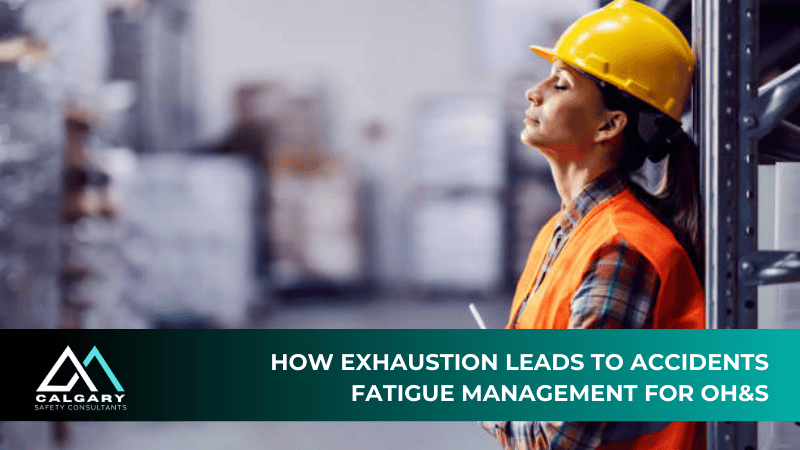
Fatigue is more than just being tired—it’s a state of mental and physical exhaustion that reduces a worker’s ability to function safely.
Key causes of workplace fatigue include:
- Long shifts & extended work hours (common in construction, oil & gas, and healthcare)
- Night shifts & rotating schedules (disrupting natural sleep cycles)
- Monotonous or repetitive work (leading to mental fatigue)
- Physically demanding tasks (increasing exhaustion faster)
- High-stress environments (causing mental burnout)
Fatigue & Workplace Safety Research: https://www.ccohs.ca/oshanswers/psychosocial/fatigue.html
How Does Fatigue Lead to Workplace Accidents?
A fatigued worker is a dangerous worker. Studies show that being awake for 17+ hours has the same effect on reaction time as a 0.05% blood alcohol level—after 20+ hours, it’s equal to 0.08% BAC (legally impaired driving level)!
Top Fatigue-Related Workplace Risks:
Transportation & Trucking
- Drowsy driving accidents leading to crashes & fatalities
- Reduced reaction times when making split-second decisions
- Lane drifting & slowed braking response
Commercial Driver Fatigue Regulations: https://tc.canada.ca/en/road-transportation/driver-fatigue-management
Construction & Oil & Gas
- Increased risk of falls & equipment mishandling
- More frequent errors when operating heavy machinery
- Delayed emergency responses in hazardous conditions
Fatigue Risks in Oil & Gas: https://www.ohscanada.com/fatigue-in-the-oil-and-gas-industry/
Manufacturing & Industrial Work
- Lack of concentration leading to improper use of tools & machinery
- Higher risk of repetitive strain injuries due to reduced awareness
- Poor decision-making under fatigue-related stress
Manufacturing Fatigue Risks: https://www.ccohs.ca/oshanswers/ergonomics/standing_fatigue.html
How Businesses Can Manage Workplace Fatigue
- Create Fatigue Management Policies
- Set maximum shift hours and ensure proper rest periods.
- Limit overtime for safety-sensitive roles.
- Encourage self-reporting of fatigue without fear of penalties.
Fatigue Policy Development Guide: https://www.worksafebc.com/en/resources/health-safety/health-safety-manuals/fatigue-management-guide
- Implement Work-Rest Schedules
- Use the “2-hour rule”—workers should take short breaks every 2 hours for high-concentration tasks.
- Rotate night shift workers regularly to avoid chronic fatigue buildup.
- Provide longer breaks for physically demanding jobs.
Work-Shift Best Practices: https://www.ccohs.ca/oshanswers/psychosocial/fatigue_shiftwork.html
- Monitor Fatigue with Wearable Tech & Safety Systems
- Use alertness monitoring technology (e.g., fatigue detection cameras in trucks).
- Introduce wearable fatigue trackers for high-risk workers.
- Encourage the use of self-assessment fatigue checklists before shifts.
Fatigue Monitoring Technology: https://www.niosh.gov/ohs-monitoring-tech
- Educate & Train Employees on Fatigue Awareness
- Teach workers how to recognize fatigue symptoms in themselves & co-workers.
- Offer sleep hygiene training to improve rest quality outside of work.
- Train managers to identify and intervene in fatigue-related risks.
Fatigue Training Programs: https://www.fatiguekit.com/
How we help
How Calgary Safety Consultants Can Help
At Calgary Safety Consultants, we specialize in helping businesses manage workplace fatigue risks and stay OH&S compliant.
We Offer:
✔ Fatigue Management Training for employees & supervisors
✔ Shift Scheduling & Work-Rest Policy Development
✔ Fatigue Risk Assessments for High-Risk Jobs
✔ Custom Safety Programs to reduce fatigue-related accidents
Final Thoughts: Fatigue is a Workplace Hazard—Treat it Like One!
Fatigue isn’t simply a matter of feeling tired—it’s a serious and often underestimated workplace hazard that can lead to devastating consequences. Physically and mentally, fatigue affects reaction time, decision-making, memory, coordination, and focus. In high-risk industries such as construction, manufacturing, transportation, and energy, these impairments can be the difference between a normal shift and a life-threatening incident. The data is sobering: fatigue is a contributing factor in countless injuries and fatalities across Canadian worksites each year.
Beyond the human toll, fatigue also has a significant financial impact on businesses. Reduced alertness and concentration lead to mistakes, delays, equipment damage, and increased absenteeism. According to national and international studies, fatigue-related incidents cost employers millions of dollars annually in medical costs, downtime, workers’ compensation claims, and lost productivity.
Fortunately, these outcomes are preventable. By implementing structured and proactive fatigue management strategies, Calgary businesses can significantly reduce risk and create safer, more productive work environments. These strategies may include scheduling practices that allow for adequate rest, education on sleep hygiene, monitoring of overtime hours, regular wellness check-ins, and clear protocols for recognizing and responding to signs of fatigue in the workplace.
Ready to see the impact on your bottom line? Contact Calgary Safety Consultants for your complimentary consult to explore tailored OH&S solutions that drive real financial results.
Stay safe, stay compliant, and keep your business running smoothly!

About the author
John Duplessis, B.Sc., CRSP
John Duplessis is a Canadian Registered Safety Professional with more than 30 years of occupational health and safety experience in oil and gas, construction, green energy, midstream operations, and industrial project work.