On this page
- What Is a Near Miss?
- Real-Life Near Miss Stories: Lessons Learned
- Why Reporting Near Misses Is a Game-Changer
- Do Near Misses Have to Be Reported?
- How to Build a Near-Miss Reporting System People Actually Use
- What Happens If You Ignore Near Misses?
- How Calgary Safety Consultants Can Help
- Final Thoughts: Don’t Ignore the Warnings
- Frequently asked questions
For employers in Calgary and across Western Canada, tracking near misses isn’t just about compliance—it’s about preventing disasters before they happen. Let’s dive into why near misses matter, real-life examples, when they have to be reported, and how to build a reporting system your people will actually use.
Quick answer
What Is a Near Miss?
A near miss is an unplanned event that almost results in an injury, damage, or loss—but doesn’t. It’s like:
✅ A worker slipping on a wet floor but catching themselves before falling.
✅ A heavy tool falling from a scaffold and landing inches away from someone.
✅ A chemical spill that didn’t cause harm—this time.
✅ A forklift nearly backing into a worker who steps out of the way just in time.
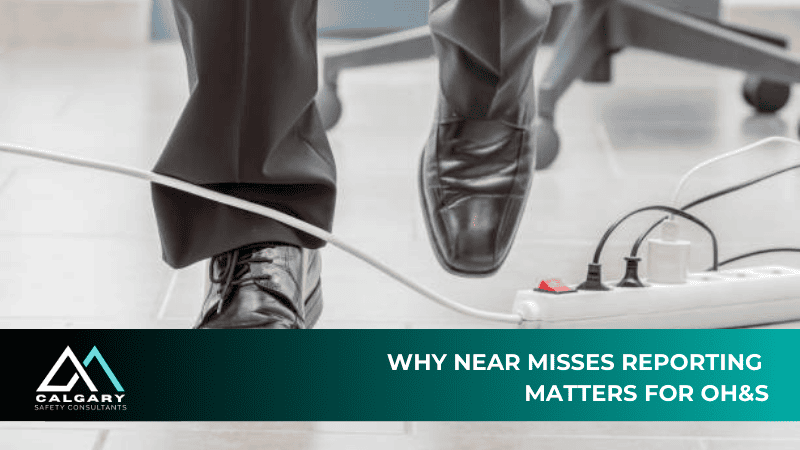
✅ An overloaded power strip that sparks but doesn’t start a fire.
Near misses are red flags telling you something needs fixing before luck runs out.
Reference: The Canadian Centre for Occupational Health and Safety (CCOHS) explains near misses and their role in workplace safety:
https://www.ccohs.ca/oshanswers/hsprograms/near_miss.html
Real-Life Near Miss Stories: Lessons Learned
The Warehouse Close Call: A Forklift Disaster Avoided
A Calgary-based warehouse had a habit of leaving pallets in aisles. One day, a forklift operator almost crashed into a hidden pallet while turning a corner. The operator stopped just in time, avoiding an accident.
❌ What Went Wrong?
- Poor aisle organization
- No clear pedestrian/forklift pathways
- Lack of visibility mirrors
✔ Fixes That Prevented Future Accidents
- Created dedicated pathways for forklifts.
- Installed convex mirrors at blind spots.
- Trained employees on proper storage practices.
Reference: SafeWork Alberta has specific guidelines on forklift safety:
https://www.alberta.ca/forklift-safety.aspx
The Office Trip Hazard: A Coffee Spill That Could Have Been Worse
An office employee was rushing to a meeting, didn’t see a coffee spill, and slipped—but caught themselves on a chair. No injury, just a startled look. Lucky? Yes. A warning? Absolutely.
❌ What Went Wrong?
- No “Wet Floor” signs.
- Employees not trained to report hazards.
- Cleaning crew unaware of the spill.
✔ Fixes That Prevented Future Incidents
- Placed spill stations in key areas.
- Implemented a quick hazard reporting system.
- Trained staff on slip, trip, and fall prevention.
Reference: Workplace slip-and-fall prevention strategies from the Workers’ Compensation Board (WCB) of Alberta:
https://www.wcb.ab.ca/assets/pdfs/employers/ohs_slips_trips_falls.pdf
Why Reporting Near Misses Is a Game-Changer
Heinrich’s classic safety pyramid suggested that for every serious injury there are roughly 29 minor injuries and 300 near misses. Safety professionals still debate the exact ratio, but the lesson holds: serious incidents rarely come out of nowhere, and near misses are your early warning.
If a workplace ignores near misses, those close calls can turn into real injuries—or worse. Many businesses only react after someone gets hurt. By reporting and fixing near misses, you can:
🔹 Prevent actual accidents – Fix hazards before someone gets hurt.
🔹 Improve workplace safety culture – Employees who are encouraged to speak up feel safer and more engaged.
🔹 Reduce costs – Fixing small hazards is far cheaper than injury claims, downtime, or OH&S penalties, and fewer injuries mean lower WCB premiums.
🔹 Boost OH&S compliance – Regulators expect employers to identify and control hazards proactively.
🔹 Build risk awareness – Regular reporting keeps workers alert to the hazards around them.
A near-miss reporting system isn’t about blaming workers—it’s about identifying and fixing issues before they escalate.
Reference: Alberta’s OH&S requirements on hazard identification:
https://www.alberta.ca/ohs-hazard-assessment-and-control.aspx
Do Near Misses Have to Be Reported?
Often, yes—at least internally, and sometimes to the regulator. It depends on how serious the outcome could have been and where the work happens:
- Alberta: A potentially serious incident (PSI)—one where, under slightly different circumstances, a serious injury was likely—must be reported to Alberta OHS as soon as possible. The employer or prime contractor must also investigate it, with the joint committee or health and safety representative involved where there is one.
- British Columbia: The Workers Compensation Act requires employers to investigate incidents that had the potential to cause serious injury, starting with a preliminary investigation within 48 hours and completing a full investigation within 30 days.
- Saskatchewan: Certain “dangerous occurrences”—such as a crane or hoist failure, a structural failure, or accidental contact with an energized electrical conductor—must be reported to the OHS Division even when no one was hurt.
Even when a near miss doesn’t meet a legal reporting threshold, recording it internally is how you catch the hazard before it hurts someone. If you’re unsure whether an event is reportable, check with your regulator or get advice before you decide it isn’t.
How to Build a Near-Miss Reporting System People Actually Use
Many employees don’t report near misses because they:
- Think it’s not a big deal.
- Fear getting blamed or punished.
- Don’t know how or where to report it.
That’s why businesses need a clear and easy system. Here’s how to do it:
Step One: Make Near-Miss Reporting Quick and Simple
- Use a short, easy-to-fill form (paper or digital).
- Consider a mobile app or QR code system for instant reporting.
- Set up designated reporting stations around the workplace.
Step Two: Create a No-Blame, No-Punishment Policy
- Make it clear that reporting near misses helps everyone—no one will be disciplined for speaking up.
- Recognize and reward employees for reporting hazards (gift cards, shout-outs in meetings, etc.).
Step Three: Investigate and Take Action
- Treat near misses like actual incidents—investigate what went wrong and fix the root cause.
- Involve employees in brainstorming solutions.
- Share lessons learned with the whole team so everyone benefits.
Step Four: Track and Analyze Trends
- Log all near misses and look for patterns (e.g., recurring hazards, problem areas).
- Use reports to improve training, update procedures, or invest in better equipment.
If the same kinds of close calls keep showing up, read What if near misses are warning signs you are overlooking? for a practical example of how to act on the pattern.
What Happens If You Ignore Near Misses?
- More accidents – That “almost fall” could be a broken leg next time.
- Higher costs – OH&S penalties, WCB claims, and downtime add up fast.
- Loss of employee trust – If workers see problems ignored, they won’t bother reporting issues in the future.
Companies that don’t take near-miss reporting seriously risk bigger incidents, legal trouble, and reputational damage.
How we help
How Calgary Safety Consultants Can Help
At Calgary Safety Consultants, we help employers turn near misses into safer workplaces. Here’s how:
✅ Near Miss Reporting Programs – We help you create simple, effective systems for employees to report hazards.
✅ Incident Investigations – We help analyze why near misses happen and how to prevent the next one.
✅ Hazard Assessments – We identify hidden risks before they lead to accidents.
✅ Workplace Safety Audits – We assess your work environment for hidden risks before they cause an accident.
✅ Training & Safety Culture Development – We teach your team why reporting near misses matters and how to act on them.
✅ Compliance Support – Need help meeting OH&S requirements in Alberta, British Columbia or Saskatchewan? We’ll make sure you’re on track and avoiding penalties.
Final Thoughts: Don’t Ignore the Warnings
A near miss isn’t just luck—it’s a warning sign. Fixing small problems now prevents major accidents later. The best workplaces don’t just react to incidents; they prevent them before they happen.
Let’s make workplaces safer, smarter, and accident-free. Book your complimentary consultation today.
Stay safe, stay compliant, and keep your business running smoothly!
Jurisdiction note: This article provides general occupational health and safety information. The legal requirements that apply depend on the workplace location, industry and federal, provincial or territorial jurisdiction. Verify current requirements with the applicable regulator before using the information operationally. Government of Canada overview of occupational health and safety jurisdiction.
References
- Canadian Centre for Occupational Health and Safety (CCOHS). Near Miss. https://www.ccohs.ca/oshanswers/hsprograms/near_miss.html
- Government of Alberta. Reporting and investigating Potentially Serious Incidents (PSI). https://open.alberta.ca/dataset/1eaf5e61-cf1e-497f-8c2e-1a133d817f46/resource/026da05d-63dc-4a65-b708-566609aa917f/download/reporting-and-investigating-potential-serious-incidents.pdf
- Government of British Columbia. Incident/accident prevention and investigation. https://www2.gov.bc.ca/gov/content/careers-myhr/managers-supervisors/occupational-health-safety/accident-prevention-investigation
- WorkSafeBC. Reference Guide for Employer Incident Investigations. https://www.worksafebc.com/en/resources/health-safety/books-guides/investigations-accidents-incidents-reference-guide-and-workbook
- Government of Saskatchewan. Reporting serious injuries, fatalities and dangerous occurrences. https://www.saskatchewan.ca/business/safety-in-the-workplace/reporting-serious-injuries-fatalities-and-dangerous-occurrences
- Workers’ Compensation Board – Alberta. https://www.wcb.ab.ca/

About the author
John Duplessis, B.Sc., CRSP
John Duplessis is a Canadian Registered Safety Professional with more than 30 years of occupational health and safety experience in oil and gas, construction, green energy, midstream operations, and industrial project work.