On this page
The Energy Wheel, which is considered best practice, is a crucial tool for hazard identification in any workplace or industry. It streamlines hazard identification and groups them into categories such as Gravity, Motion, Mechanical, Electrical, Pressure, Temperature, Chemical, Biological, Radiation, and Sound. These hazard groups are also frequent to all workplaces in all industries.
Where did the Energy Wheel Come From?
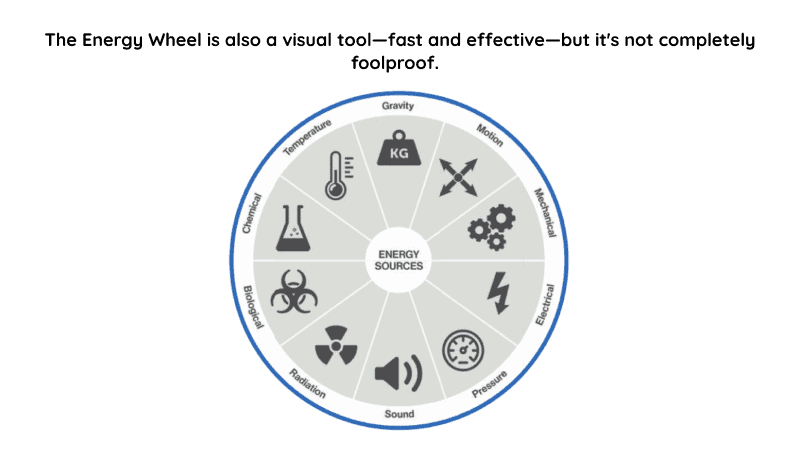
Dr. William Haddon, a leading expert in injury prevention, introduced the concept that all illnesses or injuries stem from undesired contact with various forms of energy. The Energy Wheel applies this principle to assist workers in identifying potential sources of energy-related hazards on worksites, including the ones they often overlook. Therefore, if we think about the energy associated with hazards, and the possible interactions, we can identify a hazard with more ease.
Get on Track With the Energy Wheel by Booking a Free Consult
The main reason why we recommend this process is to eliminate confusion. In many workplaces, there is a frequent mix-up between hazards and hazardous circumstances. It’s crucial to distinguish between the two words, (hazard versus hazardous). The word hazard is a verb that poses a potential danger. Hazardous, as an adverb, describes actions involving risk or danger. Getting these two confused often leads to misdiagnosis of hazards and leaves the hazards without proper controls.
We commonly see this type of error when people classify driving as a hazard during hazard assessment. This is where people can get confused because driving is hazardous, but often misunderstood as something you can easily control. Actually, driving, despite being the main focus by several companies, is not the hazard, it is actually the task.
Just listing driving as a hazard, and not the six or actual more hazards, limits the opportunities to control the risks and avoid incident. The hazards associated with driving are many, and they occur frequently. We’ve seen hazard identifications missing the motion hazard of the vehicle potentially exceeding the speed limit. We also see mechanical components missed as hazards, which can include the electrical hazards of the vehicle. There is also pressure hazards of the tires while checking the air, the temperature hazards of the exhaust, the chemical hazards of the fuel, the biological hazards left by the previous driver, and the sound hazards by the motor.
The main idea is that failing to identify a hazard correctly can lead to severe outcomes. Our examination of one of our client’s data from the past five years, while ensuring their anonymity, revealed that incorrect hazard identification was the main cause in 56% of the 150 incidents. They regained momentum the following year, reducing it to 14% after the correction. By changing tactics, they avoided $120,000 in property damage and additional expenses throughout three quarters of their business cycle.
Assessing Your OH&S ROI is a Significant KPI to Understanding Your Safety Culture
Investing in OH&S is more than a compliance checkbox—it’s a strategic move for sustainable growth. By partnering with OH&S experts, businesses can boost productivity, minimize hidden costs, and ultimately increase profitability. With clear ROI, an effective safety program doesn’t just protect employees: it strengthens the foundation for a thriving, resilient business.
Ready to see the impact on your bottom line? Contact Calgary Safety Consultants for your complimentary consult to explore tailored OH&S solutions that drive real financial results.
How we help
If you'd like help identifying and controlling hazards in your workplace, Calgary Safety Consultants works with employers in Alberta, British Columbia and Saskatchewan on hazard assessments, safe work procedures and program support.

About the author
John Duplessis, B.Sc., CRSP
John Duplessis is a Canadian Registered Safety Professional with more than 30 years of occupational health and safety experience in oil and gas, construction, green energy, midstream operations, and industrial project work.