
Rural and Remote Worksite Safety Consulting for Saskatchewan Employers
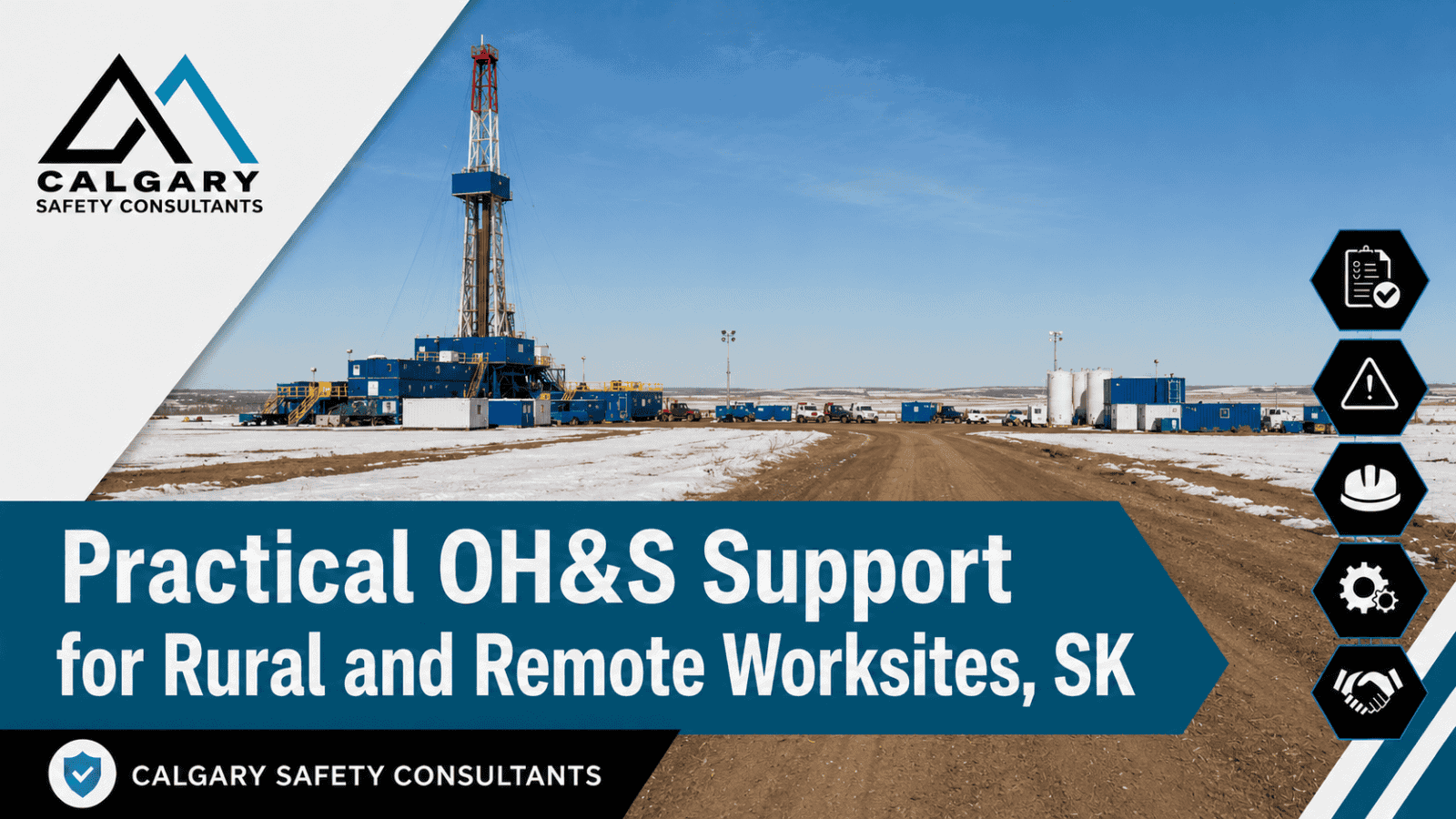
Rural worksite safety consulting helps Saskatchewan employers manage OH&S requirements when work happens outside a fixed facility, away from major centres, on rural roads, at temporary worksites, or across multiple field locations.
Calgary Safety Consultants provides practical occupational health and safety consulting support for Saskatchewan employers that need safety manuals, SECOR support, COR support, hazard assessments, workplace inspections, incident investigation support, emergency response planning, contractor safety documentation, training record reviews, and Saskatchewan OH&S compliance guidance for rural and remote worksites.
Rural and remote worksite safety consulting is especially important when crews travel between sites, work alone or in small teams, operate mobile equipment, manage contractors, or rely on field-level communication, inspections, emergency response planning, and supervisor follow-up to control risk. When these systems are unclear, employers can face missed hazards, weak documentation, delayed emergency response, audit findings, client concerns, and preventable operational disruption.
Saskatchewan Rural and Remote Worksite OH&S Consulting Support
Rural and remote worksites in Saskatchewan create safety challenges that are different from fixed urban workplaces. Employers may be managing mobile crews, changing weather, long travel distances, seasonal road conditions, limited supervision, weak communication coverage, contractor coordination, emergency response delays, equipment breakdowns, and work that changes from site to site.
A rural or remote safety program cannot rely only on generic policies. It needs to explain how workers identify hazards, communicate concerns, manage travel risks, respond to emergencies, complete inspections, report incidents, verify corrective actions, and document work when supervisors or managers are not immediately nearby.
Our rural and remote worksite safety consulting support helps Saskatchewan employers review existing OH&S programs, identify practical gaps, update procedures, improve forms, and organize records so the safety program can be used in real field conditions.
What We Review in a Rural or Remote Safety Program
A rural or remote safety program should be more than a binder, template, or collection of forms. It should explain how the employer manages real work conditions when workers are outside a controlled facility, away from direct supervision, or moving between temporary work locations.
When reviewing a rural or remote safety program, Calgary Safety Consultants can assess whether the documentation clearly addresses:
• Field-level hazard assessments and job hazard analyses.
• Lone worker and small crew procedures.
• Travel, road conditions, and journey management.
• Communication methods when cell coverage is limited.
• First aid, emergency response, and access routes.
• Site-specific emergency response planning.
• Vehicle, trailer, and mobile equipment inspections.
• Contractor and subcontractor coordination.
• Supervisor responsibilities and verification requirements.
• Worker orientation and training records.
• Inspection frequency, corrective action tracking, and closeout evidence.
• Incident reporting and investigation expectations.
• SECOR or COR documentation requirements.
The goal is to identify what is missing, what is unclear, and what is unlikely to work in the field. Once those gaps are understood, the safety program can be updated so workers, supervisors, managers, and contractors know what is expected before the work starts.
Remote Worksite Safety Procedures That Work in Saskatchewan Field Conditions
Many employers have a safety manual, but the manual may not reflect the realities of rural or remote work in Saskatchewan.
A procedure may work in an office, shop, yard, or fixed facility but fail in the field because communication is limited, weather changes quickly, workers are travelling between sites, emergency services may be delayed, or equipment support is not close by.
When rural and remote worksite procedures are unclear, small issues can become larger problems. Field-level hazard assessments may be rushed. Inspections may not be completed consistently. Workers may not know who to contact. Emergency response plans may not match the actual work location. Corrective actions may be assigned but never verified.
These gaps affect compliance, productivity, claims management, client confidence, audit performance, prequalification, and due diligence.
Saskatchewan Worksite Conditions That Should Be Built Into the Safety Program
Rural and remote Saskatchewan worksites can involve wide travel distances, seasonal weather, gravel roads, highway work, agricultural traffic, wildlife exposure, mobile equipment, contractor overlap, and limited access to immediate support. These conditions should not be treated as afterthoughts. They should be built directly into the safety program, hazard assessment process, inspection system, and emergency response plan.
For example, a municipal crew working outside a town boundary may need different communication and emergency response expectations than a shop-based crew. A contractor working across farms, roads, utility corridors, or temporary construction sites may need field-level hazard assessment forms that address changing ground conditions, traffic exposure, weather, equipment movement, and access routes. A small employer preparing for SECOR or COR may need stronger records to show that inspections, training, corrective actions, and supervisor follow-up are happening.
When these controls are clearly documented, employers are better positioned to manage compliance, protect workers, respond to incidents, support claims management, and show due diligence during audits, inspections, client reviews, or prequalification requests.
Challenges Saskatchewan Employers Face at Rural and Remote Worksites
Common safety gaps at rural and remote worksites include incomplete field-level hazard assessments, inconsistent inspection records, generic emergency response plans that do not reflect actual work locations, missing training documentation, unclear supervisor responsibilities, weak contractor coordination, and corrective actions that have not been verified. While these issues may look administrative, they often create larger operational, compliance, claims, audit, and due diligence concerns when incidents, inspections, audits, client reviews, or prequalification requests occur.
| Common Challenge | Safety Control |
|---|---|
| Lone Work | Lone worker procedures |
| Remote Travel | Journey management |
| Poor Cell Coverage | Communication plans |
| Emergency Delays | Site-specific ERP |
| Mobile Equipment | Inspections and training |
Field-Based Safety Program Support for Saskatchewan Employers
We support employers operating rural and remote worksites across Saskatchewan and other Canadian jurisdictions.
Common industries include:
- Construction and trades.
- Agriculture and agri-business.
- Road maintenance and civil construction.
- Transportation and trucking.
- Utilities and infrastructure.
- Oil and gas support services.
- Environmental and reclamation work.
- Forestry and resource-sector support.
- Municipal operations.
- Mobile equipment service.
- Remote maintenance crews.
- Contractors and subcontractors.
- Small and mid-sized employers.
- Multi-site employers.
- Potash, mining, and resource support contractors.
- Grain handling, seed cleaning, and agricultural service operations.
- Rural utilities, power, water, and infrastructure maintenance.
- Oilfield, energy, and industrial support work in rural regions.
- Roadbuilding, traffic control, and highway maintenance contractors.
- Environmental, reclamation, and vegetation management crews.
- Rural healthcare, community services, and outreach operations.
- Camp-based, seasonal, and temporary project work.
The safety program should explain what must happen before, during, and after the work. This includes how the work is planned, how hazards are reviewed in the field, how workers communicate concerns, how supervisors verify controls, how incidents are reported, and how corrective actions are closed with evidence.
Rural and Remote Worksite Safety Support Across Saskatchewan
Calgary Safety Consultants provides rural and remote worksite safety support for employers operating throughout Saskatchewan, including Northern Saskatchewan, Southern Saskatchewan, Central Saskatchewan, East Central Saskatchewan, Southeast Saskatchewan, Southwest Saskatchewan, and Northwest Saskatchewan. Many organizations operate far from major population centres and must manage occupational health and safety requirements across large geographic areas, changing work locations, and diverse operating conditions.
We support rural and remote worksites across Saskatchewan, including employers operating near major centres, smaller communities, agricultural regions, resource support areas, municipal service areas, highway corridors, and temporary field locations.
Whether work is being performed near remote communities, agricultural regions, municipal infrastructure projects, resource-sector developments, or temporary field locations, rural and remote worksite safety consulting helps ensure safety programs reflect the actual conditions workers face each day. Our goal is to help Saskatchewan employers develop practical safety systems, maintain compliance, support due diligence, and provide workers and supervisors with documentation that works in real-world field environments.
Nearby Areas Served
We support rural and remote worksites across Saskatchewan, including employers operating near major centres, smaller communities, agricultural regions, resource support areas, municipal service areas, highway corridors, and temporary field locations:
- Regina.
- Saskatoon.
- Prince Albert.
- Moose Jaw.
- Yorkton.
- Swift Current.
- North Battleford.
- Lloydminster.
- Estevan.
- Weyburn.
- Melfort.
- Humboldt.
- Meadow Lake.
- La Ronge.
- Rural Saskatchewan.
- Northern Saskatchewan.
- Southern Saskatchewan.
- East Central Saskatchewan.
- Remote, temporary, mobile, seasonal, and field-based worksites across Saskatchewan.
We also support employers operating across Saskatchewan, Alberta, British Columbia, and other Canadian jurisdictions.
Safety Consulting Services for Rural and Remote Saskatchewan Worksites
Rural and remote worksite safety consulting works best when it connects documentation to actual work, actual hazards, actual supervision, and actual field conditions.
Saskatchewan employers may need support for:
- COR and SECOR support for employers preparing for certification, audit maintenance, or client requirements.
- Customized safety manuals and program documents that reflect the work, hazards, workers, and operating structure of the business.
- Hazard assessments, JHAs, workplace inspections, and corrective action tracking for practical risk control.
- Incident investigation support to help identify causes, document findings, and prevent repeat events.
- OHS regulatory support when inspection findings, orders, complaints, or corrective action requests need a structured response.
- Ongoing safety program support for employers that need regular help maintaining records, updating documents, and supporting supervisors.
- OH&S training support to help employers improve worker awareness, supervisor follow-up, and documentation.
These services can be provided as a focused project or as ongoing support, depending on what your organization needs. Some employers need a full safety program rebuild, while others need targeted help correcting specific gaps before a SECOR or COR audit, client submission, regulatory inspection, project start-up, shutdown, turnaround, prequalification review, or internal safety program review.
If your organization needs a safety manual or OH&S program that reflects the actual work being performed, we can review your current documentation, identify gaps, and develop practical content that supports supervisors, workers, managers, and contractor coordination in the field.
Helpful Saskatchewan OH&S and COR/SECOR resources:
Government of Saskatchewan Safety in the Workplace
Why Rural and Remote Saskatchewan Worksites Need Different Safety Controls
Rural and remote worksite safety consulting is important because field-based work creates conditions that are harder to control than work performed in a fixed facility. Crews may travel long distances, work in changing weather, operate mobile equipment, rely on limited communication coverage, or complete work where supervision is not immediately available. These conditions can increase the risk of delayed reporting, missed hazards, incomplete follow-up, and slower emergency response.
Saskatchewan employers also need to account for lone work, contractor coordination, rural road access, temporary work locations, and equipment support that may not be close by. When these factors are not addressed clearly in the safety program, workers and supervisors may be left trying to make decisions without practical procedures, reliable records, or a clear escalation process.
Common gaps at rural and remote worksites include incomplete field-level hazard assessments, weak inspection records, generic emergency response plans, missing training records, unclear supervisor responsibilities, and corrective actions that are assigned but never verified. These gaps can affect compliance, productivity, client confidence, claims management, and SECOR or COR audit performance.
Calgary Safety Consultants helps Saskatchewan employers strengthen rural and remote worksite safety consulting through safety manual reviews, hazard assessments, SECOR and COR readiness support, emergency response planning, inspection systems, incident investigation support, contractor documentation, and practical safety program updates that reflect the way work is actually performed in the field.
When to Request Rural and Remote Worksite Safety Support
Employers often request rural and remote worksite safety consulting when their safety documentation no longer matches the work being performed. This can happen after business growth, staff turnover, new client requirements, SECOR or COR preparation, an incident, a regulatory inspection, or expansion into new regions.
You should consider support if your organization is dealing with incomplete field-level hazard assessments, inconsistent inspections, missing training records, unclear emergency response plans, weak contractor documentation, outdated safety manual content, or corrective actions that are not being verified.
These issues can affect more than compliance. They can slow down field work, create confusion for supervisors, increase claims exposure, weaken audit performance, and make it harder to prove that the employer took reasonable steps to control known hazards.
Calgary Safety Consultants can help review the current state of your OH&S program, identify the most important gaps, and provide practical recommendations that fit your work, workforce, locations, and operational risks.
Frequently Asked Questions About Rural and Remote Worksite Safety Consulting
Do you provide safety consulting for rural and remote worksites?
Yes. Calgary Safety Consultants provides occupational health and safety consulting support for employers operating rural, remote, temporary, mobile, and field-based worksites across Saskatchewan and other Canadian jurisdictions.
How is rural and remote worksite safety different from regular workplace safety?
Rural and remote worksites often involve travel, changing locations, limited supervision, weather exposure, communication gaps, emergency response delays, and mobile equipment. These conditions require safety procedures that are practical in the field.
Can Rural and remote worksite safety consulting help with SECOR or COR for rural employers?
Yes. We help rural and remote employers review safety programs, identify documentation gaps, improve records, update procedures, and prepare for SECOR or COR audit expectations.
Can you update our existing safety manual?
Yes. We can review and update a safety manual so it better reflects field operations, travel, lone work, emergency response, mobile crews, contractor management, and Saskatchewan OH&S expectations.
Can you help with hazard assessments for rural worksites?
Yes. We help employers develop, review, and improve hazard assessments, job hazard analyses, and field-level hazard assessment processes for rural, remote, mobile, and temporary worksites.
Can you help improve emergency response planning?
Yes. We can help review emergency response planning for rural and remote worksites, including communication, first aid, access, transportation, severe weather, vehicle incidents, and emergency contact procedures.
Do rural employers require a safety program?
Yes. We can support incident investigations by helping organize information, review contributing factors, document findings, and develop corrective actions that reduce the likelihood of repeat incidents.
Can Rural and remote worksite safety consulting help after an incident at a remote worksite?
Yes. Rural employers still need a practical safety program that reflects their work, hazards, workers, equipment, supervision structure, and legal OH&S responsibilities. A rural or remote worksite may require additional procedures for travel, communication, emergency response, lone work, contractor coordination, inspections, and field-level hazard assessments.
What industries commonly operate remote worksites?
Common industries include agriculture, construction, road maintenance, transportation, utilities, oil and gas support services, environmental work, municipal operations, resource projects, mobile equipment service, and contractors working across multiple temporary locations.
Can Rural and remote worksite safety consulting support multiple work locations?
Yes. We can support employers with multiple rural, remote, temporary, mobile, or field-based work locations across Saskatchewan. This may include reviewing safety manuals, hazard assessments, inspection systems, emergency plans, training records, contractor documentation, and SECOR or COR readiness across different sites.
How often should hazard assessments be reviewed?
Hazard assessments should be reviewed when work changes, new equipment is introduced, site conditions change, incidents or near misses occur, workers identify new hazards, or procedures are no longer working as intended. For rural and remote worksites, regular review is especially important because weather, access, supervision, travel, and communication conditions can change quickly.
What should a remote emergency response plan include?
A remote emergency response plan should include site location details, communication methods, emergency contacts, first aid arrangements, transportation routes, severe weather procedures, worker check-in requirements, rescue or evacuation steps, equipment breakdown response, and instructions for contacting emergency services when response times may be delayed.