On this page
- What Is a Certificate of Recognition (COR)?
- How COR Works in Alberta
- Why COR Is a Competitive Advantage in Calgary
- The Financial Case: WCB PIR Refunds
- Business Benefits Beyond the Certificate
- Beyond COR: Management Systems and ISO 45001
- COR in British Columbia and Saskatchewan
- How Calgary Safety Consultants Can Help
- Frequently asked questions
Lower injury rates are reason enough to build a strong safety program, and COR gives employers a structured way to get there. In Alberta, though, COR also carries real economic weight: it can open doors with larger clients, it can earn refunds on your WCB premiums, and it gives you a structure for running safety as part of the business rather than beside it.
Quick answer
COR at a Glance
- A COR is awarded through an approved certifying partner and signed by both your partner and the Government of Alberta after your health and safety management system passes an audit.
- A certification audit must score at least 80% overall and at least 50% in every audit element.
- A COR is valid for three years if maintenance requirements are met, including a maintenance audit in each of the two calendar years after certification.
- Holding a COR earns a WCB-Alberta refund of 10% in the first year and 5% in each year you maintain it, with refunds of up to 20% for improved or leading performance. Many owners and prime contractors also ask for COR before you can bid.
What Is a Certificate of Recognition (COR)?
A COR is awarded to employers who develop a health and safety program that meets an established standard. It confirms that a qualified auditor has evaluated your health and safety management system and found that it meets provincial requirements.
Small employers can work toward a Small Employer COR (SECOR) instead. In Alberta, SECOR is for businesses with up to 10 employees and uses a self-assessment rather than an external audit. Our guide on how to prepare for a SECOR evaluation explains how small-employer certification works in each province and territory.
It helps to be clear about who does what. A COR is not something a consultant can hand you. In Alberta, it is awarded through your certifying partner and signed by both your partner and the Government of Alberta after a successful audit or evaluation. A consultant’s role is to help you build a system that will stand up to that audit, and to keep it working afterward.
How COR Works in Alberta
Most employers follow the same five steps, whatever their industry.
- Choose a certifying partner. Alberta has 13 certifying partners authorized to administer COR. Pick the one that fits your industry.
- Complete the required training. Confirm your partner’s training requirements and audit process early, so they do not hold up your timeline.
- Build and use your system. Your policies, hazard assessments, inspections, training records, incident investigations and corrective actions need to reflect the work you actually do, and your records need to prove it.
- Pass the certification audit. You need at least 80% overall and at least 50% in each audit element. If a consultant helped you develop your system, that consultant cannot carry out your audit.
- Keep it current. Your COR stays valid for three years if you complete a maintenance audit in each of the two calendar years after certification. Maintenance audits need at least 60% overall and can be done by a qualified internal or external auditor recognized by your partner.
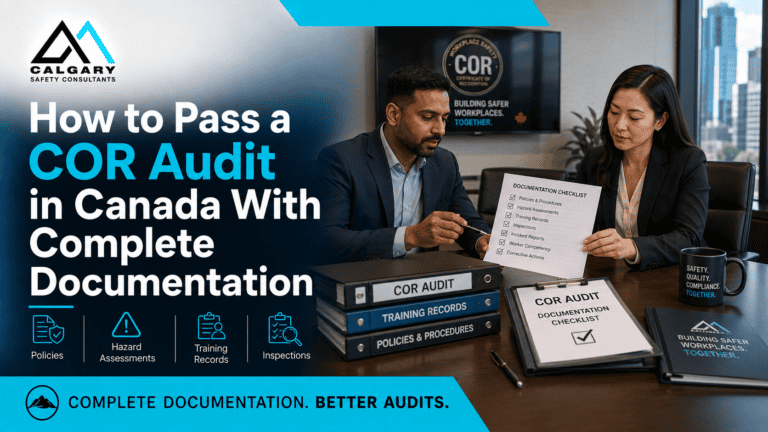
For a practical checklist of the records and evidence auditors look for, read our guide on how to prepare for a COR audit.
Why COR Is a Competitive Advantage in Calgary
Calgary’s economy leans heavily on energy, construction, transportation and the industries that serve them. Owners and prime contractors in those sectors prequalify their suppliers, and they often ask for a valid COR or SECOR before you can bid or work on site.
Prequalification platforms such as ISNetworld and Avetta grade contractors against each client’s own requirements. When a client requires COR, a missing certificate can lower your grade or keep you off the bid list, however good your work is.
At Calgary Safety Consultants, we call this the safety trade barrier. The work is there, but you cannot reach it without proof that your safety program works. A COR is the proof most Alberta clients recognize.
The Financial Case: WCB PIR Refunds
WCB-Alberta’s Partnerships in Injury Reduction (PIR) program is voluntary and runs through WCB, the Government of Alberta, certifying partners and safety associations. Employers who maintain a COR can be eligible for refunds of up to 20%. PIR rewards three things:
- Holding a COR: a 10% industry-rate refund in the first year, then 5% in each year you maintain the COR.
- Improving your performance: a 1% refund for every 1% improvement, up to a maximum of 20%.
- Industry leadership: refunds from 10% up to the maximum of 20%.
Any refunds are in addition to the savings fewer injuries can bring: less lost time, fewer claims, less overtime to cover absences, and fewer incident investigations pulling supervisors off the job.
Business Benefits Beyond the Certificate
The refund and the bid access are the returns you can see on paper. The larger ones show up in day-to-day operations.
- Fewer injuries and lower costs. A working system can find hazards before they hurt someone, which can mean less downtime, fewer claims and less disruption to schedules.
- Stronger engagement and retention. Workers notice when safety is managed rather than just posted on a wall. That builds trust, and people tend to stay where they feel looked after.
- A reputation clients trust. COR is a recognized signal to clients, suppliers and the community that you take your responsibilities seriously.
- Steadier productivity. Clear procedures, current hazard assessments and fewer incidents mean crews spend more time on the work and less time recovering from problems.
These benefits depend on a system people actually use. A COR earned with a binder that sits on a shelf tends to show its gaps at the next maintenance audit.
Beyond COR: Management Systems and ISO 45001
Prequalification reviews often look past the certificate at how your safety management system is built: leadership commitment, worker participation, risk assessment, contractor management and performance evaluation. Those are also the building blocks of ISO 45001, the international standard for occupational health and safety management systems.
In our experience, companies whose COR programs meet the management system requirement face fewer rejections in ISNetworld and Avetta than those that collect only the minimum audit evidence. If your clients are starting to ask about ISO 45001, our ISO 45001 consulting page explains how the two fit together.
COR in British Columbia and Saskatchewan
British Columbia: WorkSafeBC’s COR program runs through certifying partners and is built on a Plan-Do-Check-Act safety management system. Employers who pass a certification audit and stay in good standing with WorkSafeBC can be considered for a financial incentive.
Saskatchewan: for construction employers, the Saskatchewan Construction Safety Association (SCSA) runs COR and SECOR.
Eligibility, training and incentives differ by province and by certifying partner, so confirm the details with yours before you set a timeline.
How we help
How Calgary Safety Consultants Can Help
Calgary Safety Consultants provides COR and SECOR consulting, safety program development and audit-preparation support for employers across Alberta, British Columbia and Saskatchewan. We do not issue COR certificates or guarantee certification; a COR is awarded through your certifying partner after a successful audit or evaluation.
Depending on where your program stands, we can:
- Review your current program against COR expectations and give you a prioritized gap list
- Develop or update your safety manual, hazard assessments, safe work practices and forms
- Help supervisors and workers understand their roles in the system
- Run a mock audit or pre-audit review to reduce surprises on audit day
- Build corrective action plans after an audit and keep the system current between audits
Every project is delivered personally by John Duplessis, B.Sc., CRSP, who has more than 30 years of occupational health and safety experience.
References
- Government of Alberta. Get a Certificate of Recognition (COR). https://www.alberta.ca/get-certificate-recognition
- Government of Alberta. Maintain or renew a COR. https://www.alberta.ca/maintain-renew-cor
- WCB-Alberta. Partnerships in Injury Reduction (PIR). https://www.wcb.ab.ca/insurance-and-premiums/lower-your-premiums/partnerships-in-injury-reduction-(pir).html
- WorkSafeBC. Certificate of Recognition. https://www.worksafebc.com/en/health-safety/create-manage/certificate-recognition
- Saskatchewan Construction Safety Association. COR/SECOR. https://scsaonline.ca/cor-secor/

About the author
John Duplessis, B.Sc., CRSP
John Duplessis is a Canadian Registered Safety Professional with more than 30 years of occupational health and safety experience in oil and gas, construction, green energy, midstream operations, and industrial project work.