
OH&S Leadership Training
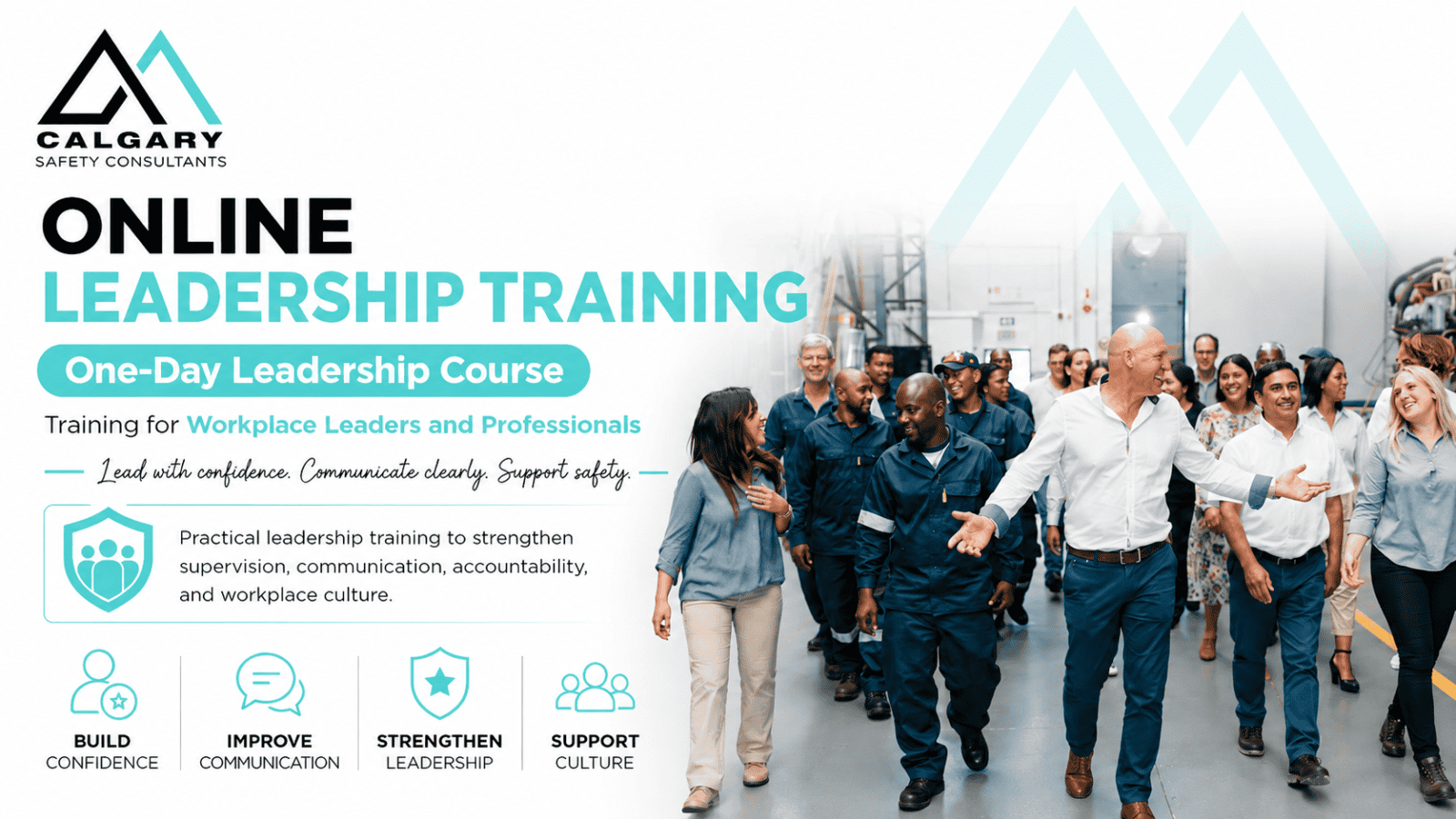
Strong workplace health and safety performance starts with leadership.
Policies, procedures, inspections, hazard assessments, and training are important, but they only become effective when leaders understand their responsibilities and consistently turn those requirements into action.
Calgary Safety Consultants provides practical OH&S Leadership Training for Canadian workplaces, with flexible delivery options including Online OH&S Leadership Training, Virtual Instructor-Led Training, and Classroom Training.
Our training is designed for supervisors, managers, business owners, executives, team leads, and others who direct work or influence workplace health and safety.
Whether you need to train a newly promoted supervisor or strengthen safety leadership across an entire management team, we can help you choose a training approach that works for your organization.
Choose Your OH&S Leadership Training Option
Online OH&S Leadership Training
Complete your OH&S Leadership Training online at your own pace from virtually anywhere in Canada.
Our online course provides supervisors and managers with a structured introduction to their health and safety responsibilities and the practical leadership activities required to support an effective workplace safety program.
Participants learn how leadership decisions influence hazard control, worker behaviour, communication, training, incident prevention, accountability, and overall health and safety performance.
Online OH&S Leadership Training is ideal for new supervisors, managers, business owners, remote employees, smaller organizations, or employers that need consistent training available on demand.
Virtual Instructor-Led OH&S Leadership Training
Bring your leadership team together without requiring everyone to travel to the same location.
Our Virtual OH&S Leadership Training is delivered live by an experienced occupational health and safety professional using Microsoft Teams or another agreed virtual platform.
Participants can ask questions, discuss actual workplace challenges, and examine how leadership principles apply within their own operations.
Virtual training is particularly effective for organizations with managers and supervisors located across multiple offices, branches, projects, or provinces.
It combines the convenience of remote learning with the discussion and interaction of instructor-led training.
Classroom OH&S Leadership Training
Bring OH&S Leadership Training directly to your workplace.
Our classroom training provides managers, supervisors, and other organizational leaders with an opportunity to explore health and safety responsibilities through discussion, practical examples, and workplace-based scenarios.
Classroom sessions can be especially valuable when an organization wants to strengthen its safety culture, improve supervisory consistency, prepare new leaders, address recurring safety concerns, or improve implementation of an existing health and safety management system.
Training can also be customized to reflect your organization’s operations, hazards, policies, responsibilities, and health and safety objectives.
What Is OH&S Leadership Training?
OH&S Leadership Training helps people who direct work understand how their decisions affect workplace health and safety.
A supervisor’s responsibilities extend beyond telling workers to follow the rules.
Managers and supervisors influence:
- How work is planned.
- Who is assigned to perform the work.
- Whether workers are adequately trained.
- How hazards are identified and controlled.
- Whether procedures are followed.
- How unsafe conditions are addressed.
- How workers are supervised.
- How incidents are reported and investigated.
- Whether corrective actions are completed.
- How worker concerns are handled.
- How consistently health and safety expectations are enforced.
- Whether production pressures are allowed to override established controls.
Effective safety leadership connects these responsibilities to everyday operations.
The objective is to help leaders understand not only what needs to be done, but what their role is in making sure it actually happens.
Who Should Take OH&S Leadership Training?
OH&S Leadership Training is designed for people who direct work, make operational decisions, supervise employees, allocate resources, or have responsibility for workplace health and safety.
This can include:
- Business owners.
- Senior executives.
- Directors.
- Operations managers.
- Department managers.
- Project managers.
- Superintendents.
- Supervisors.
- Forepersons.
- Team leads.
- Lead hands.
- Safety coordinators.
- Health and safety professionals.
- Human resources professionals.
- Newly promoted supervisors.
- Employees preparing for supervisory responsibilities.
If a person has authority to direct how work is performed, their decisions can affect worker health and safety.
The Role of Leadership in Workplace Health and Safety
A health and safety program can look excellent on paper and still perform poorly in the field.
The difference is often implementation.
Consider a company that has a written hazard assessment process.
The policy exists.
The form exists.
Workers have been told to complete it.
But supervisors rarely review the assessments, changing conditions aren’t discussed, identified deficiencies aren’t corrected, and production continues even when established controls no longer fit the work.
Technically, the organization has a process.
Operationally, the process isn’t functioning as intended.
This is where leadership becomes critical.
Effective leaders make health and safety requirements part of how work is planned, assigned, supervised, verified, and improved.
Safety leadership therefore isn’t separate from operational leadership.
It is part of it.
What Does Our OH&S Leadership Training Cover?
Our OH&S Leadership Training focuses on the practical responsibilities leaders encounter in Canadian workplaces.
Course topics include:
- The role of leadership in workplace health and safety.
- Canadian occupational health and safety principles.
- Employer responsibilities.
- Manager and supervisor responsibilities.
- Worker responsibilities and rights.
- Accountability and authority.
- Due diligence.
- Supervisor competency.
- Health and safety policies and programs.
- Leadership commitment.
- Worker participation.
- Hazard identification.
- Hazard assessment.
- Risk management.
- The hierarchy of controls.
- Safe work procedures.
- Training and competency.
- Workplace inspections.
- Incident reporting.
- Incident investigation.
- Corrective action.
- Emergency preparedness.
- Contractor management.
- Communication.
- Documentation and records.
- Enforcement and accountability.
- Responding to unsafe behaviour.
- Responding to worker concerns.
- Stop-work decisions.
- Management of change.
- Safety performance measurement.
- Continuous improvement.
- Building a positive workplace safety culture.
The objective is to help leaders connect individual health and safety activities into a functioning management process.
Safety Leadership and Accountability
Leadership requires accountability.
Health and safety responsibilities need to be clearly assigned so people understand what is expected of them.
However, assigning responsibility isn’t enough.
A person also needs:
- Appropriate authority.
- Necessary resources.
- Suitable training.
- Adequate knowledge.
- Sufficient time.
- Access to information.
- Management support.
A supervisor can’t reasonably be expected to control workplace hazards if they have no authority to stop work, obtain equipment, correct unsafe conditions, or require workers to follow established procedures.
At the same time, authority creates responsibility.
When leaders identify a significant problem and have the authority to correct it, failing to act can create unnecessary risk for workers and the organization.
Good safety leadership therefore requires clear expectations and meaningful follow-through.
Understanding Due Diligence
Due diligence is an important concept for Canadian workplace leaders.
In practical terms, leaders should be able to demonstrate that reasonable precautions were taken to protect workers and meet applicable occupational health and safety requirements.
That means more than having policies stored in a binder or on a company server.
Organizations need evidence that their health and safety systems are actually being implemented.
That evidence may include:
- Hazard assessments.
- Training records.
- Inspection records.
- Meeting minutes.
- Maintenance records.
- Safe work procedures.
- Incident investigations.
- Corrective actions.
- Supervisor observations.
- Worker competency records.
- Contractor documentation.
- Management reviews.
Documentation matters because it helps demonstrate what was identified, what decisions were made, what actions were taken, and whether those actions were completed.
However, documentation alone isn’t due diligence.
The records need to reflect what is actually happening in the workplace.
Supervisors Have a Critical Role
Supervisors often have the greatest day-to-day influence over workplace health and safety.
They are close enough to the work to see what is actually happening and usually have enough authority to influence how that work is performed.
Supervisors may be responsible for:
- Planning work.
- Assigning workers.
- Confirming worker competency.
- Reviewing hazards before work begins.
- Ensuring required controls are available.
- Communicating procedures.
- Monitoring work.
- Correcting unsafe conditions.
- Addressing unsafe behaviour.
- Responding to worker concerns.
- Investigating incidents.
- Conducting inspections.
- Ensuring corrective actions are completed.
- Stopping work when conditions become unacceptable.
That makes supervisor training particularly important.
Promoting an experienced employee into a supervisory position doesn’t automatically make that person competent to manage occupational health and safety responsibilities.
They need to understand what those responsibilities are and how to apply them.
Hazard Assessment Is a Leadership Process
Hazard assessment is one of the foundations of workplace health and safety.
Leaders should understand how hazards are identified, assessed, and controlled because they frequently make decisions that affect the level of risk workers face.
A supervisor may need to determine:
- What could harm the worker?
- What has changed since the work was originally planned?
- Are the existing controls still appropriate?
- Are workers following the established procedure?
- Is additional equipment required?
- Does the worker have the necessary training and competency?
- Are other workers, contractors, or members of the public affected?
- Does the work need to stop?
These aren’t paperwork questions. They are operational decisions.
Effective health and safety leaders understand that hazard assessment should influence how work is actually performed.
Using the Hierarchy of Controls
Safety leaders also need to understand the hierarchy of controls.
When a hazard is identified, the objective should be to control the hazard as effectively as reasonably possible.
Depending on the circumstances, this may involve:
- Eliminating the hazard.
- Substituting a safer material, process, or method.
- Using engineering controls.
- Implementing administrative controls.
- Using personal protective equipment.
Weak safety systems frequently rely too heavily on worker behaviour and personal protective equipment.
A stronger leadership approach asks whether the work itself can be changed.
- Can the hazard be eliminated?
- Can workers be separated from the hazard?
- Can equipment reduce the exposure?
- Can the process be redesigned?
- Can the work be planned differently?
Training workers remains important, but training shouldn’t become a substitute for better hazard controls.
Training and Worker Competency
Sending a worker to a course doesn’t automatically make the worker competent to perform every related task.
Leaders need to consider the complete competency picture.
That may include:
- Education.
- Training.
- Experience.
- Knowledge.
- Demonstrated skill.
- Familiarity with equipment.
- Understanding of procedures.
- Knowledge of workplace hazards.
- Ability to recognize changing conditions.
- Appropriate supervision.
A worker may have a training certificate and still require workplace-specific instruction before performing a task independently.
Supervisors should understand the difference between training completed and competency demonstrated.
This distinction becomes particularly important when work involves significant hazards.
Safety Leadership and Worker Participation
Workers frequently have information that management doesn’t. They know where procedures are difficult to follow. They see equipment problems. They recognize when production demands are creating shortcuts. They know where work conditions change. They may see hazards before supervisors or managers do.
Strong safety leaders create an environment where workers can raise these concerns early. That doesn’t mean every suggestion will result in a change. It means concerns are taken seriously, evaluated appropriately, and addressed when action is required.
Worker participation can improve hazard identification, incident prevention, corrective action, and the practical effectiveness of workplace procedures.
Responding to Unsafe Work and Worker Concerns
How a supervisor reacts when a worker raises a safety concern sends an important message.
If concerns are routinely dismissed, workers may stop reporting them.
If leaders respond professionally and investigate legitimate concerns, workers are more likely to speak up before an incident occurs.
A leader may need to:
- Listen to the concern.
- Clarify the hazard.
- Review the work.
- Confirm applicable procedures.
- Determine whether existing controls remain adequate.
- Obtain additional technical assistance.
- Correct deficiencies.
- Stop work where necessary.
- Document decisions.
- Communicate the outcome.
The objective isn’t to avoid operational disruption at all costs.
The objective is to make a reasonable decision based on the actual risk.
Incident Reporting and Investigation
Incidents provide information about how the health and safety system is performing.
When an incident occurs, leaders should look beyond who made the immediate mistake.
A worker action may be part of the event, but effective investigations also examine the conditions that allowed the event to occur.
Questions may include:
- Was the hazard identified?
- Was there an adequate procedure?
- Was the worker trained?
- Was competency confirmed?
- Was appropriate equipment available?
- Was the worker adequately supervised?
- Had similar concerns been reported previously?
- Were production pressures influencing decisions?
- Had working conditions changed?
- Were previous corrective actions effective?
The purpose of an investigation should be to understand what happened and prevent recurrence.
That requires leadership support.
Corrective Action and Follow-Through
Finding a problem doesn’t prevent an incident.
Correcting it does.
Organizations frequently identify deficiencies through inspections, investigations, audits, hazard assessments, or worker reports but fail to close the loop.
Effective leaders make sure corrective actions have:
- A clearly defined action.
- An assigned person.
- A reasonable completion date.
- Appropriate resources.
- Documentation.
- Follow-up.
- Verification of effectiveness.
Closing an item on a spreadsheet isn’t the same as confirming the hazard has actually been controlled.
Verification matters.
Management of Change
Workplaces change constantly. Organizations introduce new equipment. Processes change. New chemicals are used. Workers change positions. Projects move to different locations. Contractors are introduced. Production levels increase. New technology is implemented. Organizations restructure.
Each change can introduce new hazards or alter existing controls.
Safety leaders should understand when change requires another look at:
- Hazard assessments.
- Procedures.
- Training.
- Equipment.
- Staffing.
- Emergency planning.
- PPE.
- Supervision.
- Contractor controls.
- Communication.
Managing change proactively is generally far easier than responding after a change contributes to an incident.
Building a Strong Workplace Safety Culture
Safety culture isn’t created by slogans. Workers judge an organization’s priorities by what leaders actually do. If supervisors ignore procedures when production falls behind, workers notice.
If managers fail to correct known hazards, workers notice. If incidents are blamed entirely on workers without examining system weaknesses, workers notice. The opposite is also true.
Workers notice when leaders:
- Ask about hazards.
- Correct problems.
- Provide appropriate resources.
- Follow the same rules expected of everyone else.
- Support reasonable stop-work decisions.
- Respond to concerns.
- Investigate incidents properly.
- Recognize good safety performance.
- Hold people accountable consistently.
- Follow through on commitments.
Leadership behaviour helps determine whether the organization’s safety program becomes part of everyday work or remains primarily a collection of documents.
Production and Safety Aren’t Competing Objectives
One of the most damaging assumptions in workplace safety is that production and safety are competing priorities.
Poorly controlled work can create:
- Injuries.
- Equipment damage.
- Operational delays.
- Overtime.
- Lost productivity.
- Workers’ compensation claims.
- Regulatory intervention.
- Rework.
- Staff shortages.
- Project delays.
- Increased insurance costs.
- Damage to client relationships.
Preventing incidents supports reliable operations.
Strong safety leadership therefore isn’t about stopping productive work.
It is about planning and controlling work so it can be completed safely, efficiently, and consistently.
OH&S Leadership Training Certificates
OH&S Leadership Training can support organizations that are:
- Promoting employees into supervisory positions.
- Developing new managers.
- Strengthening an existing health and safety program.
- Preparing for COR or other external audits.
- Implementing a new safety management system.
- Responding to recurring incidents.
- Addressing inconsistent supervisory practices.
- Expanding into new locations.
- Improving accountability.
- Strengthening hazard management.
- Improving incident investigation.
- Developing a stronger safety culture.
- Standardizing expectations across multiple locations.
Training can help establish a common understanding of what effective health and safety leadership should look like throughout the organization.
OH&S Leadership Training for Canadian Workplaces
Occupational health and safety legislation isn’t identical across Canada.
Federal, provincial, and territorial jurisdictions establish their own requirements, terminology, duties, and responsibilities.
However, several important leadership principles remain consistently relevant.
Employers and workplace leaders need to understand their applicable responsibilities, provide appropriate resources, identify and control hazards, ensure workers receive necessary instruction and training, provide effective supervision, respond to workplace concerns, and maintain evidence that the organization’s health and safety processes are functioning.
Organizations operating in multiple jurisdictions may also need to account for important differences between provincial, territorial, and federal requirements.
Our OH&S Leadership Training provides a practical Canadian foundation while emphasizing the importance of understanding the requirements that apply where the work is actually performed.
Frequently Asked Questions about OH&S Leadership Training
What is OH&S Leadership Training?
OH&S Leadership Training helps managers, supervisors, business owners, and other workplace leaders understand their role in preventing injuries, controlling hazards, supervising work, maintaining accountability, and supporting an effective workplace health and safety program.
Who should take OH&S Leadership Training?
The training is appropriate for supervisors, managers, executives, business owners, project managers, forepersons, team leads, lead hands, safety professionals, and employees preparing to move into leadership positions.
Is OH&S Leadership Training only for supervisors?
No. Supervisors are an important audience, but health and safety leadership extends throughout an organization. Senior managers, business owners, executives, project managers, and others who make decisions affecting workers can also benefit.
Can OH&S Leadership Training be completed online?
Yes. Calgary Safety Consultants offers Online OH&S Leadership Training that participants can complete from an internet-connected computer or compatible device.
Is virtual instructor-led training available?
Yes. Live Virtual OH&S Leadership Training can be delivered to groups using Microsoft Teams or another agreed virtual platform. This is particularly useful for organizations with leaders located in different offices or regions.
Is classroom OH&S Leadership Training available?
Yes. Instructor-led classroom training can be arranged for organizations that prefer face-to-face learning or want greater discussion of their workplace-specific health and safety challenges.
Will I receive a certificate after completing the training?
Yes. Participants who successfully complete the online course requirements receive a certificate of completion.
Does leadership training make someone a competent supervisor?
Training is an important part of competency, but competency also depends on factors such as knowledge, experience, demonstrated ability, familiarity with the work, and understanding of workplace-specific hazards and procedures.
What is due diligence in occupational health and safety?
Due diligence generally involves taking reasonable precautions to protect workers and being able to demonstrate that appropriate health and safety actions were taken. The specific legal requirements depend on the applicable Canadian jurisdiction and circumstances.
Why is safety leadership important?
Leaders influence how work is planned, how resources are allocated, how hazards are controlled, how workers are supervised, how concerns are addressed, and whether health and safety expectations are consistently followed. Their decisions therefore have a significant influence on workplace health and safety performance.
Does OH&S Leadership Training replace supervisor-specific workplace training?
No. General leadership training provides foundational knowledge, but organizations still need to ensure supervisors understand the hazards, procedures, equipment, responsibilities, and requirements specific to their workplace.
Can this training help with COR?
Leadership, accountability, hazard management, training, inspections, investigations, corrective action, documentation, and management involvement are important components of occupational health and safety management systems and COR programs. Leadership training can help managers and supervisors better understand their role in implementing these processes.
Can you train our entire management team?
Yes. Calgary Safety Consultants can provide group OH&S Leadership Training through virtual or classroom delivery. Training can also be adapted to address the responsibilities, systems, and safety challenges relevant to your organization.
Can OH&S Leadership Training be customized for our company?
Yes. Instructor-led training can be adapted to incorporate your organization’s operations, policies, procedures, responsibilities, hazards, and health and safety objectives.