Online Safety Training
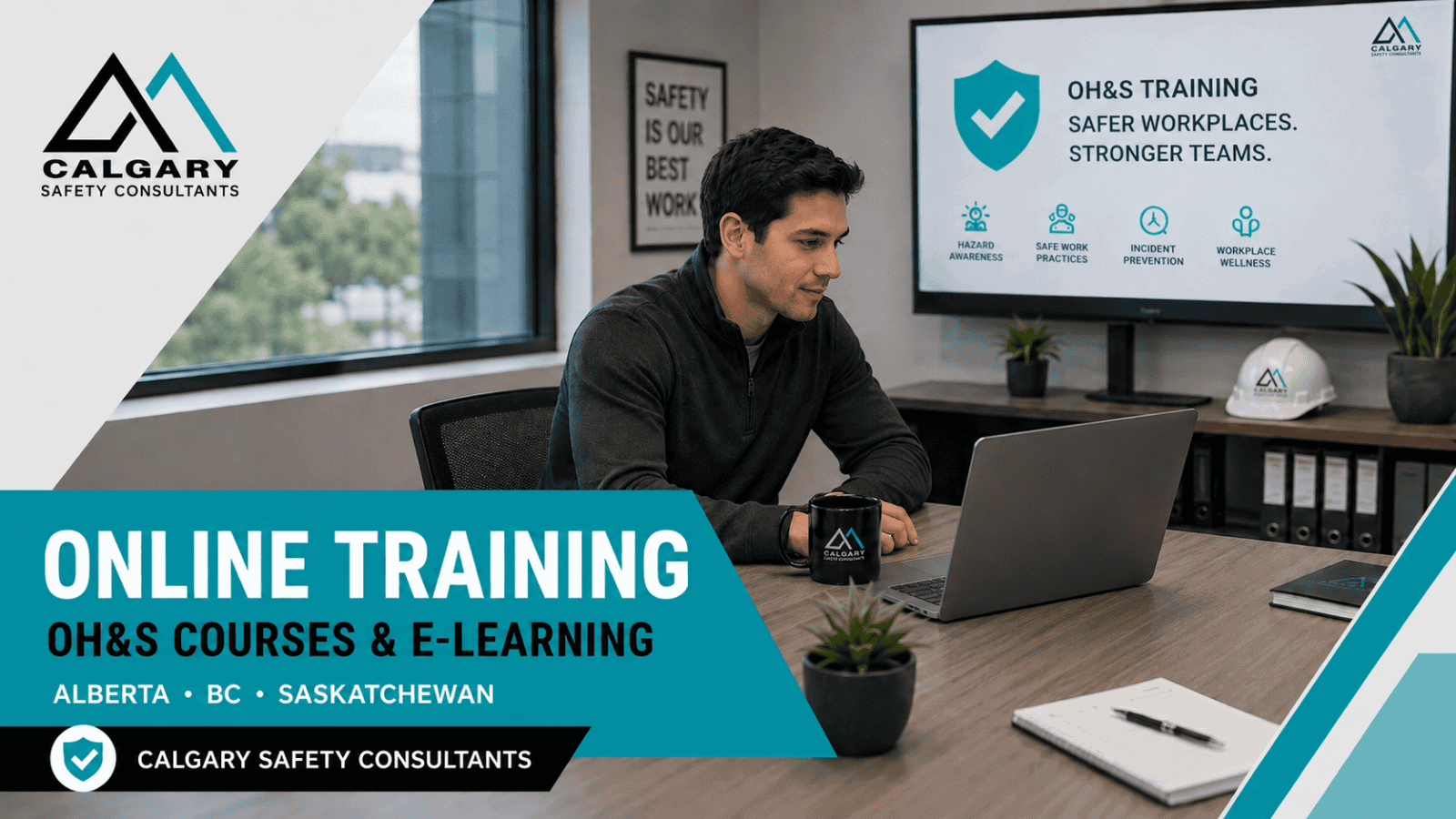
Online safety training helps employers provide practical workplace safety awareness for workers, supervisors, managers, contractors, and safety representatives. Calgary Safety Consultants offers online safety training resources designed to support onboarding, supervisor follow-up, training records, OH&S program implementation, and due diligence for employers across Alberta, British Columbia, Saskatchewan, and Canada.
Training should do more than check a box. It should help workers understand hazards, responsibilities, procedures, reporting expectations, and the role they play in preventing incidents. It should also help employers maintain records, support supervisors, prepare for audits, and respond more effectively when clients, regulators, or internal reviewers ask for evidence of training.
Our online safety training resources are built for practical workplace use. They can support small employers, multi-site operations, contractors, field-based crews, municipal employers, transportation companies, construction firms, warehouses, manufacturers, agricultural operations, healthcare employers, and resource support services.
Practical Online Health and Safety Courses
Better Online Safety Training Supports Safer Workplaces
Effective health and safety training gives workers the knowledge and confidence needed to recognize hazards, follow safe work procedures, and respond appropriately when conditions change. Well-designed training can help employers reduce incidents, strengthen compliance, improve productivity, and demonstrate due diligence.
Practical Knowledge
Learn how workplace health and safety requirements apply to everyday tasks, responsibilities, and decisions. Each course focuses on information workers and supervisors can use in real workplace situations.
Flexible Learning
Complete training online and at your own pace. Our courses provide a convenient option for busy workers, supervisors, and employers who need accessible training without attending a scheduled classroom session.
Workplace Application
Training goes beyond basic awareness by helping participants understand how to identify hazards, apply controls, communicate concerns, and contribute to a stronger workplace health and safety culture.
Practical Online Safety Training for Employers
Online safety training gives employers a practical way to provide consistent safety awareness across workers, supervisors, departments, locations, and shifts. For many organizations, training is one of the most visible parts of the safety program. It helps explain expectations, supports compliance, improves worker understanding, and creates records that may be needed during audits, inspections, incident reviews, client prequalification, or internal safety program assessments.
For employers, the value of online safety training is not only the course itself. The value is in how the training fits into the broader OH&S system. A worker may complete WHMIS, TDG, respectful workplace, PPE, or incident reporting training online, but the employer still needs to connect that training to workplace procedures, supervisor expectations, hazard assessments, inspections, and corrective action follow-up.
This is where practical training design matters. Training should be clear, accessible, and connected to the work being performed. A construction employer may need workers to understand hazard assessments, PPE, inspections, and incident reporting before they arrive on site. A transportation company may need TDG, WHMIS, supervisor awareness, and documentation that supports client or regulatory expectations. A municipal employer may need consistent safety orientation across public works, utilities, parks, administration, and field crews.
Calgary Safety Consultants’ online safety training resources are intended to support worker awareness and employer documentation without making safety more complicated than it needs to be. The goal is to help employers train workers, support supervisors, organize records, and strengthen the safety program in a way that works in real operations.
Available Online Safety Training Courses
WHMIS TRAINING
Who it is for: Workers, supervisors, contractors, and employers whose workplaces include hazardous products.
What it helps with: WHMIS training helps workers understand hazardous product labels, safety data sheets, workplace labels, hazard communication, storage considerations, and basic responsibilities related to hazardous products.
Why it matters: WHMIS is one of the most common training needs for Canadian employers. It supports worker awareness, onboarding, documentation, and hazard communication. For employers, consistent WHMIS training can help reduce confusion, improve safe handling practices, and provide training records for audits, inspections, or client requirements.
Recommended CTA: View WHMIS Training
TDG TRAINING
Who it is for: Workers, drivers, supervisors, shippers, receivers, and employers involved in transporting dangerous goods by road.
What it helps with: TDG training supports awareness of dangerous goods classifications, documentation, safety marks, handling expectations, emergency response information, and worker responsibilities.
Why it matters: Transportation and logistics employers need workers to understand TDG responsibilities before dangerous goods are handled, offered for transport, or transported. Online TDG training can help employers maintain records and support consistent awareness across drivers, shipping staff, supervisors, and contractors.
Recommended CTA: View TDG Training
OH&S LEADERSHIP TRAINING
Who it is for: Supervisors, managers, lead hands, forepersons, business owners, operations leaders, and safety coordinators.
What it helps with: OH&S leadership training supports understanding of supervisor responsibilities, worker communication, hazard control, inspections, incident reporting, corrective actions, and safety program follow-up.
Why it matters: Supervisors influence safety every day. They assign work, observe conditions, coach workers, confirm controls, and respond when issues are identified. Leadership training helps supervisors understand that safety is not only documentation. It is a daily management responsibility connected to productivity, risk, claims, compliance, and due diligence.
Recommended CTA: View OH&S Leadership Training
INCIDENT REPORTING AND INVESTIGATION TRAINING
Who it is for: Supervisors, managers, safety coordinators, committee members, representatives, and workers involved in incident reporting or investigation.
What it helps with: This training supports incident reporting expectations, information gathering, basic investigation concepts, contributing factor review, corrective action development, and documentation.
Why it matters: Incident investigations should help employers learn, not simply assign blame. Training can help supervisors and safety personnel understand what information to collect, how to document findings, and how corrective actions can prevent repeat incidents. Better investigations can also support claims management, regulatory response, audit performance, and operational improvement.
Recommended CTA: View Incident Investigation Training
JOINT HEALTH AND SAFETY COMMITTEE AND REPRESENTATIVE TRAINING
Who it is for: Health and safety committee members, health and safety representatives, managers, supervisors, and employers that need better committee or representative support.
What it helps with: This training supports understanding of committee roles, representative duties, meeting structure, inspections, worker participation, communication, and safety program support.
Why it matters: Committees and representatives can improve worker participation and help identify workplace concerns before they become larger problems. Training helps members understand their role and improves the quality of inspections, recommendations, meeting records, and communication between workers and management.
Recommended CTA: View Committee and Representative Training
RESPECTFUL WORKPLACE TRAINING
Who it is for: Workers, supervisors, managers, HR personnel, and employers that need awareness around respectful conduct, workplace behaviour, harassment prevention, and reporting expectations.
What it helps with: Respectful workplace training supports awareness of appropriate workplace behaviour, reporting channels, supervisor response, communication, and prevention-focused workplace expectations.
Why it matters: Respectful workplace issues can affect morale, productivity, retention, claims, investigations, and legal exposure. Training helps employers communicate expectations and supports a safer, more respectful workplace culture.
Recommended CTA: View Respectful Workplace Training
PPE AND SAFETY CULTURE TRAINING
Who it is for: Workers, supervisors, managers, contractors, and employers that need practical awareness training to support daily safety expectations.
What it helps with: PPE training can support awareness of selection, use, care, limitations, and responsibilities. Safety culture training can help workers and leaders understand how communication, reporting, leadership, and follow-up affect safety performance.
Why it matters: PPE and culture are often treated as simple topics, but both affect daily operations. Workers need to understand expectations, and supervisors need to reinforce them consistently. Training can help create a shared baseline.
Recommended CTA: View Workplace Safety Courses
Who Should Use Online Safety Training
Online safety training is useful for employers that need consistent, accessible, and documented safety training for workers, supervisors, managers, contractors, and safety representatives. It can support both new worker onboarding and refresher training for existing staff.
These resources are especially useful for small and mid-sized employers that do not have a large safety department. In many workplaces, safety responsibilities are shared between owners, managers, supervisors, HR, administration, and field leaders. Online training helps create a consistent foundation so everyone starts with the same basic understanding.
Online safety training may also support multi-site employers, rural employers, remote worksites, mobile crews, contractors, and field-based operations. These workplaces often need training that can be delivered without bringing everyone into one classroom at the same time.
Common industries include construction, transportation, warehousing, manufacturing, agriculture, municipal operations, utilities, healthcare, contractors, resource support, oil and gas support services, environmental work, and mobile service providers.
Training can also support health and safety committees, health and safety representatives, supervisors, and lead hands who need a clearer understanding of safety responsibilities. When training is combined with good procedures, practical supervision, and reliable records, it can help employers improve consistency across the organization.
How Online Safety Training Supports Compliance and Operations
Online safety training supports compliance by helping employers provide clear information to workers and maintain records showing that training was completed. Training records can become important during regulatory inspections, client reviews, incident investigations, COR or SECOR audits, internal audits, or claims-related reviews.
Training also supports operations. Workers who understand expectations are less likely to be confused about reporting procedures, PPE requirements, hazardous products, incident response, inspections, or communication responsibilities. Supervisors also benefit when workers arrive with a clearer baseline of awareness.
Online safety training can help employers improve consistency. This matters when a company operates across multiple locations, uses contractors, hires seasonal workers, manages remote crews, or has workers starting at different times. Instead of relying only on informal explanations, employers can assign training, track completion, and support the training with workplace-specific orientation.
Training can also support supervisor performance. Supervisors are more effective when training is connected to workplace expectations. For example, incident investigation training should be connected to the employer’s reporting procedure. WHMIS training should be connected to the actual hazardous products in use. PPE training should be connected to the employer’s hazard assessments and job requirements.
From a business perspective, good training can reduce confusion, improve documentation, support client confidence, and reduce preventable disruption. It can also help employers demonstrate that workers were informed, supervisors were supported, and safety expectations were communicated.
Training by itself does not create due diligence. However, training is one important part of due diligence when it is supported by procedures, supervision, hazard assessments, inspections, corrective actions, and records.
Related OH&S Services and Next Steps
Online safety training works best when it is connected to a practical safety program. Calgary Safety Consultants can help employers use training as part of a broader OH&S system that includes policies, procedures, hazard assessments, inspections, training records, corrective action tracking, and supervisor support.
If your organization is preparing for certification, audit maintenance, or client requirements, COR and SECOR support can help identify gaps in training records, documentation, inspections, hazard assessments, and implementation evidence. Employers that need stronger written systems can also review customized safety manuals designed to reflect the actual work, hazards, workers, and operating structure of the business.
For employers that need stronger field-level documentation, hazard assessments and workplace inspections support can help improve how hazards are identified, recorded, controlled, and reviewed. If your organization is responding to an inspection, complaint, incident follow-up, order, or corrective action request, OHS regulatory support can help create a structured response.
Some employers need ongoing help maintaining the safety program after training is completed. Ongoing safety program support can help review records, update documents, organize training, support supervisors, and keep the program moving.
Online safety training can also be paired with free downloads, safety resources, and practical OH&S books. Training helps build awareness. Templates help organize the work. Consulting support helps ensure the program reflects the actual workplace.
If you are not sure which training your organization needs, start with a consultation or review your current safety program and training records.
Training Records, Refresher Training, and Supervisor Follow-Up
Training records are one of the most important parts of a practical online safety training system. Employers should be able to show who completed training, what course was completed, when it was completed, and whether refresher training or additional workplace-specific instruction is required.
Good records help during audits, inspections, client reviews, incident investigations, and internal reviews. They also help supervisors manage the work. If a supervisor does not know whether a worker has completed the required training, it becomes harder to assign work confidently or verify that the worker understands the hazards and procedures.
Refresher training should not be treated as a random calendar task. It should be considered when work changes, legislation changes, procedures change, incidents occur, inspections identify repeat gaps, or workers demonstrate uncertainty about safe work expectations. Some training may also need to be refreshed based on employer policy, client requirements, certification requirements, or jurisdictional expectations.
Supervisor follow-up is where online training becomes practical. A completed course should lead to a workplace conversation. The supervisor should confirm that the worker understands how the training applies to the job, the site, the equipment, the procedure, and the hazards present.
For example, after incident reporting training, a supervisor may review the company’s actual reporting form. After WHMIS training, the supervisor may show workers where safety data sheets are stored. After PPE training, the supervisor may review task-specific PPE requirements.
Training records show completion. Supervisor follow-up helps turn completion into workplace understanding.
Frequently Asked Questions About OH&S Online Training
What online safety training courses are available?
Consultants offers online safety training resources that may include WHMIS, TDG, OH&S Leadership, Incident Reporting and Investigation, Joint Health and Safety Committee or representative training, Respectful Workplace, PPE, safety culture, ergonomics, and other workplace safety topics. Course availability may change as new resources are added. Employers can use the Online Training page to review current options and identify training that supports their workers, supervisors, and safety program requirements.
Is online safety training acceptable for employers?
Online safety training can be useful for awareness-level training, onboarding, refresher training, and documentation. However, employers should make sure training is suitable for the work, hazards, jurisdiction, and worker responsibilities. Online training should be supported by workplace-specific orientation, procedures, supervision, competency checks, and records. Some tasks may also require practical instruction, hands-on verification, or additional employer-specific training.
Can online safety training help with COR or SECOR preparation?
Yes. Online safety training can support COR or SECOR preparation by helping employers organize worker and supervisor training records. However, training is only one part of audit readiness. Employers also need evidence of hazard assessments, inspections, investigations, corrective actions, leadership involvement, communication, and program maintenance. Calgary Safety Consultants can help review training records as part of broader COR or SECOR support.
Do supervisors need different safety training than workers?
In many workplaces, yes. Workers need to understand hazards, procedures, reporting expectations, PPE, and their responsibilities. Supervisors often need additional training because they assign work, monitor conditions, communicate expectations, verify controls, respond to incidents, and follow up on corrective actions. Supervisor safety training can help connect daily leadership decisions to compliance, productivity, due diligence, and worker protection.
Can online safety training be used for new worker orientation?
Online safety training can support new worker orientation, but it should not be the entire orientation process. Employers should also provide workplace-specific information such as emergency procedures, site hazards, reporting steps, supervisor contacts, PPE requirements, equipment rules, and company policies. Online training gives workers a foundation, while orientation connects that foundation to the actual workplace.
How should employers track online safety training records?
Employers should track the worker’s name, course title, completion date, expiry or refresher date where applicable, certificate or completion evidence, and any follow-up training required. Records should be easy to retrieve during audits, inspections, client reviews, incident investigations, or internal management reviews. A simple system is better than scattered records that cannot be verified when needed.
Can Calgary Safety Consultants help choose the right training?
Yes. Calgary Safety Consultants can help employers review their current safety program, workforce, hazards, client requirements, audit expectations, and training records to identify practical training needs. This may include online courses, supervisor training, committee or representative training, WHMIS, TDG, incident investigation, respectful workplace training, or broader OH&S leadership support.
Does online training replace workplace-specific procedures?
No. Online training does not replace workplace-specific procedures. It helps build awareness and understanding, but employers still need procedures that reflect the actual work, equipment, hazards, workers, supervision structure, and jurisdictional requirements. Training should be connected to the employer’s own safety manual, hazard assessments, inspections, emergency response plans, reporting procedures, and supervisor expectations.