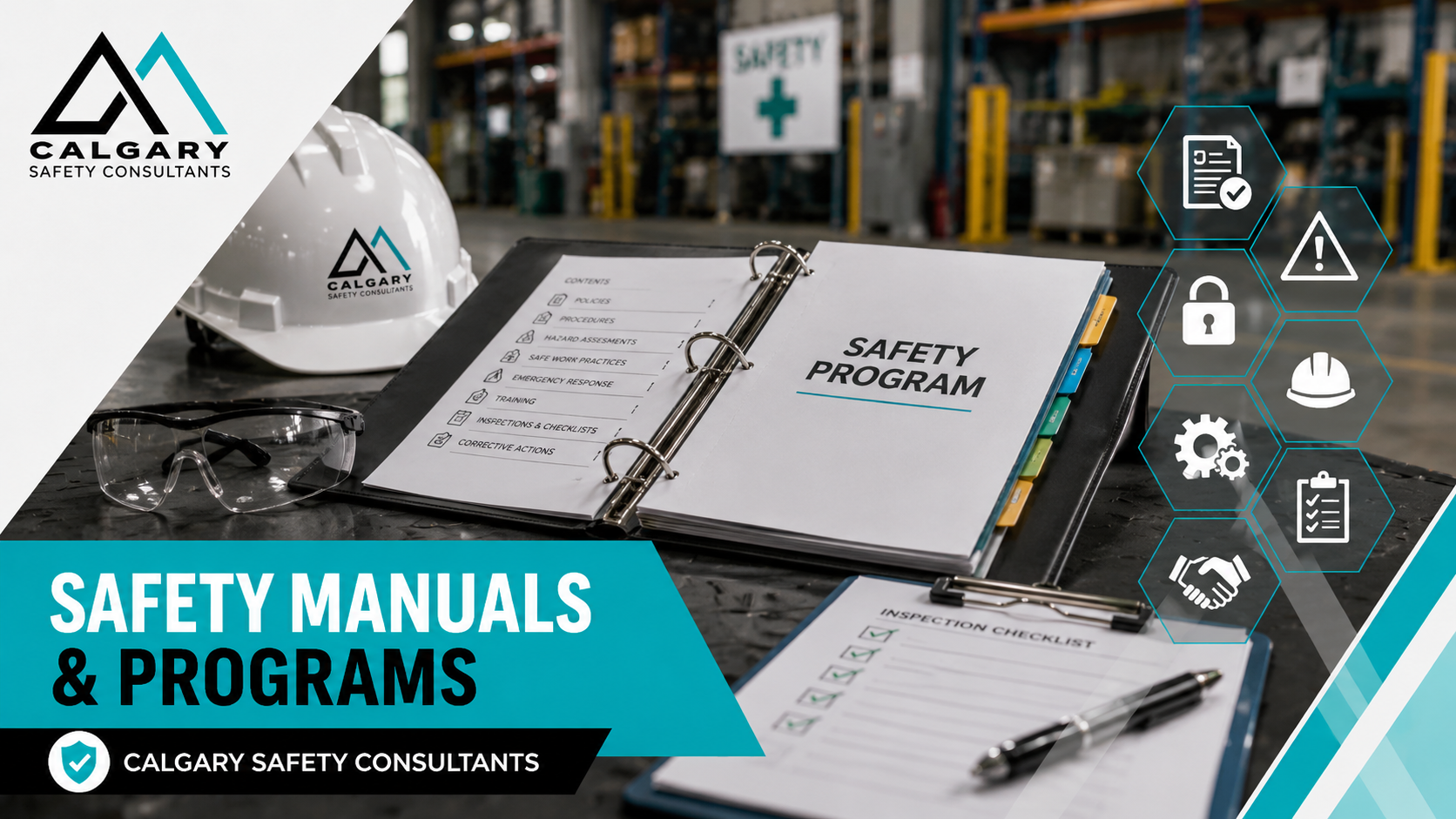
Where do I start if I don’t have a proper safety manual or program?
A safety manual should not be a generic binder that sits on a shelf. It should explain how your company manages real hazards, assigns safety responsibilities, documents work activities, responds to incidents, prepares for emergencies, and keeps workers, supervisors, and managers aligned.
Calgary Safety Consultants develops customized safety manuals for employers in Calgary and across Alberta, British Columbia, and Saskatchewan. Each manual is built around your company’s work activities, industry, workforce, equipment, client requirements, and operational risks.
Whether you need a new safety manual, an update to an outdated manual, or documentation for a client, audit, COR, SECOR, or contractor prequalification process, we help you create a manual that is clear, practical, and usable in the field.
A generic safety manual may look complete, but it often fails when workers, supervisors, auditors, clients, or regulators need to use it.
If the manual does not match the work being performed, it can create confusion. Supervisors may not know which forms to use. Workers may not understand expectations. Office staff may struggle to provide the right documentation during prequalification. Management may believe the company has a safety system in place, while the actual field process looks completely different.
That gap creates risk.
A customized safety manual helps close that gap by connecting your written procedures to the way your company actually operates.
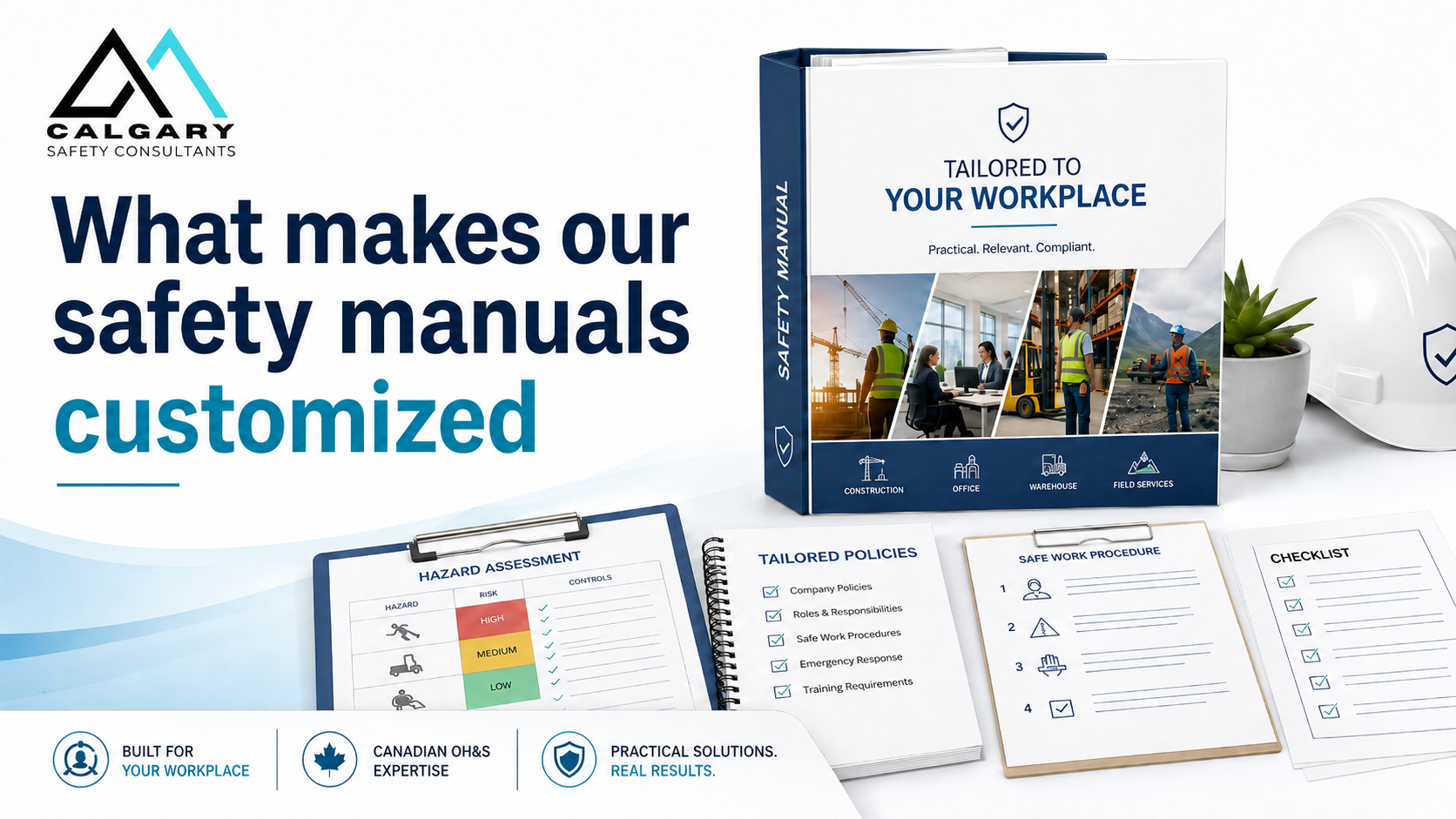
A well-built safety manual can support:
The goal is not to create more paperwork. The goal is to create safety documentation your team can understand, use, maintain, and explain.
A customized safety manual is not built from a one-size-fits-all template.
It is developed around your company’s actual work.
That means we consider:
This matters because a small service contractor, construction company, transportation employer, manufacturer, oil and gas service company, and renewable energy contractor should not all be using the same safety manual.
The structure may be similar, but the content needs to reflect the work.
You may need a new or updated safety manual if:
A safety manual should grow with the company. If your manual has not been reviewed in years, there is a good chance it no longer reflects your current work, workforce, hazards, or client expectations.
If your company does not have a safety manual, we can help you build one from the ground up.
This is useful for newer companies, growing contractors, employers entering new markets, or businesses that need to formalize their safety documentation before bidding, mobilizing, or completing prequalification.
A new manual can give your company a clear safety foundation, including responsibilities, procedures, forms, and expectations that can be communicated across the business.
If you already have a safety manual, you may not need to start over. We can review your existing manual, identify what is missing, remove content that no longer applies, and update the sections that need improvement.
A manual review can help identify:
In many cases, the best solution is not a larger manual. It is a clearer manual.
Your final manual should be based on your company’s needs, but it may include:
Not every company needs every section. A customized manual should include what is needed, remove what is not relevant, and make the content practical enough for supervisors and workers to apply.
We can support employers with a range of safety manual and safety program services, depending on where the organization is starting from and what level of documentation is required. Depending on your needs, related services may include safety program gap reviews, COR or audit readiness support, development of safe work practices and procedures, hazard assessment documentation, emergency response planning, contractor safety management procedures, inspection forms, incident investigation forms, training matrix development, and ongoing consulting support to help keep the program current and usable.
Feel free to check what we have to offer:
These services help organizations establish structured safety management systems that support hazard identification, incident prevention, and regulatory compliance.
Safety manuals for client prequalification
Many employers contact us because a client, prime contractor, vendor portal, or project owner has asked for safety documentation.
This can include requests for:
When documentation is incomplete or inconsistent, it can delay approval, affect bidding, slow mobilization, or create unnecessary back-and-forth with the client. A customized safety manual helps organize your safety system so your company can respond with more confidence.
A safety manual alone does not create COR, SECOR, or audit success.
The manual must be supported by implementation, records, worker involvement, inspections, training, corrective actions, and management review.
However, the manual is still an important foundation. It explains how the safety system is supposed to work and gives your company a structure to follow.
We can help develop or update safety manual content so it better supports COR, SECOR, internal audits, external audits, maintenance requirements, and corrective action planning.
A safety manual should be usable by the people who rely on it.
That includes owners, managers, supervisors, workers, administrators, safety coordinators, subcontractors, auditors, and clients.
We focus on clear wording, practical structure, and realistic expectations. The manual should be detailed enough to support compliance and due diligence, but not so complicated that nobody uses it.
A good safety manual helps answer simple but important questions:
Calgary Safety Consultants helps employers create practical safety documentation that supports compliance, client confidence, audit readiness, and safer day-to-day operations.
We do not build generic manuals that sound good but fail in the field.
We help build customized safety manuals that reflect how your company works, what hazards your people face, and what documentation your clients, supervisors, workers, and auditors expect to see.
The result is a safety manual that is easier to use, easier to maintain, and easier to explain.
We start with a no-obligation consultation to understand your business, your work activities, your locations, your current safety documentation, and any client, contractor, COR, audit, or prequalification requirements you need to meet.
This step helps us determine whether you need a full customized safety manual, an update to an existing manual, or targeted support for specific gaps in your current health and safety program.
Once the scope and agreement are in place, we begin with a project kickoff meeting. This gives us a chance to confirm your priorities, gather the right documents, clarify timelines, and make sure the project is aligned with your operational needs.
The kickoff also helps avoid assumptions. A safety manual should reflect how your company actually works, not how a generic template assumes you work.
We review your existing safety manual, policies, procedures, forms, training records, inspections, hazard assessments, emergency response documents, and other relevant materials.
The purpose of the gap review is to identify what is missing, outdated, unclear, duplicated, inconsistent, or no longer aligned with your current operations. We also look for areas where the manual may create confusion for supervisors, workers, subcontractors, or auditors.
After the gap review, we define what your customized safety manual needs to include. This may be based on your work activities, hazards, job roles, equipment, worksites, jurisdictional requirements, client expectations, COR requirements, audit criteria, or contractor prequalification needs.
This step also confirms the finer details of the project, including what will be developed, revised, removed, consolidated, or left outside the scope. The goal is to create a clear content plan before the manual is built or updated, so the final document is practical, focused, and aligned with the agreement.
We develop or update the safety manual using clear, practical language that reflects your company’s work and gives your team usable direction.
This may include revising policies, improving procedures, building safe work practices, updating forms, aligning hazard assessment processes, strengthening inspection and investigation sections, clarifying responsibilities, and removing unnecessary or duplicated content.
The result is a customized safety manual that is easier to understand, easier to use, and better connected to real workplace conditions.
Once the draft manual is complete, we review it with you and make final revisions where needed. This step helps confirm that the manual reflects your operations, meets the agreed scope, and gives your team practical direction.
We also identify any implementation considerations, such as training needs, communication requirements, missing records, form changes, or follow-up actions that should be addressed after the manual is finalized.
A safety manual only works if people understand how to use it. As part of the project, we help you understand what changed, how the manual should be used, and what steps may be needed to support rollout.
Depending on the agreement, we can provide hands-on implementation support or take a lighter advisory role. This may include guidance on worker communication, supervisor training, inspection schedules, hazard assessment updates, recordkeeping, corrective action tracking, or ongoing program maintenance.
At minimum, we provide clear implementation guidance so you know what to do next and how to put the manual into practice.
Hear from businesses that have partnered with Calgary Safety Consultants to improve their workplace safety. Our clients share their experiences and the positive impact our COR audits, safety assessments, and tailored consulting solutions have had on their operations.
Need help with a safety manual, COR audit preparation, OHS order, hazard assessment, training, or ongoing safety support? Complete the form below or book a 30-minute consultation. We will review your situation, identify the next practical step, and explain how Calgary Safety Consultants can help.
Prefer to book directly?
Request your 30-minute consultation today by completing the calendar appointment below.
A customized safety manual is a company-specific safety document built around your actual work, hazards, workforce, locations, equipment, and client requirements. It is different from a generic template because it reflects how your company operates and what your team needs to manage safety properly.
A generic safety manual may include broad policies, but it often fails to match real field work. That can create confusion, weak documentation, audit issues, and client concerns. A manual that does not reflect your business is harder to implement and harder to defend.
Yes. If your current manual is outdated, too generic, too long, or disconnected from field operations, we can review it and update the sections that need improvement.
Yes. Many client and contractor prequalification systems ask for safety policies, procedures, forms, and evidence of a working safety system. A customized manual helps organize that documentation and can make the prequalification process easier to manage.
Yes. A customized safety manual can support COR or SECOR readiness by organizing policies, responsibilities, procedures, and forms. The manual is only one part of the process, but it gives the safety system a clearer foundation.
Yes. Small and mid-sized businesses often need safety manuals for bidding, contractor approval, growth, or basic compliance. The manual should match the size and risk level of the company instead of being overloaded with unnecessary content.
Yes. Calgary Safety Consultants supports employers in Calgary and across Alberta, British Columbia, and Saskatchewan.
Yes. Implementation support can include guidance on forms, supervisor expectations, worker orientation, inspections, hazard assessments, corrective actions, and ongoing manual maintenance.

Calgary Safety Consultants provides practical occupational health and safety consulting, safety training, COR support, safety program development, and regulatory compliance support for employers across Alberta, British Columbia, and Saskatchewan.
We help organizations strengthen worker training, improve documentation, manage workplace hazards, prepare for audits, and build safety systems that support compliance, productivity, and operational due diligence.