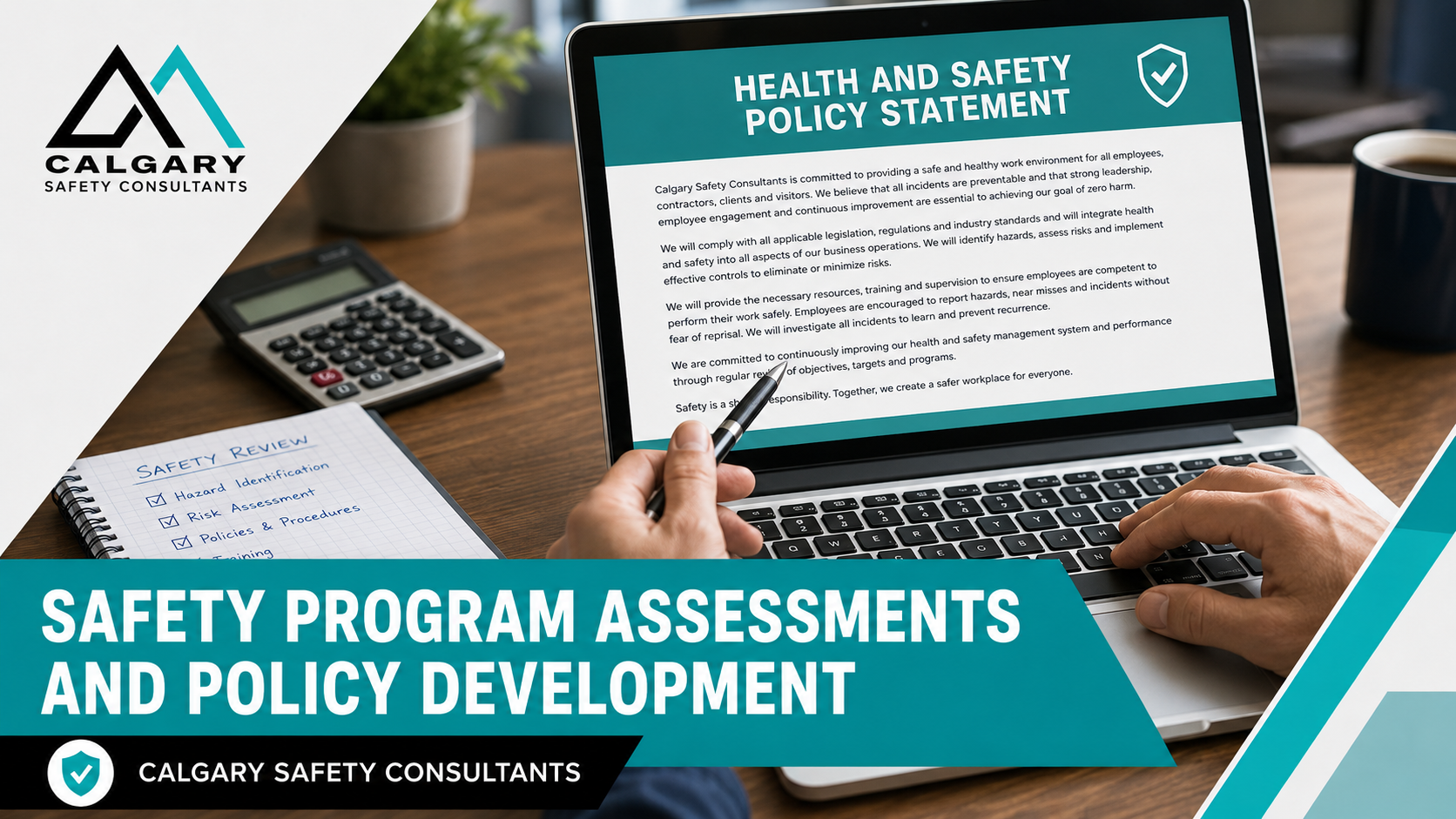
Many employers have a safety manual, policies, forms, training records, and inspection documents, but still struggle to know whether the program is current, complete, compliant, and actually being used in daily operations.
Calgary Safety Consultants helps employers in Calgary and across Alberta, British Columbia, and Saskatchewan assess their existing safety programs, identify gaps, update policies and procedures, strengthen documentation, and build practical systems that support real workplace conditions.
Our goal is to help you understand what is working, what is missing, what needs to be updated, and what should be prioritized so your safety program supports compliance, supervision, training, audits, claims management, and day-to-day risk control.
A safety program assessment is a structured review of your current occupational health and safety program. It looks at whether your policies, procedures, forms, training records, inspections, hazard assessments, incident reporting process, emergency response planning, and corrective action systems are complete, current, practical, and aligned with workplace requirements.
A strong assessment does more than check whether documents exist. It looks at whether those documents reflect actual work, whether supervisors and workers understand the process, whether records are being maintained, and whether the program can support due diligence during an audit, inspection, incident review, client request, or regulatory follow-up.
Policy development is the next step when gaps are found. This may involve creating new policies, updating outdated procedures, simplifying forms, improving roles and responsibilities, or aligning documents with current operations.
You may need a safety program assessment if your company has a safety manual but you are not sure whether it still reflects current work activities, equipment, staffing, worksites, contractors, training requirements, or provincial expectations.
This often happens when a company grows, adds new services, changes equipment, expands into another province, hires new supervisors, prepares for COR or SECOR, responds to an incident, or receives questions from a client, auditor, regulator, or prime contractor.
Support may also be needed when safety policies are too generic, procedures are difficult to use, forms are not being completed, inspections are inconsistent, hazard assessments are outdated, or corrective actions are not being tracked to completion. These issues can create confusion for supervisors, weaken documentation, and make it harder to show that hazards are being managed.
A safety program assessment helps identify the practical gaps before they become larger compliance, operational, or liability concerns. It gives the employer a clearer path for improving the program without guessing what to fix first.
We review your current safety program to identify what is complete, what is missing, what is outdated, and what may not reflect current workplace conditions. This may include your safety manual, policies, procedures, forms, inspection records, training records, incident reports, hazard assessments, emergency response plans, and corrective action records.
We help develop and update practical OH&S policies and procedures that are clear, workplace-specific, and easier for supervisors and workers to use. The goal is to avoid generic language and create documents that support actual work, legal expectations, and operational control.
We help employers update existing safety manuals so they better reflect current tasks, roles, hazards, work locations, contractors, equipment, and documentation needs. This is useful when a manual exists but has become outdated, too generic, or disconnected from daily operations.
We help organize documentation that may support due diligence during audits, inspections, incident reviews, client requests, or internal management reviews. This may include policies, safe work procedures, hazard assessments, inspections, training records, meeting minutes, incident investigations, corrective action tracking, and worker communication records.
We help employers identify safety program gaps before an audit or certification review. This can include reviewing required elements, checking documentation quality, organizing evidence, improving forms, and helping prioritize corrective actions before audit pressure increases.
A safety program assessment shows where the gaps are. Policy and procedure development helps close those gaps.
When these two processes are separated, employers may end up with a list of issues but no practical way to correct them. On the other side, if policies are written without first reviewing the workplace and existing program, the result can be generic documents that do not match real work conditions.
A stronger approach connects the review to the corrective action. The assessment identifies what needs attention. The policy and procedure work turns those findings into usable documents, clearer responsibilities, better forms, and stronger follow-up.
This helps the safety program move beyond paperwork. It becomes a working system that supports supervision, training, inspections, incident response, audit readiness, and daily decision-making.
We help Alberta employers assess and improve safety programs, policies, procedures, hazard assessment systems, training records, inspections, and corrective action processes. This support can help employers better align their documentation with Alberta OH&S expectations, COR readiness, and daily workplace conditions.
We help BC employers review and strengthen safety program documentation, workplace procedures, inspection systems, hazard identification processes, and WorkSafeBC-related safety records. This can help improve consistency, documentation quality, and operational follow-up.
We help Saskatchewan employers review existing safety programs, update policies and procedures, improve safety forms, organize records, and strengthen practical compliance systems. This support can help companies improve safety management and prepare for audits, client reviews, or internal program improvements.
We start by learning about your company, work activities, industry, workforce, current safety program, documentation concerns, audit needs, client requirements, and any recent incidents, inspections, or compliance issues.
This helps us understand whether you need a full program assessment, a targeted policy review, document updates, or a broader safety program improvement plan.
We review your existing safety manual, policies, procedures, forms, hazard assessments, inspections, training records, incident reporting process, emergency response plan, corrective action records, and other relevant safety documents.
The purpose is to identify what is complete, what is outdated, what is missing, and what may not reflect current workplace conditions.
We compare the current program against practical OH&S program expectations, workplace needs, audit considerations, and the realities of your operations.
This helps identify gaps in documentation, implementation, communication, supervision, recordkeeping, responsibilities, and follow-up.
We provide practical recommendations that identify what should be updated, developed, simplified, removed, or strengthened.
The goal is to help you focus on the most important improvements first instead of trying to fix everything at once.
Where needed, we develop or update policies, procedures, forms, and supporting documents using clear, practical wording.
This may include health and safety policies, responsibilities, inspections, hazard assessments, incident reporting, investigations, emergency response, training, PPE, contractor safety, violence and harassment prevention, working alone, corrective actions, or other program elements.
We review the updated documents with your team and provide guidance on how they should be used, communicated, and maintained.
A policy only has value if supervisors and workers understand what it means and how it applies to the work.
Where needed, we recommend a follow-up plan to help maintain the program over time. This may include scheduled reviews, supervisor coaching, inspection improvements, training updates, document control, corrective action tracking, or audit preparation.
This service does not replace the employer’s responsibility to manage workplace health and safety. Employers remain responsible for identifying hazards, controlling risks, training workers, supervising work, maintaining records, completing inspections, investigating incidents, and keeping the safety program current.
Our role is to provide practical OH&S consulting support, identify gaps, improve documentation, develop usable policies and procedures, and help your team build a clearer safety management process.
Where legal advice, appeals, prosecutions, penalties, or formal legal representation are involved, employers should consult qualified legal counsel.
Need help reviewing your safety program, updating policies, improving procedures, organizing safety documentation, preparing for COR or SECOR, or identifying gaps before they become larger problems?
Complete the form below or book a 30-minute consultation. We will review your situation, identify the next practical step, and explain how Calgary Safety Consultants can help.
Prefer to book directly?
Request your 30-minute consultation today by completing the calendar appointment below.
A safety program assessment is a structured review of an employer’s current health and safety program. It looks at policies, procedures, forms, training records, hazard assessments, inspections, incident reporting, emergency response planning, corrective actions, and other program elements to identify gaps, outdated content, and areas for improvement.
A company should review its safety program when operations change, new equipment or tasks are introduced, incidents occur, audit preparation begins, regulatory concerns arise, or existing documents no longer reflect actual work. Regular reviews also help keep the program current and easier to defend during audits, inspections, or client reviews.
Yes. Calgary Safety Consultants can review existing policies and procedures, identify outdated or generic content, and update the documents so they better reflect current work activities, legal expectations, supervisor responsibilities, and practical workplace needs.
Yes. A safety program assessment can help identify gaps before a COR or SECOR audit. This may include reviewing documentation, checking whether required elements are addressed, organizing records, improving forms, and developing corrective actions before the audit process creates additional pressure.
A safety manual is the written documentation. A safety program is how those policies, procedures, forms, training, inspections, hazard assessments, and corrective actions are actually used in the workplace. A strong safety program connects written documents to daily supervision, worker participation, recordkeeping, and follow-up.
Yes. Calgary Safety Consultants can develop new policies, procedures, forms, and supporting documents when existing material is missing, outdated, too generic, or not aligned with current operations.

Calgary Safety Consultants provides practical occupational health and safety consulting, safety training, COR support, safety program development, and regulatory compliance support for employers across Alberta, British Columbia, and Saskatchewan.
We help organizations strengthen worker training, improve documentation, manage workplace hazards, prepare for audits, and build safety systems that support compliance, productivity, and operational due diligence.