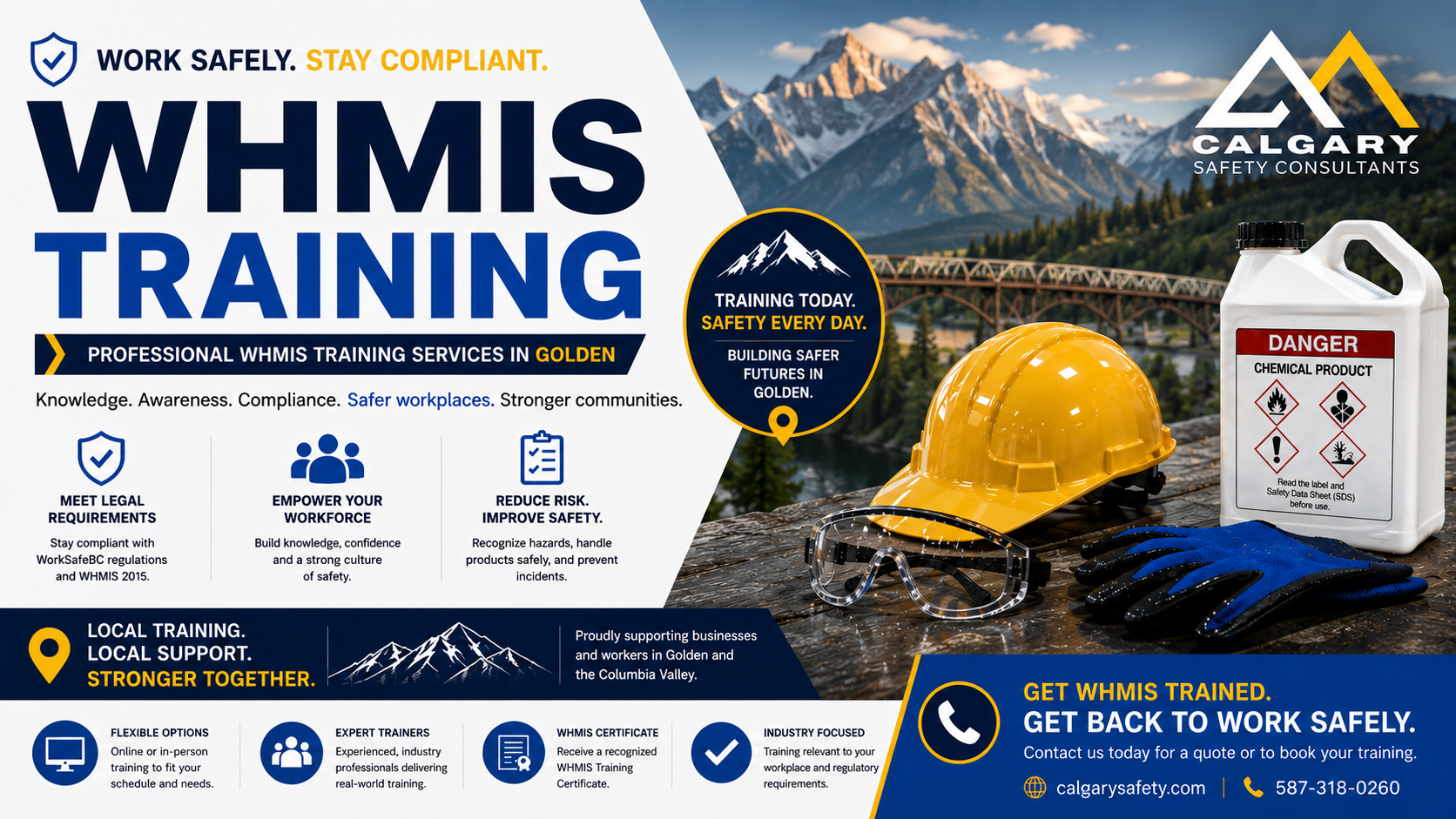
Calgary Safety Consultants provides online WHMIS training and certification for workers, supervisors, contractors, and employers in Golden and surrounding Columbia Valley and Kicking Horse region communities.
Our WHMIS training helps workers understand hazardous product labels, Safety Data Sheets, pictograms, hazard classes, exposure risks, safe handling practices, storage requirements, emergency procedures, and their role in workplace hazard communication.
For Golden employers, WHMIS training supports more than basic compliance. It helps strengthen onboarding, contractor orientation, safety program documentation, inspection readiness, training records, supervisor accountability, and day-to-day hazardous product awareness.
Whether you need WHMIS training for one worker, a new hire group, supervisors, construction workers, hospitality employees, tourism workers, maintenance staff, transportation workers, cleaning staff, office employees, laboratory personnel, contractors, or a full Golden-based team, Calgary Safety Consultants can help you choose the right training option and support workplace-specific WHMIS requirements.
WHMIS training is available online and can be completed at the worker’s own pace. This makes it practical for Golden employers that need consistent safety training without pulling workers away from operations for a full classroom session.
Online WHMIS training is especially useful for employers with seasonal workers, shift workers, contractor crews, hospitality and tourism teams, construction crews, maintenance staff, transportation employees, warehouse workers, cleaning teams, office staff, and employees working across multiple sites or service locations.
Available WHMIS training options include:
WHMIS training is available in three delivery formats:
You may also:
Golden workplaces use hazardous products in many different settings. Some are obvious, such as construction sites, maintenance shops, transportation operations, equipment service areas, municipal services, warehouses, laboratories, forestry support work, tourism operations, and industrial service workplaces. Others are less obvious, such as hotels, restaurants, recreation facilities, offices, retail spaces, cleaning operations, property management sites, administrative workplaces, and service businesses where workers may use disinfectants, aerosols, toner, adhesives, batteries, cleaning products, sanitizers, fuels, lubricants, or maintenance supplies.
WHMIS training helps workers recognize hazardous products before exposure occurs. When workers understand labels, pictograms, SDS information, storage requirements, PPE, and emergency procedures, they are more likely to use products correctly and less likely to rely on assumptions or shortcuts.
For Golden employers, this matters because weak WHMIS training can create real operational problems. Workers may choose the wrong PPE, transfer products without proper workplace labels, store incompatible products together, miss SDS instructions, mix products incorrectly, or fail to respond properly during a spill, leak, release, fire, or exposure incident. Those gaps can affect worker safety, productivity, claims performance, contractor prequalification, inspection readiness, customer confidence, and audit results.
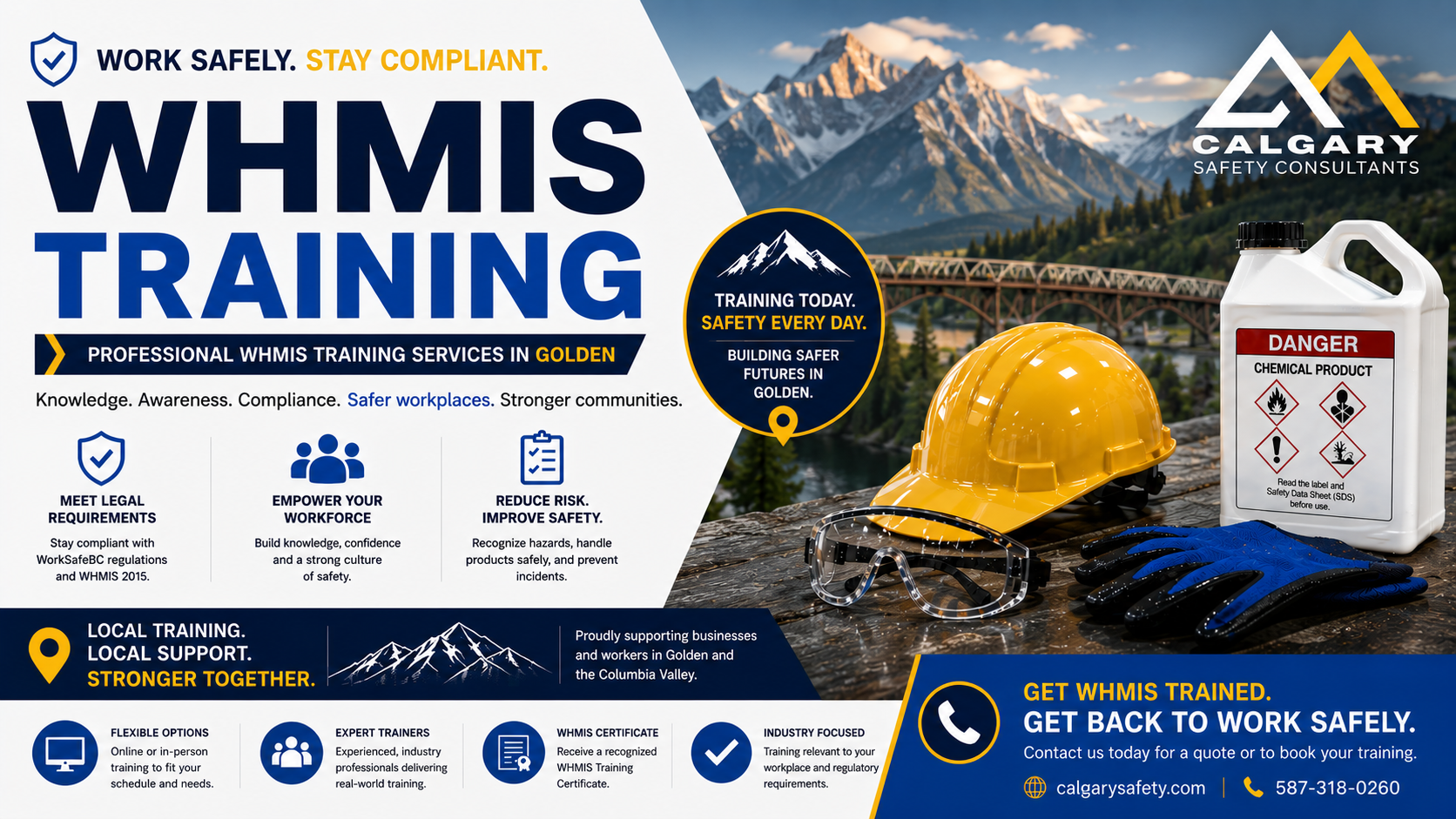
WHMIS training is required when workers work with, handle, store, or may be exposed to hazardous products at work.
In Golden, WHMIS training is commonly needed for:
WHMIS training is also useful during new worker orientation, seasonal hiring, refresher training, contractor onboarding, safety program reviews, inspection preparation, and audit preparation.
WHMIS certification provides documentation that a worker has completed WHMIS training. This can help Golden employers maintain training records, support onboarding, demonstrate due diligence, and confirm that workers have received general WHMIS education.
A WHMIS certificate is useful, but it does not replace workplace-specific WHMIS instruction.
Employers still need to make sure workers understand the hazardous products used at their own workplace. This includes knowing where SDSs are located, how workplace labels are used, what PPE is required, how products are stored, what controls are in place, what emergency procedures apply, and what to do if a spill, leak, release, fire, or exposure occurs.
This is where many employers fall short. They provide a general WHMIS course but do not connect the training to their actual products, tasks, work areas, and emergency procedures. Calgary Safety Consultants can help employers close that gap by supporting workplace-specific WHMIS procedures, SDS review, training records, and safety program documentation.
WHMIS training helps Golden workers understand how hazardous product information is communicated and applied in real workplace situations. The course is not just about recognizing symbols or completing a certificate. It helps workers read labels, use Safety Data Sheets, understand common hazards, recognize exposure risks, and know when to stop and ask for more information.
For Golden employers, this supports onboarding, refresher training, contractor orientation, training records, inspection readiness, and workplace due diligence.
This course covers the essential WHMIS information workers need before using, handling, storing, or working near hazardous products, including:
Golden workplaces may use hazardous products in construction, hospitality, tourism, recreation services, transportation, municipal operations, forestry support, equipment service, maintenance shops, warehouses, laboratories, cleaning operations, offices, property management, and general service businesses.
These products may include cleaners, disinfectants, sanitizers, fuels, solvents, lubricants, degreasers, aerosols, compressed gases, corrosives, adhesives, coatings, batteries, toner, equipment fluids, pool chemicals, cleaning chemicals, and other hazardous materials.
Because hazardous products appear in both higher-risk and lower-risk workplaces, WHMIS training needs to be practical. Workers should know where to find hazard information, what it means, and how to apply it before starting the task.
This module introduces WHMIS as Canada’s workplace hazard communication system. Workers learn how WHMIS helps identify hazardous products, confirm product hazards, and understand the controls needed before work begins.
It also explains the roles of suppliers, employers, supervisors, and workers, including responsibilities for labels, Safety Data Sheets, worker education, workplace-specific instruction, supervision, and reporting concerns.
This module focuses on the information workers need before using a hazardous product. Participants learn about physical hazards, health hazards, exposure routes, supplier labels, workplace labels, and Safety Data Sheets.
Workers also learn why familiar products can still become dangerous when conditions change, why smell or past experience should not be used to judge safety, and how SDS information supports first aid, spill response, handling, storage, PPE, exposure controls, and emergency planning.
This module applies WHMIS to common workplace settings and roles, including supervisors, laboratories, and office environments.
Supervisors learn how to support WHMIS through coaching, label checks, SDS access verification, field observation, corrective action, and stop-work decisions.
Laboratory workers learn how WHMIS applies to small quantities, transferred chemicals, sample containers, chemical compatibility, ventilation, fume hoods, PPE, spill response, and contamination prevention.
Office workers learn how WHMIS applies to cleaners, disinfectants, aerosols, toner, adhesives, batteries, and maintenance products that may be present in lower-risk workplaces.
Calgary Safety Consultants provides WHMIS training support for employers and workers in Golden and surrounding Columbia Valley, Kicking Horse, and mountain corridor communities, including:
Calgary Safety Consultants provides more than basic online safety training. We help employers connect WHMIS training to practical workplace safety requirements.
Golden employers choose us because we understand how WHMIS connects to real workplace operations, including worker onboarding, contractor orientation, seasonal hiring, hospitality, tourism, recreation services, construction, transportation, forestry support, municipal work, maintenance, property management, SDS access, workplace labelling, supervisor responsibilities, and safety documentation.
Our WHMIS training options are useful for workers who need certification, but they also support employers who need better documentation, stronger training records, clearer procedures, and practical safety program support.
Calgary Safety Consultants can help employers with:
Calgary Safety Consultants is here to help you ensure compliance, enhance safety, and streamline your OH&S program. Don’t wait—fill out the form, and we’ll connect with you to discuss how we can support your business. Let’s get started!
Workers will receive documentation after successfully completing the WHMIS course. This helps employers maintain training records for onboarding, audits, inspections, contractor requirements, and safety program documentation.
No. A WHMIS certificate helps document that the worker completed general WHMIS training, but employers should still provide workplace-specific instruction on the actual hazardous products, SDS locations, PPE, storage practices, safe work procedures, and emergency-response expectations used at the site.
Yes. Calgary Safety Consultants provides online WHMIS training for workers, supervisors, contractors, and employers in Golden and surrounding areas. Online training is a practical option for new hires, refresher training, contractor orientation, group training, seasonal workers, shift workers, hospitality teams, and workers who need flexible access.
Workers need WHMIS training when they use, handle, store, or may be exposed to hazardous products at work. In Golden, this may include workers in construction, hospitality, tourism, recreation services, transportation, municipal operations, forestry support, maintenance, cleaning, laboratories, office environments, property management, and general industry.
Yes. Online WHMIS training can be used for individual workers, new hire groups, supervisors, contractors, seasonal workers, hospitality teams, cleaning staff, maintenance workers, and employees working across multiple Golden jobsites or locations. Employers should maintain training records and provide site-specific instruction on the hazardous products used at their workplace.
Supervisors should understand WHMIS because they are often responsible for making sure workers use hazardous products safely, follow required controls, maintain labels, access Safety Data Sheets, and stop work when product identity or required controls cannot be confirmed.
Hospitality, office, and cleaning workers may need WHMIS training if they use, handle, store, or may be exposed to hazardous products such as cleaning chemicals, disinfectants, sanitizers, aerosols, toner, adhesives, batteries, pool chemicals, fuels, lubricants, or maintenance products.
Yes. Online WHMIS training is the recommended option for most workers and employers, but virtual instructor-led and classroom WHMIS training are available for teams that need live instruction, group discussion, or help applying WHMIS requirements to workplace-specific products and procedures.

Calgary Safety Consultants provides practical occupational health and safety consulting, safety training, COR support, safety program development, and regulatory compliance support for employers across Alberta, British Columbia, and Saskatchewan.
We help organizations strengthen worker training, improve documentation, manage workplace hazards, prepare for audits, and build safety systems that support compliance, productivity, and operational due diligence.