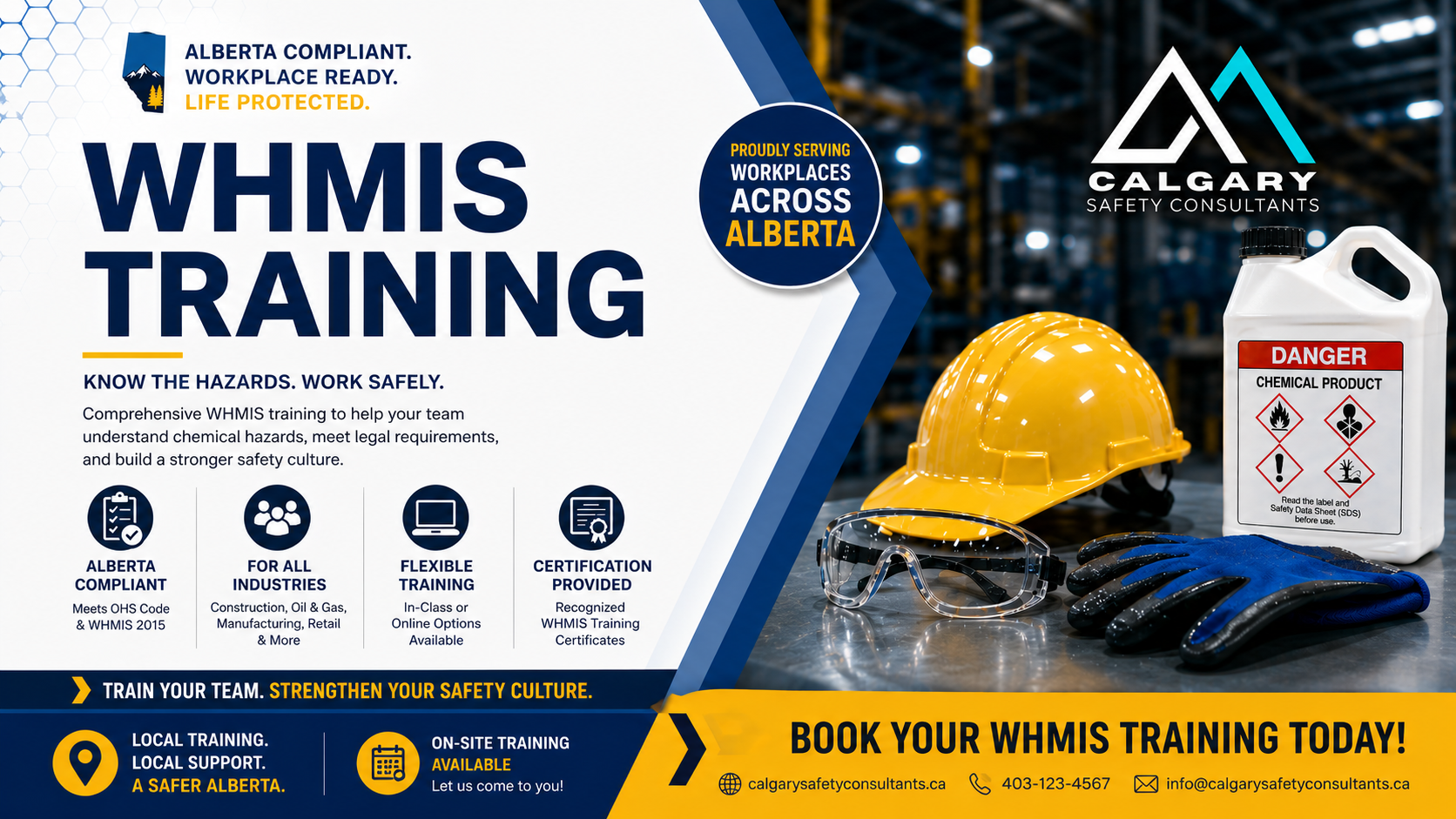
Calgary Safety Consultants provides online WHMIS training for Alberta workers, supervisors, and employers who need practical hazard communication training for the workplace. Our WHMIS course helps participants understand hazardous product labels, Safety Data Sheets, hazard classes, exposure risks, safe handling practices, emergency response, and the responsibilities that support WHMIS compliance in Alberta workplaces.
This training is suitable for employers across Calgary, Edmonton, Red Deer, Fort McMurray, Grande Prairie, Lethbridge, Medicine Hat, Canmore, and surrounding Alberta communities. Whether your organization operates in construction, oil and gas, transportation, warehousing, maintenance, office operations, municipal services, or general industry, WHMIS training helps workers recognize hazardous products and use the information provided through labels and Safety Data Sheets before exposure or incidents occur.
Calgary Safety Consultants can help employers set up online WHMIS training for new hires, existing workers, supervisors, contractors, and multi-location teams across Alberta. Whether you need one worker trained or a full group enrolled, we can help you get practical WHMIS training in place quickly and maintain clear training records for your safety program.
Request Group Training Options
Call 1-888-231-0358
WHMIS training is required when workers use, handle, store, or may be exposed to hazardous products at work. In Alberta, this can include employees in industrial, commercial, construction, maintenance, transportation, cleaning, laboratory, healthcare, municipal, agricultural, and office environments.
Some workplaces have obvious WHMIS risks, such as fuels, solvents, compressed gases, corrosive products, paints, adhesives, disinfectants, and industrial chemicals. Other workplaces have lower-volume products, but the risk still exists when workers transfer products, use chemicals in poorly ventilated areas, mix incompatible products, ignore label instructions, or cannot quickly access the correct Safety Data Sheet.
The goal of WHMIS training is not just to complete a certificate. The goal is to make sure workers understand the hazard information before they use the product, so they can prevent exposure, spills, fires, reactions, and other workplace incidents.
Alberta employers must make sure workers understand the hazardous products they may use, handle, store, or be exposed to during work. Online WHMIS training provides the foundation, but employers still need to connect that training to the actual products, labels, Safety Data Sheets, PPE, storage areas, emergency procedures, and safe work practices used at their workplace.
A WHMIS certificate is helpful documentation, but it does not replace site-specific instruction. Workers should know how to identify hazardous products, read supplier and workplace labels, access the correct SDS, follow required controls, and respond properly to spills, leaks, releases, fires, or exposure incidents.
Strong WHMIS training helps Alberta employers improve onboarding, support contractor orientation, reduce exposure risk, strengthen inspection readiness, and demonstrate due diligence during audits or incident investigations.
After completing the course, participants receive documentation showing they have completed WHMIS training. This helps employers maintain training records, support onboarding, and demonstrate that workers have received instruction in WHMIS hazard communication.
However, a certificate alone does not replace employer-specific training. Employers should also make sure workers understand the hazardous products actually used at their workplace, where Safety Data Sheets are located, what site-specific controls apply, what PPE is required, and what to do during a spill, release, or exposure incident.
This distinction is important. Online WHMIS training provides the foundation. Site-specific instruction connects that foundation to the actual products, tasks, controls, and emergency procedures in the workplace.
Online WHMIS training is a practical option for Alberta employers because workers can complete the course without waiting for a classroom session or removing full crews from operations at the same time. This is especially useful for employers with workers spread across multiple communities, project sites, service routes, or shift schedules.
The course should help workers understand how WHMIS information is used in real workplace decisions. A worker should know how to recognize a hazardous product, read a supplier label, locate and review a Safety Data Sheet, understand common hazard pictograms, follow safe handling instructions, and respond properly when a spill, leak, exposure, or storage concern occurs.
For employers, WHMIS training also supports due diligence. When training is documented, current, and connected to the actual hazardous products used at the workplace, it becomes easier to demonstrate that workers were given the information they need to work safely.
Available online training options include:
WHMIS training is available in three delivery formats:
The goal is to ensure that workers and supervisors understand how to apply WHMIS requirements in practice, not just in theory. Online WHMIS training provides a strong foundation for Alberta employers, but it should be supported by site-specific instruction on the actual hazardous products, controls, PPE, storage areas, and emergency procedures used at the workplace.
Alberta workplaces use hazardous products in many different ways. A construction worker may deal with adhesives, concrete products, fuels, paints, sealants, and compressed gases. A shop worker may use lubricants, solvents, aerosols, and cleaning chemicals. A transportation worker may handle products during loading, storage, or delivery. An office worker may only encounter cleaners, toner, disinfectants, or maintenance products, but still needs to understand basic hazard communication when those products are used at work.
WHMIS training is most effective when workers can connect the course material to the products they actually see on the job. That is why Calgary Safety Consultants focuses on practical understanding, not just memorization. Workers need to know what the label is telling them, what the Safety Data Sheet adds, and what actions they should take before the task begins.
If you are training multiple workers, Calgary Safety Consultants can help you organize online WHMIS training for your Alberta team. This is useful for new worker onboarding, annual or periodic refresher training, contractor orientation, seasonal hiring, project start-up, and employers with workers spread across more than one location.
Group training helps employers keep WHMIS records organized, reduce scheduling disruption, and support consistent hazard communication across the workplace.
Calgary Safety Consultants provides online WHMIS training and workplace safety support across Alberta. Alberta locations we serve:
Calgary Safety Consultants helps Alberta employers set up practical WHMIS training for workers, supervisors, contractors, new hires, and multi-location teams. Our WHMIS training supports onboarding, refresher training, training records, contractor orientation, and safety program due diligence.
We can also help employers strengthen the workplace-specific side of WHMIS by reviewing SDS access, labelling practices, hazardous product storage, PPE expectations, emergency procedures, and related safety program documentation.
Calgary Safety Consultants is here to help you ensure compliance, enhance safety, and streamline your OH&S program. Don’t wait—fill out the form, and we’ll connect with you to discuss how we can support your business. Let’s get started!
Online WHMIS training can support Alberta workplace training requirements when it provides workers with the information they need to understand hazardous products, labels, Safety Data Sheets, hazard classes, safe handling practices, and emergency procedures. Employers should also provide site-specific instruction for the hazardous products used at their workplace.
Workers need WHMIS training when they use, handle, store, or may be exposed to hazardous products at work. This can include workers in construction, oil and gas, transportation, warehousing, maintenance, cleaning, healthcare, education, laboratories, municipal operations, and office environments.
WHMIS training should be kept current. Employers should review training when workers are exposed to new hazardous products, when workplace conditions change, when procedures change, or when a worker shows they do not understand the required WHMIS information. Many employers also set refresher training intervals as part of their internal safety program. We suggest annual to every 3 years max.
Yes. General WHMIS training gives workers the foundation, but employers should also provide workplace-specific instruction. Workers need to know which hazardous products are present, where Safety Data Sheets are located, what controls are required, what PPE must be used, and what emergency steps apply at that workplace.
Yes. Calgary Safety Consultants provides online WHMIS training for employers and workers across Alberta, including Calgary, Edmonton, Red Deer, Fort McMurray, Grande Prairie, Lethbridge, Medicine Hat, Canmore, and surrounding areas.
Yes. Online WHMIS training can be used for individual workers, new hire groups, supervisors, contractors, and employees working across multiple Alberta locations. Employers should maintain training records and provide
Supervisors should understand WHMIS because they are often responsible for making sure workers use hazardous products safely, follow required controls, maintain labels, access Safety Data Sheets, and stop work when product identity or hazard controls cannot be confirmed.
Office staff may need WHMIS training if they use, handle, store, or may be exposed to hazardous products such as cleaning chemicals, disinfectants, aerosols, toner, adhesives, batteries, or maintenance products.
The online course provides general WHMIS education. Employers should add workplace-specific instruction covering the actual hazardous products, SDS locations, PPE, safe work procedures, storage practices, and emergency procedures used at their site.

Calgary Safety Consultants provides practical occupational health and safety consulting, safety training, COR support, safety program development, and regulatory compliance support for employers across Alberta, British Columbia, and Saskatchewan.
We help organizations strengthen worker training, improve documentation, manage workplace hazards, prepare for audits, and build safety systems that support compliance, productivity, and operational due diligence.