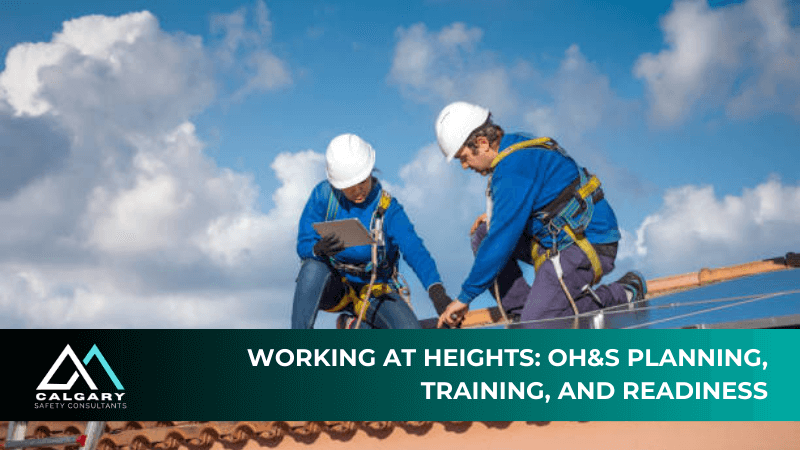
Working at heights is one of those topics that everyone knows is serious, but in day-to-day operations it can quietly slide into “we’ve always done it this way” territory. Ladders get grabbed in a hurry, people lean a little too far on a roof, a harness is worn but not adjusted properly, and the assumption is that the fall protection gear will save the day if anything goes wrong.
The problem is that falls from heights are still a leading cause of serious injuries and fatalities in Canadian workplaces, especially in construction, maintenance, warehousing, and industrial settings. A lot of those incidents involve situations where there was some kind of fall protection on paper, but not much real planning behind it.(CCOHS)
If you want to improve your working at heights program, you have to think beyond “buy the harness and tick the training box.” Real control means planning the work, training people for what they actually do at height, and having a credible rescue plan that does not start and end with “call 911.”
Working at heights is not just about people on big commercial roofs or hanging off the side of a high-rise. It includes any situation where a worker could be hurt if they fell from one level to another. Alberta’s OHS Code, for example, requires fall protection at 3 metres and below that height if there is a risk of serious injury due to what you might land on.(Search OHS Laws)
Common working at heights situations include:
If a worker can fall and be seriously injured, you should be thinking “working at heights,” whether or not the law forces you into a formal fall protection plan at that exact height.
A common trap is to jump straight to personal fall arrest systems. Harness, lanyard, anchor, problem solved. In reality, fall arrest is the last line of defense, not the first. CCOHS and most regulators recommend following a hierarchy of controls for falls, similar to other hazards.(CCOHS)
In plain language, the hierarchy looks like this:
When your default answer is “put a harness on them,” you are accepting a lot of exposure by choice. When you design the job to keep people off the edge or behind a guardrail, you are controlling the risk at a much more reliable level.
A decent working at heights program starts long before anyone clips in. The best question a supervisor can ask is: “Why are we at height in the first place, and what is the safest way to do this work?”
A practical working at heights plan should cover at least:
WorkSafeBC, CCOHS, and other agencies all emphasize that a written fall protection or working at heights plan is essential once you are into serious elevation or complex jobs.(WorkSafeBC) Even for smaller Alberta sites, having at least a simple written plan for higher-risk tasks is just good management.
Working at heights training is one of those topics that can be either a powerful control or a checkbox exercise. The difference is in how specific and practical the training is.
Strong training programs go beyond general theory and include:
Refresher training is also key. Working at heights practices drift over time. Workers forget details, shortcuts become normal, and new equipment shows up with features no one truly understands. Short, site-specific refreshers and toolbox talks are a smart way to keep skills sharp between formal courses.
This is the part of working at heights that many employers quietly avoid. Everyone is more comfortable talking about harnesses and anchors than about what happens when someone is hanging 6 metres in the air, unconscious, with their lanyard fully deployed.
A working at heights rescue plan is not optional. Canadian guidance is clear that employers must plan for a prompt rescue of a fallen worker, not just rely on public emergency services.(CCOHS)
A credible rescue plan should answer simple but tough questions:
It is important to actually practice the rescue plan. Tabletop discussions are useful, but until your team physically goes through a drill, you will not see the real timing issues, communication gaps, or equipment limitations. Even a basic, well-practiced ladder or lift-based rescue is miles better than a vague “we will figure it out if it happens.”
In audits and investigations, the same themes show up again and again around working at heights:
These gaps are often not about bad intentions. They are about competing priorities, cost pressures, and a lack of clear ownership for working at heights controls. Leaders sometimes underestimate the complexity of doing heights work safely, especially when jobs are short duration or “routine.”
If you are operating in Calgary or anywhere in Alberta, working at heights compliance is not just a regulatory box. It is a visible marker of how seriously you take OH&S in general. Under Part 9 of the Alberta OHS Code and related guidance, employers have to protect workers from falling, implement effective systems, and ensure training and rescue readiness.(Search OHS Laws)
Calgary Safety Consultants can support your organization in a few practical ways:
If you want support getting your working at heights program to the next level, you can connect directly at https://calgarysafetyconsultants.ca and we can talk about practical next steps that fit your size, risk profile, and budget.
Working at heights is one of the clearest places where people can see the difference between a “paper” safety program and a real one. Workers know when a harness is just a visual comfort item versus when the company has actually thought through the work, the risks, and the rescue.
When leaders invest in solid planning, real training, and credible rescue readiness, a few things happen:
Over time, that approach builds trust. People start to believe that the organization is serious about sending them home in the same condition they arrived, even when the job involves riskier tasks like working at heights.
In my view, working at heights is one of the most unforgiving areas of OH&S. You can get away with small cracks in your program for a long time, and then one bad day can expose every weakness at once. A missed anchor check, a poorly chosen lanyard, a rushed ladder setup, or a non-existent rescue plan can turn into a life-altering event in seconds.
That is why I think employers should treat working at heights as a flagship element of their safety program. If you can demonstrate that your organization plans heights work carefully, trains people properly, and is genuinely ready to rescue someone if things go wrong, you are likely doing a lot of other things right too.
The harsh truth is that a harness is not a plan. A real plan looks at whether you need to be at height at all, what physical controls you can use, how you will protect people if they still have to be exposed, and how you will get them down and treated if the system is ever put to the test. When you approach working at heights with that level of respect, you dramatically reduce the chances that your organization becomes part of the fall statistics that regulators and safety groups keep reminding us about.
Calgary Safety Consultants can help you turn your safety program into a powerful asset, not a regulatory liability. Reach out today and take the next step toward building a workplace that’s not just compliant—but genuinely safe.
Connect with us here and let us help you improve your OH&S practices.
Working at heights includes any situation where a worker could be injured by falling from one level to another, not just high-rise or roof work. This can include ladders, mezzanines, scaffolds, aerial lifts, racking systems, and work on top of equipment or tanks. If a fall could cause serious harm, you should treat it as working at heights and apply appropriate controls.
A harness alone is not a complete control; it is the last line of defence. Effective working at heights programs use the hierarchy of controls: eliminate the need to work at height where possible, use guardrails and engineered systems, apply administrative controls, and use personal fall arrest systems only when exposure cannot be avoided. Planning, supervision, and equipment selection are just as important as the harness.
A written plan forces you to think through the task, the surfaces and edges involved, the weather, the equipment required, anchor points, inspection steps, and rescue procedures before anyone leaves the ground. It also supports due diligence under OH&S legislation by showing that the employer identified the risks and chose controls intentionally rather than leaving workers to improvise.
Need help with a safety manual, COR audit preparation, OHS order, hazard assessment, training, or ongoing safety support? Complete the form below or book a 30-minute consultation. We will review your situation, identify the next practical step, and explain how Calgary Safety Consultants can help.
Prefer to book directly?
Request your 30-minute consultation today by completing the calendar appointment below.

Calgary Safety Consultants provides practical occupational health and safety consulting, safety training, COR support, safety program development, and regulatory compliance support for employers across Alberta, British Columbia, and Saskatchewan.
We help organizations strengthen worker training, improve documentation, manage workplace hazards, prepare for audits, and build safety systems that support compliance, productivity, and operational due diligence.