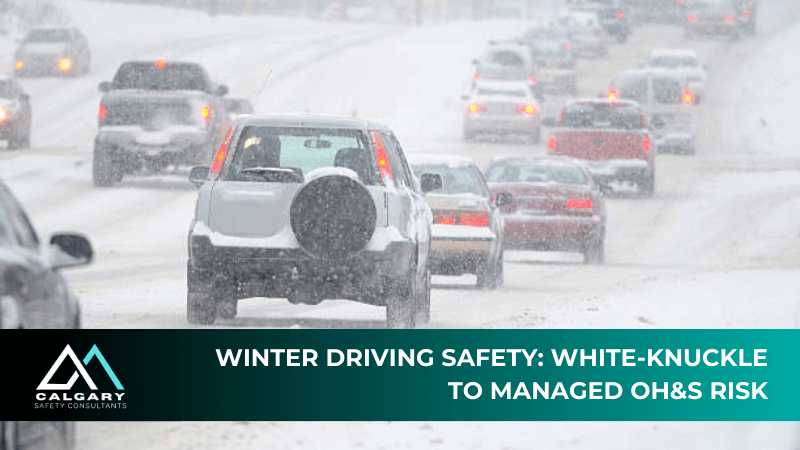
Every winter, the same story plays out. The first real snowfall hits, the roads go greasy, and suddenly every commute turns into a stress test. Most people think about winter driving as a personal risk: you, your car, and the ditch. But if your workers drive for any part of their job – sales calls, client visits, deliveries, site checks – then winter driving is an occupational health and safety issue, not just a personal one.
In Canada, employers have a legal duty to take all reasonable steps to protect workers’ health and safety, which includes when they’re behind the wheel for work purposes. That duty sits inside provincial OHS legislation and codes, and it doesn’t disappear the moment the worker leaves your yard or office parking lot.(open.alberta.ca)
Treating winter driving as part of your safety management system – with hazards, controls, training, and monitoring – is the difference between hoping everyone gets home safe and actually managing the risk.
Winter road conditions amplify every bad habit: tailgating, speeding, distraction, rushing to make up time. Add snow, ice, slush, black ice, poor visibility, and shortened daylight and it’s not surprising that work-related crashes spike in the colder months. In some jurisdictions, close to a third of all work-related crashes that cause injury happen in the late fall and early winter period.(worksafebc.com)
For employers, this is not just a driving problem. It’s a cost and liability problem:
Viewed through an OH&S lens, winter driving is just another high-risk task that needs structure, not a seasonal nuisance to be handled with one reminder email and a “drive safe everyone.”
Across Canadian jurisdictions, the message is consistent: if workers are driving for work, the vehicle is a workplace and you are responsible for managing that risk.(wscc.nt.ca)
At a practical level, that means you should be able to show:
Regulators and insurers increasingly expect to see winter driving treated like any other significant hazard – documented, controlled, and built into your overall OH&S program.(worksafebc.com)
A lot of organizations technically have a “winter driving policy,” but it lives in a binder and nobody remembers what it says. A useful winter driving plan is simple, clear, and operational – people actually use it when they make decisions.
Good winter driving programs usually cover four big pieces:
If your people can’t answer basic questions like “Who decides if a trip gets cancelled?”, “Do I have the right to refuse to drive if I think it’s unsafe?”, or “What am I supposed to carry in the vehicle in January?”, your program needs work.
It sounds obvious, but a shocking number of fleets roll into winter on bald all-season tires and hope for the best. Winterized vehicles are one of the easiest and most effective controls you can put in place.
Transport Canada and multiple road safety agencies recommend using dedicated winter tires on all wheels in cold, snowy, or icy conditions, and checking that they have sufficient tread depth and correct air pressure.(Transport Canada) Proper winter tires, with softer rubber and winter tread patterns, significantly improve traction and braking performance compared to standard all-seasons.(Transport Canada)
Your winter driving standard for company vehicles (and, ideally, for personal vehicles used for work) should cover things like:
On top of that, every work vehicle should carry a winter emergency kit. At minimum, that means warm clothing and blankets, food and water, a shovel, traction aids (like sand or kitty litter), booster cables, a flashlight, and a way to call for help.(Transport Canada)
Winter vehicle prep is the engineering side of the equation; driver behaviour is the human side. Even experienced drivers need a refresher when conditions change.
Your winter driving training doesn’t have to be complicated, but it should be more than “slow down.” Good content usually hits on:
Winter training should be built into orientation for new hires who will drive for work and refreshed every fall for existing staff. Short toolbox talks, quick online modules, and targeted refreshers for high-mileage drivers all help keep winter risk top-of-mind.(worksafebc.com)
The best winter driving rules in the world won’t matter if your culture still whispers “just get there” or “we can’t cancel on a client.” This is where supervisors, dispatchers, and managers either make winter driving safer – or quietly undermine it.
Supervisors should be trained to:
One of the most powerful controls is simple: explicit permission to slow down or not go at all. When workers know they won’t be blamed if they choose caution, they make safer decisions. That’s culture, not paperwork.
Most employers don’t have time to build a winter driving program from scratch, cross-check it against legislation, and then translate it into real-world tools and training. That’s where a specialized OH&S partner makes life a lot easier.
At Calgary Safety Consultants (calgarysafetyconsultants.ca), winter driving fits naturally into the kind of work we already do with clients across Western Canada. We can help you:
We can also help you align winter driving controls with broader OH&S requirements in Alberta and other provinces, so you’re not managing driving risks in a silo. When regulators or auditors ask, you’ll be able to show that winter driving is treated as part of your formal safety management system, not just a seasonal reminder email.
If you want to go further, we can help you measure and track winter driving performance – near-miss reporting, incident trends, and leading indicators like completion of winter checks – so you can see whether your controls are working and where to improve.
Here’s my honest opinion: most organizations under-manage winter driving. They act surprised every year when the first storm hits, even though winter is about as predictable as it gets in Canada. They talk a lot about “safety first,” but they still pressure people to make it to that meeting, that delivery window, that site visit, even when conditions are clearly deteriorating.
From an OH&S perspective, that’s avoidable risk. We already know winter is coming. We already know that road conditions will get worse. We already know that work-related crashes spike in this season. And we already have well-documented best practices for vehicles, training, trip planning, and emergency preparedness.
So the real gap isn’t knowledge, it’s follow-through. The employers who do winter driving well treat it exactly like any other serious hazard: they assess it, they control it, they train for it, and they keep checking whether their system still works as conditions change. The ones who don’t tend to rely on “common sense” and hope.
If your workers drive for you in winter – even a few times a month – you’re in the first category or the second. There really isn’t a middle.
The good news is that getting serious about winter driving doesn’t mean endless paperwork. With a clear plan, sensible policies, and focused training, you can dramatically reduce the risk of winter-related driving incidents and prove that you’re taking your OH&S responsibilities seriously. And if you’d rather not figure it out alone, companies like Calgary Safety Consultants exist specifically to help you close that gap.
My view? Winter driving will always be risky. But in a well-run organization, it should never be unmanaged.
Calgary Safety Consultants can help you turn your safety program into a powerful asset, not a regulatory liability. Reach out today and take the next step toward building a workplace that’s not just compliant—but genuinely safe.
Connect with us here and let us help you improve your OH&S practices.
Winter driving is an OH&S issue because when employees drive for work, the vehicle becomes a workplace. Employers have a legal duty to identify winter driving as a hazard, assess the risk, and put controls, training, and procedures in place to protect workers on the road.
Employers are responsible for ensuring winter driving hazards are assessed, vehicles are properly maintained and winterized, policies and procedures are in place, workers are trained, and trips are planned with weather and road conditions in mind. They must also investigate driving incidents and near misses and follow up with corrective actions.
Yes. If a worker uses a personal vehicle for work tasks, such as client visits or site checks, the employer still has a duty to manage that risk. Many organizations set minimum standards for personal vehicles used on company business, including winter tires, emergency kits, and pre-trip checks.
Need help with a safety manual, COR audit preparation, OHS order, hazard assessment, training, or ongoing safety support? Complete the form below or book a 30-minute consultation. We will review your situation, identify the next practical step, and explain how Calgary Safety Consultants can help.
Prefer to book directly?
Request your 30-minute consultation today by completing the calendar appointment below.

Calgary Safety Consultants provides practical occupational health and safety consulting, safety training, COR support, safety program development, and regulatory compliance support for employers across Alberta, British Columbia, and Saskatchewan.
We help organizations strengthen worker training, improve documentation, manage workplace hazards, prepare for audits, and build safety systems that support compliance, productivity, and operational due diligence.