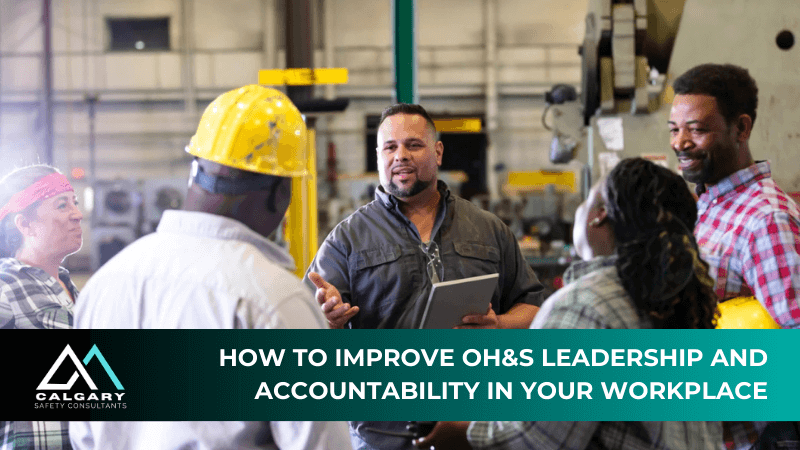
Most workplaces don’t fail on safety because people don’t care. They fail because leadership and accountability are fuzzy. Everyone is “for safety,” but no one is clearly on the hook for specific actions, timelines, and results.
Good safety leadership is not just about knowing the legislation or signing off on a policy. It is about senior leaders, supervisors, and workers each taking visible responsibility for preventing harm and improving controls, day after day. ISO 45001, for example, puts leadership and worker participation right at the centre of an effective occupational health and safety management system, with top management required to demonstrate clear commitment, provide resources, and integrate OH&S into business decisions. (certification.bureauveritas.com)
In Canada, regulators like CCOHS and provincial ministries have been clear: health and safety starts at the top, but it must be lived by everyone, not just the safety department. (WorkSafeBC)
Accountability in safety gets thrown around as a buzzword, but it has a very specific meaning. Accountability is about people being answerable for the safety-related duties and decisions that fall within their role, combined with the authority and resources needed to actually carry those duties out. One definition used in safety leadership training describes accountability as the responsibility of leaders and managers to uphold safety standards and ensure that safety policies are followed. (oshacademy.com)
That means:
• Directors and senior managers are accountable for setting expectations, providing resources, and integrating OH&S into strategies, budgets, and performance measures. (ccohs.ca)
• Supervisors are accountable for day-to-day implementation: ensuring workers are trained, hazards are controlled, and procedures are followed. (Open Alberta)
• Workers are accountable for using equipment properly, following reasonable instructions, and reporting hazards and incidents so the system can improve. (Open Alberta)
Accountability is not about blame after the fact. It is about being clear beforehand who is expected to do what, by when, and how success will be checked.
When safety leadership and accountability are weak, the symptoms show up everywhere in your OH&S program. For example:
• Safety is delegated to one “safety person,” while executives and line managers stay hands-off.
• Supervisors are nominally “responsible” but never trained on their legal duties or how to lead safety conversations, coach behaviour, or handle refusal of unsafe work. (energysafetycanada.com)
• Workers only hear about safety during orientations or after an incident, not as part of normal planning and problem-solving.
• Investigations stop at “human error” rather than digging into system issues like workload, maintenance, supervision, or conflicting priorities.
• Corrective actions get written down but not verified, and no one owns the close-out.
These gaps aren’t usually intentional. They grow slowly when day-to-day production pressure, staff turnover, and unclear expectations chip away at good intentions.
Improving leadership and accountability doesn’t have to involve a full system rebuild. Most organizations can make real progress with a set of practical actions that reinforce each other:
• Make safety leadership a standing executive agenda item, not just a once-a-year review. Tie OH&S performance to business outcomes, including reputation and productivity. ISO 45001 and many modern OH&S frameworks explicitly call for leadership to integrate safety into overall organizational performance and decision-making. (Smithers)
• Clarify roles in plain language. Spell out what you expect from directors, managers, supervisors, safety advisors, and workers. Link those expectations directly to legislative duties and your internal responsibility system. (Open Alberta)
• Train supervisors in safety leadership skills. They need more than technical knowledge; they need tools for coaching, having difficult conversations, reinforcing safe behaviour, and handling reports of hazards, harassment, or violence in a competent way. (Open Alberta)
• Be visible. Leaders who show up on the floor, ask questions, and listen to workers send a much stronger message than any memo or poster. Regulators and safety agencies keep stressing that leadership must be demonstrated through action, not just words. (WorkSafeBC)
If you want accountability, you need clarity. A useful exercise is to create a short “responsibility map” for OH&S, anchored in your jurisdiction’s legal duties and in standards like ISO 45001 or CSA Z1000. For each role, list the top five safety accountabilities in everyday language. For example, a supervisor’s list might include: ensuring workers are competent for the tasks assigned; checking that required controls and PPE are in place; correcting unsafe acts and conditions; reporting concerns to the employer; and participating in investigations and inspections. (Open Alberta)
Once you have that map, you integrate it into:
• Job descriptions and performance reviews.
• Orientation for new leaders and supervisors.
• Internal training and competency assessments.
This approach aligns with the Canadian internal responsibility system: each party has defined roles, shared responsibility, and a duty to cooperate in maintaining a safe workplace. (Open Alberta)
Leadership and accountability are only visible if they show up in how you discuss safety and what you measure. That doesn’t mean drowning everyone in lagging indicators. It means choosing a handful of meaningful metrics and building regular conversation around them.
Some examples:
• Leading indicators: completed inspections with quality comments, percentage of corrective actions verified on time, participation in toolbox talks, hazard reports closed with worker feedback, training completion and refresher rates.
• Lagging indicators: recordable injuries, lost time, high-potential near misses, regulatory orders or stop work notices, and trends in specific risk areas (e.g., musculoskeletal injuries, slips and trips, psychosocial risks).
Use these numbers to support learning, not punishment. When leaders review trends together and ask “what do we need to fix in the system?” instead of “who messed up?”, they build trust and encourage honest reporting. This approach is consistent with guidance from Canadian and international bodies, which emphasize continuous improvement and worker participation as core elements of effective OH&S systems. (bprhub.com)
In more mature safety cultures, leadership is not confined to formal positions. Supervisors and managers still carry legal duties, but every worker is encouraged and empowered to be a “safety leader” in their own space. That means: stopping work when something doesn’t look right; coaching a coworker on a safer way to do a task; bringing up patterns they see before an incident happens; and participating in joint health and safety committees and risk assessments. (amcsgroup.com)
To get there, organizations need to:
• Respond constructively when people raise concerns or report near misses.
• Recognize and reinforce proactive safety behaviour, not just production results.
• Involve workers in developing procedures and choosing controls so they have ownership.
• Equip supervisors to support, not shut down, these conversations.
Many organizations know they need stronger safety leadership and accountability, but they are busy, short-staffed, or unsure where to start. This is where Calgary Safety Consultants (https://calgarysafetyconsultants.ca) can make the work easier and more effective.
Support can include:
• Leadership and supervisor workshops tailored to Canadian legislation and your sector, helping leaders understand their legal obligations and, more importantly, how to translate them into daily practice.
• A practical OH&S responsibility map based on your structure, aligned with the Alberta OHS Act, Regulation and Code, and with standards like ISO 45001.
• Coaching for managers and supervisors on how to lead inspections, conversations, and incident reviews that focus on systems and controls, not just blame.
• Gap assessments of your existing health and safety program to identify where leadership and accountability are unclear or not supported by training, resources, or documentation.
• Help integrating safety metrics into management reviews, so OH&S performance becomes part of how you run the business, not an add-on.
Because Calgary Safety Consultants is focused on Canadian workplaces, the advice you receive is grounded in local legal requirements and real-world experience across different industries, from construction and manufacturing to office and service environments.
In my view, the next big step change in occupational health and safety performance in Canada will not come from another new regulation or a new software platform. It will come from organizations getting serious about safety leadership and accountability at every level. The fundamentals are well known: clear legal duties, internal responsibility systems, management standards like ISO 45001, and guidance from agencies such as CCOHS and provincial regulators are all well developed and publicly available. (ccohs.ca)
What is often missing is the discipline to turn those fundamentals into daily habits and leadership routines. When executives ask tough questions about risk, supervisors are trained and supported to lead safety, and workers trust that speaking up will actually change something, safety performance improves and stays improved.
If your workplace is stuck in a cycle of one-off initiatives, posters, and incident-driven reactions, focusing deliberately on safety leadership and accountability is one of the highest-return moves you can make. Partnering with a specialist like Calgary Safety Consultants can shorten the learning curve and help you embed practices that last beyond a single project or audit cycle.
Connect with us here and let us help you improve your OH&S practices.
Safety leadership is the way owners, executives, managers, and supervisors set expectations, make decisions, and behave when it comes to health and safety. It is less about titles and more about visible actions: asking about risk, joining inspections, supporting reporting, and backing meaningful corrective actions instead of quick fixes.
Responsibility is about having duties on paper. Accountability means you are clearly named for a task, given the authority and resources to do it, and expected to report on results. In OH&S, accountability links specific people to actions like training, inspections, hazard control, and verification, so important tasks do not fall through the cracks.
Common signs include: safety being treated as the safety advisor’s job only, supervisors not sure of their legal duties, investigations that stop at “human error,” repeated incidents with similar causes, low reporting of near misses, and corrective actions that never get verified. These patterns usually reflect unclear expectations and weak follow-through, not lack of concern.
Need help with a safety manual, COR audit preparation, OHS order, hazard assessment, training, or ongoing safety support? Complete the form below or book a 30-minute consultation. We will review your situation, identify the next practical step, and explain how Calgary Safety Consultants can help.
Prefer to book directly?
Request your 30-minute consultation today by completing the calendar appointment below.

Calgary Safety Consultants provides practical occupational health and safety consulting, safety training, COR support, safety program development, and regulatory compliance support for employers across Alberta, British Columbia, and Saskatchewan.
We help organizations strengthen worker training, improve documentation, manage workplace hazards, prepare for audits, and build safety systems that support compliance, productivity, and operational due diligence.