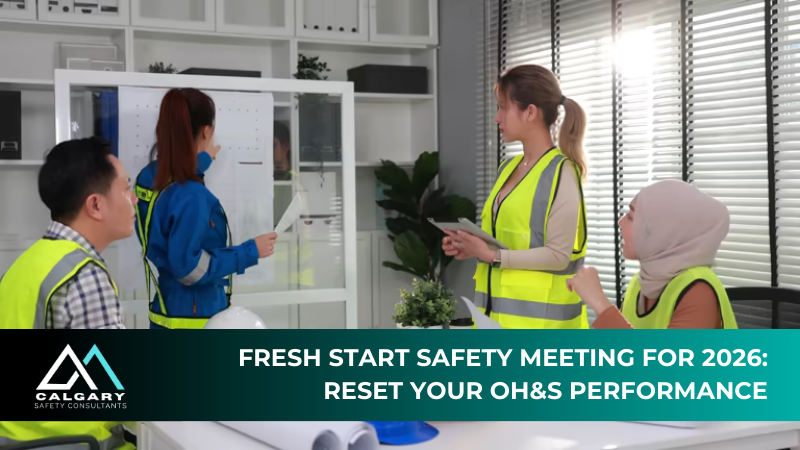
The “Fresh Start” meeting is a “General Safety Meeting”. Lets be clear, and also know that most workplaces already have several different safety meetings. There are toolbox talks, committee meetings, pre-job huddles, and monthly reviews. That’s not what this is.
A Fresh Start Safety Meeting is a special kind of meeting that only makes sense at one time of year, and for one purpose: to reset the standard for how work will be done in 2026, using what you learned in 2025.
It’s a structured reset. It’s where you turn last year’s OH&S wins and losses into plain decisions, clear targets, and a short list of “this is how we will operate now.”
If you run it right, this meeting becomes the hinge point between two years. It’s not a recap, and it’s not a lecture. It’s a reset meeting that creates momentum and credibility early, before production pressure takes over.
The first weeks of January are unique. People are back, routines are restarting, and attention is higher than it will be later in the year. The Fresh Start meeting uses that moment to do three things most companies struggle to do consistently.
First, it makes the year’s safety priorities specific. Not “be careful” or “work safe.” Specific hazards, specific controls, specific expectations.
Second, it creates a shared memory of what happened last year, without turning it into a blame session. People stop arguing about opinions and start dealing with patterns.
Third, it forces follow-through. The meeting is not successful because it happened. It’s successful because it produces a small number of commitments that leaders actually resource and verify.
Here’s the rule that separates a Fresh Start meeting from every other meeting.
You do not leave the room with “awareness.” You leave the room with decisions.
Decisions sound like this.
If you are not willing to decide, you are not running a Fresh Start meeting. You’re running a recap.
This meeting goes sideways when it’s built on vague memories. It goes well when you bring real information, keep it simple, and focus on repeat patterns.
You do not need a big slide deck. You need a short “year snapshot” you can talk through in plain language.
Bring these inputs.
If you’re short on data, don’t fake it. Use what you have. Even a small list of recurring problems is enough to drive decisions.
The goal of prep is simple: show the truth of last year in a way that’s hard to argue with.
A Fresh Start meeting is not a “safety department meeting.” It’s an operations meeting that uses safety as the lens.
You want the people who can change how work happens, plus the people who live with the results.
A good attendance list usually includes the manager with authority to approve changes, supervisors or team leads, a few respected workers, and anyone who owns high-risk planning (maintenance, fleet, project coordination, contractors, or site leadership).
Keep the group small enough to make decisions. If you invite too many people, you get speeches instead of commitments.
If you run multiple crews or sites, run one Fresh Start meeting per operation. A single generic meeting rarely lands across different risk profiles.
This is where most companies miss. They either talk too long, or they keep it so high level that nothing changes.
Here is a simple agenda you can copy and run.
That’s it. The power is not in complexity. The power is in clarity.
People don’t go quiet because they don’t care. They go quiet when they think honesty will be punished.
So the language matters. Use system language.
When you review a loss, talk like this.
This keeps the conversation focused on how work is designed and managed, not who to blame.
Wins should be treated the same way. Don’t just celebrate. Extract the lesson.
If a win happened because a supervisor verified controls every time, say that. If a win happened because planning improved, say that. Then commit to repeating the driver of the win.
Fresh Start targets fail when they are vague. “Work safely” is not a target. “Zero incidents” is not a plan.
A Fresh Start target must do three things.
Here are examples of targets that fit the Fresh Start purpose, without turning into paperwork.
Keep targets to 3 to 5. If you set 12 targets, you set zero targets. People won’t remember, and leaders won’t follow through.
This is what makes the Fresh Start meeting different. The outputs are not optional.
If you do not leave the room with these two outputs, you will drift back to normal by February.
A Fresh Start meeting becomes “just another meeting” if nobody checks the commitments.
You need one simple follow-through loop: a 30-day check, a 60-day check, and a 90-day check.
This is not “safety meeting in general.” This is the verification cycle that proves your Fresh Start was real.
If you want to set the tone fast, use something like this in the opening.
“We’re here for a Fresh Start safety reset. This is not a recap, and it’s not a blame session. We’re going to be honest about last year, pull out the lessons, and decide what changes in 2026. We’re leaving this room with three things: the risk truths we can’t ignore, the targets we will track, and the actions we will complete in the next 90 days. If we can’t decide it, we won’t pretend we did.”
That opening tells people this is different. It also makes it clear that follow-through is expected.
One mistake is making it a lecture. If people sit and listen for an hour, you didn’t run a reset meeting. You ran a presentation.
Another mistake is turning it into discipline. If people fear the review, they will hide information. Then you go blind.
Another mistake is choosing too many targets. The Fresh Start meeting is about focus.
The biggest mistake is leaving without owners and dates. If actions aren’t owned, they won’t happen. If they aren’t dated, they will drift until they disappear.
If you want this meeting to produce decisions and follow-through, Calgary Safety Consultants can help you design and run it properly, based on your actual operation and risk profile.
We can support you by pulling together a clean year snapshot from your incidents, hazards, inspections, and corrective actions, then facilitating a Fresh Start meeting that produces the two key outputs: a one-page safety reset statement and a 30-60-90 day action plan.
We can also build practical tracking tools for the 2026 targets, so you are measuring leading indicators that actually drive safer work, not just counting paperwork.
If you want help setting up and running your Fresh Start safety reset meeting, visit https://calgarysafetyconsultants.ca.
This is one of the best ways to start the year because it respects reality. It doesn’t pretend you can fix everything, and it doesn’t hide behind slogans. It forces focus and it forces decisions.
Most workplaces don’t need more meetings. They need one meeting that resets expectations, makes priorities plain, and creates follow-through early enough that it changes how the year unfolds.
If you run a real Fresh Start meeting in January and you follow it with a simple 30-60-90 day verification loop, you’ll see it. Fewer repeat issues. Better reporting. More consistent controls. Less drift. More credibility.
That’s not hype. That’s what happens when you treat the beginning of the year as a deliberate reset, not just a calendar change.
Connect with us here and let us help you improve your OH&S practices.
https://www.ccohs.ca/oshanswers/hsprograms/health_safety_meetings.html
https://www.ccohs.ca/oshanswers/hsprograms/safety-talks-how-to.html
https://www.ccohs.ca/oshanswers/hsprograms/leading-and-lagging-indicators.html
https://www.ccohs.ca/oshanswers/hsprograms/incident_investigation.html
https://www.alberta.ca/work-site-health-safety-committees
https://laws-lois.justice.gc.ca/eng/acts/L-2/section-135.html
A fresh start OH&S presentation is a structured session designed to recommit employees to workplace safety goals. It reinforces safety protocols, introduces updates, and fosters a proactive safety culture, ensuring teams are aligned and engaged.
A Fresh Start Safety Meeting is a once-a-year reset meeting, typically held in early January, designed to turn last year’s OH&S wins and losses into clear decisions, measurable targets, and a short 30-60-90 day action plan for the year ahead.
A toolbox talk is a short, task-focused discussion tied to today’s work. A Fresh Start Safety Meeting is a structured annual reset that reviews trends and lessons from the previous year and sets operational safety expectations and targets for the year ahead.
Most workplaces can run an effective Fresh Start Safety Meeting in 60 to 90 minutes, as long as the agenda stays focused on patterns, decisions, owners, and follow-through.
Need help with a safety manual, COR audit preparation, OHS order, hazard assessment, training, or ongoing safety support? Complete the form below or book a 30-minute consultation. We will review your situation, identify the next practical step, and explain how Calgary Safety Consultants can help.
Prefer to book directly?
Request your 30-minute consultation today by completing the calendar appointment below.

Calgary Safety Consultants provides practical occupational health and safety consulting, safety training, COR support, safety program development, and regulatory compliance support for employers across Alberta, British Columbia, and Saskatchewan.
We help organizations strengthen worker training, improve documentation, manage workplace hazards, prepare for audits, and build safety systems that support compliance, productivity, and operational due diligence.